
SPRING/SUMMER 2026
A Crying Shame
“He made a clever capture by mimicking the squonk and inducing it to hop into a sack, in which he was carrying it home, when suddenly the burden lightened and the weeping ceased. Wentling unslung the sack and looked in. There was nothing but bubbles and tears.”
—William T. Cox, Fearsome Creatures of the Lumberwoods, With a Few Desert and Mountain Beasts
Ryan Shea
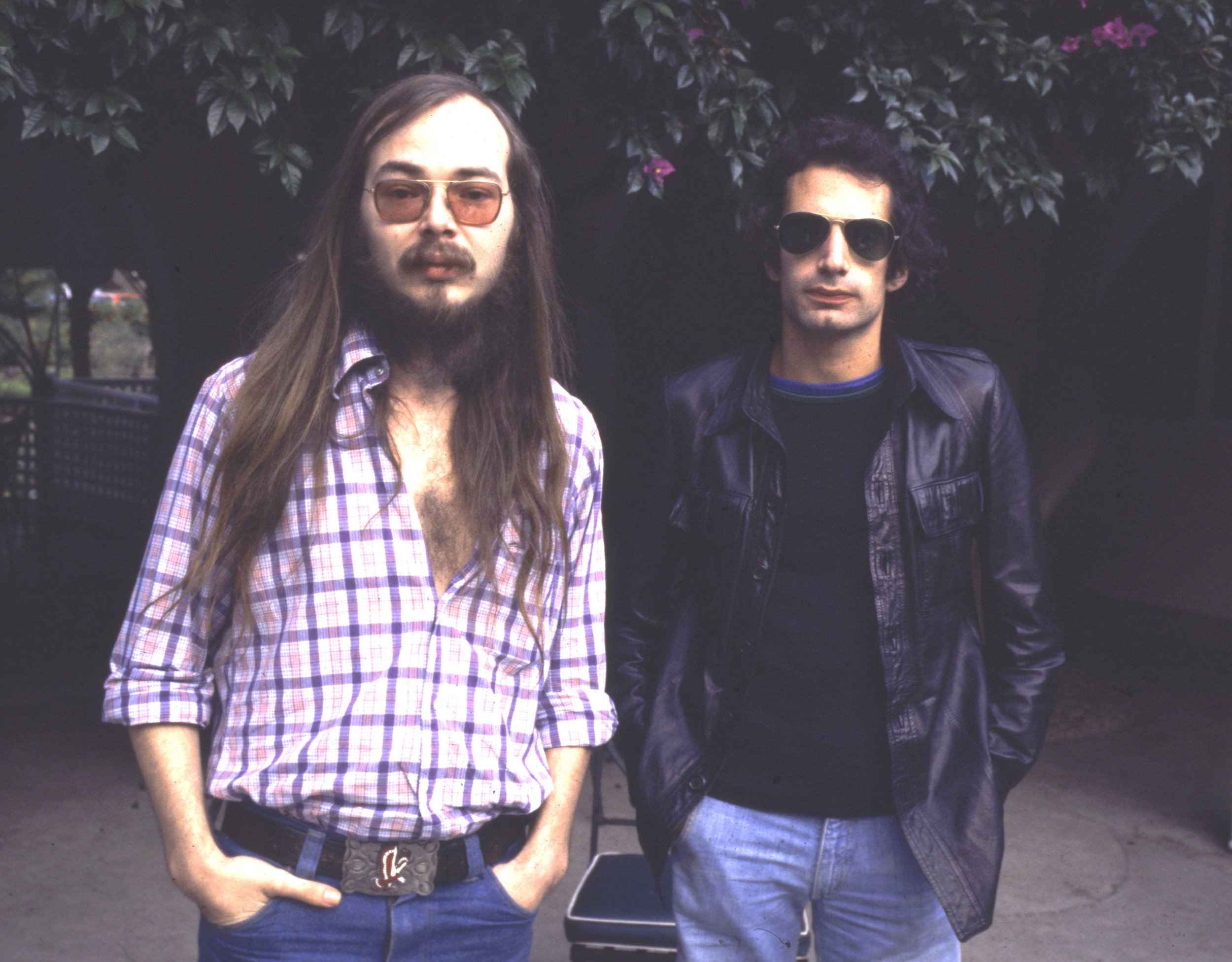
Photo: Walter Becker and Donald Fagen of Steely Dan, 1977 (Photo by Chris Walter/WireImage). Getty Images.
The smuggling of a squonk is a complicated affair, and one which culprits Jorge Luis Borges and Margarita Guerrero preferred to do in silence. Artists first began poaching squonks across international borders in 1957, when the blind Borges and the dancer Guerrero, his friend and amanuensis, compiled the Manual de zoología fantástica. The imported squonk appears within this cavalcade of fantastic creatures by the publication of the expanded 1967 Spanish edition of the work, retitled El libro de los seres imaginarios. The book was an informal, global census of impossible beasts birthed from human imagination, and its English translation, The Book of Imaginary Beings, was completed by Borges confidant Norman Thomas di Giovanni in 1969.
The rare squonk was then famously captured on the third song off Steely Dan’s seminal Pretzel Logic, “Any Major Dude Will Tell You.” This upbeat tune was Steely Dan’s skewered reflection on the copacetic commercial Zen popular throughout California in the 1970s, with the dissonant repetition of “major dude” serving as Fagen and Becker’s parody of the era’s surfer patois. Borges’ squonk featured as the referential and emotional crux of the song. Here, in what might be a surprise for the unanointed, Donald Fagen and Walter Becker’s use of literary irony is dense. Our interloping narrator attempts to commiserate and comfort through reference to the creature’s key characteristic: “Have you ever seen a squonk’s tears? Well, look at mine.” Yet the obtuseness of the phrase—the reference to the squonk—is ridiculous; anyone unfamiliar with the squonk (as many are) can find no solace in these words. Of course, while recording the song in 1973, our singers were asked by their session musicians what exactly a squonk was. Fagen and Becker snidely refused to elaborate. Their reference to the squonk was deliberately placed, creating a sense of what we might call the literary oblique between writer and listener. The squonk was sold by Steely Dan as both shibboleth and cipher.
*
An obscure creature of regional folk, the appeal of the antisocial squonk for Steely Dan rested with its association with the mythology of Jorge Luis Borges. The Book of Imaginary Beings defined the skulking squonk to the public as “the most morbid of beasts.” It was this ubiquitous, aloof morbidity in combination with the creature’s physical tears that made the dissolving squonk resonant with the despondent characters Fagen and Becker sketched: luckless victims, exhausted addicts, and American madmen. “Any Major Dude Will Tell You” was shaded with heavy thematic colors in a gaudy, Pacific hue. Becker and Fagen, two New York smart alecs, had been invited out to Los Angeles in 1972 by record producer Gary Katz, a mutual friend, to form a band for ABC Records. Estranged from the lush California culture of the 1970s, Fagen and Becker responded to Katz’s invitation by consistently mocking what they understood as California vanity. Fantasies born out of social isolation and tinged with morbid humor were drawn out in every song; characters and narrators were developed and deranged. The language of “Any Major Dude Will Tell You” reflects the bleak alienation Fagen and Becker felt contra the sun-and-surf personas their contemporaries had been able to form seamlessly around the west coast.
Set against a delicate guitar rhythm for auditory dissonance, “Any Major Dude Will Tell You,” lyrically speaking, is a string of farcical advice. The contextless, surreptitious platitudes offered in the song, voiced by Fagen, are punctuated with trendy 1970s lingo: “my funky one,” “super fine mind,” and, of course, “major dude.” “Major dude” itself was a phrase Fagen and Becker particularly identified with Californian surfers. These linguistic choices immediately characterize the optimistic narrator as well-meaning but effectively useless; they parody the indulgences of the informally therapeutic. The song lacks any kind of detailed narrative plot, instead, as Becker describes, serving more as a satire of regular Californian conversation.
The narrator, sardonically inept, delivers patronizing advice on the immaterial miseries of life through shallow metaphors: “When the demon is at your door / In the morning, it won’t be there no more.” This “wisdom,” that time, or a good night's sleep, dulls all problems (minor or existential) looks even more platitudinous in combination with the California surfer slang. Another truism: “You can try to run, but you can’t hide from what’s inside of you.” Our narrator offers next a colorless observation on the nature of sadness as observed in an amorphous public: “The people on the street have all seen better times.” And it is the repetitive phrase “Any major dude will tell you” that ultimately signals that we are listening to an iconoclastic satire of the copacetic, but hackneyed, advice anyone could (and, in 70s California, often would) provide.
The only exact consolation our narrator can muster is in their tortured self-comparison to the mythological squonk: “Have you ever seen a squonk’s tears? Well, look at mine.” An ugly folkloric creature of literature, true, but also a morbid creature which imagination made concrete. The squonk was more solid, more liquid, perhaps non-Newtonian in proper; a regular Americana Looney Tune of cryptozoology long before cryptozoology existed as a “proper” field, and even before the cellulose acetate of the Looney Tunes was copyrighted. Habitually a mooncalf, the historical squonk did nothing but hide in the hemlock undergrowth of Pennsylvania, cry globular tears, and eat whatever a squonk eats. It, when rarely seen, looked a cross between an unkissable toad and a sow, but had the redeemable behavior of neither. Steely Dan’s line referencing the sui generis species of “squonk” was juxtaposed against the “people on the street” which divided it from the amorphous mass of pedestrian society. The squonk was more fantastical, more singular, more lonely in its misery. The invocation of the obscure creature reached beyond the incestual slang of the 1970s to a higher register of intertextuality. Fagen and Becker, as Steely Dan, staked a claim through their comparison of tears.
The squonk is mythological farce. Or, more precisely, it stems from a farcical mythology. The squonk was first described in any amount of detail by forester William T. Cox in his Fearsome Creatures of the Lumberwoods, With a Few Desert and Mountain Beasts. Cox synthesized his description of the squonk from lumberyard folklore, but, as there are (suspiciously) no earlier written records of the squonk myth, Cox serves as wholesale codifier of the canonical description of the American squonk. His squonk was an ugly, self-dissolving beast, more a satire of monsters than a legitimate backwoods superstition. Cox described his scientifically named Lacrimacorpus dissolvens:
The range of the squonk is very limited. Few people outside of Pennsylvania have ever heard of the quaint beast, which is said to be fairly common in the hemlock forests of that State. The squonk is of a very retiring disposition, generally traveling about at twilight and dusk. Because of its misfitting skin, which is covered with warts and moles, it is always unhappy; in fact it is said, by people who are best able to judge, to be the most morbid of beasts. Hunters who are good at tracking are able to follow a squonk by its tear-stained trail, for the animal weeps constantly. When cornered and escape seems impossible, or when surprised and frightened, it may even dissolve itself in tears.
Since the Pennsylvanian squonk is not native to New York or California, Fagen and Becker had to then traffic the “fearsome creature” in from Argentina. They found it in Borges’ ready-made menagerie of mythology, The Book of Imaginary Beings. The theft of the squonk by the duo was facilitated by novelist Rikki Ducornet at Bard College in New York, their alma mater, in 1967 or 1968. Rikki of “Rikki Don’t Lose That Number” whom, as every Steely Dan scholar knows, Fagen once awkwardly gave his phone number to (she lost it!). Ducornet’s familiarity with Borges was well substantiated as, in 1983, she—also a talented visual artist—illustrated an edition of Borges’ parable of unreality “Tlön, Uqbar, Orbis Tertius.” Ducornet’s advocacy for the reading of Borges dated back to the late 1960s on Bard campus, where it had a singular artistic influence on the later Steely Dan, ultimately providing them with the squonk from Borges’ personal mythology.
Did Borges catalog a proper mythology by including the squonk in The Book of Imaginary Beings? In the 1969 English edition of The Book of Imaginary Beings, “The Squonk” sat tantalizingly between “The Sphinx” and the “Swedenborg’s Angels.” Borges’ placement of the squonk elevated it to sit between the riddles of mythology and the mystical spiritual concerns of theology. Borges then must have found a certain profoundness in the squonk to feature Cox’s whole, unexpunged description as the full entry for the creature in the book. What was the remarkable function of the American squonk to Borges? It was in the unhappy squonk’s self-negating superposition as both legitimate mythology and a parody of legitimate mythology.
The term “mythology” here should be defined with regard to Borges’, and later Steely Dan’s, use of the squonk’s myth of self-deprecation. In The Great Code, his literary study of the Bible, Canadian critic Northrop Frye observed a mythological schema that could be expanded to the squonk: “There are and remain two aspects of myth: one is its story-structure, which attaches it to literature, and the other is its social function as concerned knowledge, what it is important for a society to know.” While Cox did provide a brief narrative of a squonk hunt, the social importance of the squonk was, in Cox’s description, more oblique. The incongruities of the squonk against the expectation of mythology was more aligned with Frye’s classification of “demonic parody.” The “demonic parody” was Frye’s identification of a mythological symbol as a subversive, perverted parody to a mightier symbol. Frye’s literary dialectic established a parallel between the Bible and the mythologies of the “heathen kingdoms” in the Old Testament. All the “demonic parodies” of the biblical authors were, humorously, doomed to collapse into the dust as stunted parodies rooted in the material (secular) world. Frye’s readiest interpretation: the Tower of Babel was a “demonic parody” of Jacob’s Ladder, a structure of great height rooted in humanity’s hubris rather than God’s might. Was it too doomed to collapse? Certainly the low-dwelling squonk, a shuffling weeper, was, in a flood of its own tears.
The piteous squonk is a subversion and inversion of the mythological. John of Patmos’s stupendous beast of Revelation 17:8 is described as that which “was, and is not, and yet is.” Cox described the squonk, bagged by the huntsman Mr. J. P. Wentling, as literally “nothing but tears and bubbles.” John’s beast and Cox’s squonk are both rare, reclusive creatures of legend, but the squonk alone was captured. Cox stated for a fact that the squonk was a beast that could be hunted; this pulled it down to an empirical reality unlike, say, a dragon. Our captured squonk, dissolved, was a “demonic” parody of the numinous. Lacking any poetic grandeur in its liquid melancholy, the squonk, in rare fashion, was distinguished by an abject sadness.
It was, for Borges, the unique and ridiculous sadness of the squonk that made it more remarkable than any mighty monster. There is no commentary on the squonk in The Book of Imaginary Beings, merely Cox’s quote and its citation. In other words: Borges poached the squonk, displaying it flagrantly in his encyclopedia as one might a taxidermied fox among a wider stuffed menagerie. Borges took the squonk wholesale as a fantastical symbol of exotic American absurdity—Steely Dan re-acculturated (or perhaps butchered) the creature for their own irony-laden ends. Cool and pathetic, the squonk was as emotionally and physically unstable as the characters Fagen and Becker felt the most natural giving a voice to. Steely Dan then found its emotional and aesthetic sense in the dissolution of the squonk as framed by Borges’ theft of it for The Book of Imaginary Beings. That singular, endless loneliness of the squonk affirms Donald Fagen’s exact description of the persona of Steely Dan as “unstable.”
*
This dynamic of the squonk as a mythological “demonic parody” of the mighty was always present in Steely Dan’s layered language. Fagen and Becker’s first album Can’t Buy A Thrill had a squonk with a human face: “the gentleman loser.” First mentioned in “Midnite Cruiser,” the gentleman loser was a description of a type of shiftless, stock character that would, later, dominate Steely Dan’s oeuvre. The gentleman loser was described in lyric as a figure alienated from success, and, because of his own obtuse intransigence, postured as a hip, urban flaneur. The song’s mention of one “Felonious,” an intentional mispronunciation of jazz musician Thelonious Monk’s name, was a hint towards the gentleman loser’s faulty pretensions. The gentleman loser directly counted himself as one of many among the failures of the American dream, all bereft of the “bounty” of fortune and fame, admitting, “I am another gentleman loser / Drive me to Harlem or somewhere the same.” The gentleman loser was an alienated figure, a self-pitying unbeliever in the promise of American success, who could only confess his failures to the song’s listener. This figure, though uniquely American, did evoke a figure familiar to the Borges reader: a wanderer of the cityscape obsessed with cultural legitimacy. Borges’ had tango and the “fervor of Buenos Aires,” Steely Dan’s gentleman loser had jazz and oblique references.
Fagen and Becker reimagined this gentleman loser again and again as a squonkesque satire of the United States’ presumptuous mythology of success. The gentleman loser was a Mephistopheles to the self-made man synonymous with the image of the United States, a demonic parody of economic success. This idea of the gentleman loser as a kind of isolated, disconsolate outcast became more saturated on Steely Dan’s second album, Countdown To Ecstasy in the sci-fi satire “King of the World.” Set in the nuclear wreckage of America (“No marigolds in the promised land / There’s a hole in the ground where they used to grow”), “King of the World” was produced as a funky, post-apocalyptic broadcast hosted by a lonely madman dying of radiation poisoning. The man, so desperate for human connection he could only beg over his ham radio (“Should you come my way / You can share my poison wine”) and plead to his own good intentions: “I won’t take your bread / I don’t need no helping hand / I can’t be no savage / I can’t be no highwayman.” Though his only sustenance was poison, the madman, as a gentleman loser, still needed to posture his superiority against society, or the questionable ruins of society in those “savages” and “highwaymen.”
Steely Dan’s gentleman loser, even in a state of post-capitalist barbarism, existed in a cool aloofness as he watched “the sun go brown.” Like “Midnite Cruiser,” despite the nuclear fallout, the lyrics demonstrate a sharp desire for a fantastical escape: “Show me where you are / You and I will spend this day / Drivin’ in my car / Through the ruins of Santa Fe.” Santa Fe thus becomes a southwestern idyllic, birthplace of the A-Bomb, annihilated by that culmination of American technological superiority. Steely Dan’s dissonant images of the fiery American Ragnarok, the prophesied nuclear apocalypse of the Cold War, are contrasted against a cool jazz rock rhythm. Even in the twilight of American mythology, the survivor of “King of the World,” dying from radiation poisoning, retained a suicidal opposition to any reconciliation with the world, “Takin’ things the easy way / If I stay inside / I might live ‘til Saturday.” Even against creeping death, the phrasing employed is nonchalantly, as if its singer is too cool to care, a kind of dark humor created by the contrasting inclusion of Becker’s discordant vocals which discordantly cry, “(I think) my face is on fire.” This melancholic languishing in nuclear hellfire of course paralleled the squonk’s self-dissolution on water, but it also spoke to a habit of the American mythological imagination: an eschatological compulsion to imagine the obliteration of the United States through MAD (mutually assured destruction).
These characters from Can’t Buy a Thrill and Countdown to Ecstasy might indicate that Becker and Fagen’s identification with the squonk emerged when they relocated from New York to California in 1972. Steely Dan’s sardonic narratives cohered in the dim Los Angeles studios where Becker and Fagen sought refuge from the sun. They, physically, were not unlike the blind Borges wandering his library or the crying squonk hidden, resigned, in the hemlock. Becker later reflected on the entire wider cultural incongruence in Los Angeles during a 1999 HITS magazine interview with Harvey Kubernik, “I don’t think anyone showed us the ropes in L.A. Now I don’t really think there are any ropes in L.A.” The squonk for Steely Dan was a liberation from the seriousness of the world. It was the cynical liberation of alienation, of “demonic parody.” Fagen was clearly aware of this when he described the postmodern condition of Steely Dan in a 1993 Dutch radio interview: “The nineteenth century was a century of sentimentality, while the twentieth century is turning out to be a century of irony. You really have a different sort of orientation. I think the question is whether irony is a sign of decadence or a sign of sophistication that might lead to something more positive. It is hard to say.” This was a dichotomy of cultural ossification which Steely Dan had already explored through the decadence and sophistication of their third album Pretzel Logic in 1974.
While Steely Dan’s first two albums Can’t Buy A Thrill and Countdown to Ecstasy featured interesting pseudo-narratives, Pretzel Logic was the first album where the complicated interior world of Steely Dan became audible. References and in-jokes ran wild on the album. The song “Parker’s Band” was a tribute to saxophonist Charlie Parker and his stay at the Camarillo State Mental Hospital. “East St. Louis Toodle-Oo,” Steely Dan’s only cover song, is a cover of Duke Ellington’s “East St. Louis Toodle-Oo,” a favorite of author William Burroughs. Then “Rikki Don’t Lose That Number” was Donald Fagen’s fictionalized confession of his unrequited fascination with Rikki Ducornet, though “Rikki Don’t Lose That Number” flowed easily into the other irony-laden songs of fantastical self-deprecation. “Night by Night” featured the “ten-cent” longings of another luckless gentlemen loser up against a world beating him down with pleasure, his only stated consolation being the idea that he could wait out his dissolute state (“but until my ship comes in / I’ll live night by night”). Gone bust, the narrator admitted to his broken resolve, “Well, I ain’t got the heart / To lose another fight.” The eponymous song “Pretzel Logic” then dug deeper into this sense of cultural and literal displacement through a science fiction context. The song was a cryptic time travel parable about a man, out of time, who seeks consolation for his unfulfilled loneliness through Napoleon Bonaparte: “I have never met Napoleon / But I plan to find the time, yes I do.” All were stylized adolescent fantasies, but defined by Steely Dan’s gleeful cynicism, a near malicious perversity deeper than the sexual, was occluded in their own jazzy literary mythology.
*
Reality was, in truth, rather unappealing for both Borges and Steely Dan. Borges’ childhood was an isolated one in the early twentieth century. His famous description identified it, alone, with his father’s library, “If I were asked to name the chief event in my life, I should say my father’s library. In fact, I sometimes think I have never strayed outside that library.” Kept away from the wider slum of Palermo (Borges later called it “shabby-genteel”), some of the first novels Borges read were Twain’s Roughing It, Wells’ First Men in the Moon, and Stevenson’s Treasure Island. Novels presented a better image of the world to the near-sighted Borges than the tangible things he knew lay beyond the walls he was forbidden from. Born five decades later, Becker and Fagen’s childhoods in New York and New Jersey were each defined by the medium of television, Steely Dan’s earliest musical influence being what Fagen later called the “commercial” jazz of famous composer Henry Mancini in the TV show Peter Gunn and The Pink Panther series. Alienated from suburban America, Fagen and Becker’s parallel personalities were founded on a taste for commercial jazz, light misanthropy, and an appreciation for the obliquely conceptual. This taste was fed by a potent mixture of science fiction and surrealism found in authors such as A. E. Van Vogt, Philip K. Dick, and, of course, the aloof William Burroughs, from whom the vulgar term “Steely Dan” originated. Apathetic to sentimental conventions, the real world praised Borges, Becker, and Fagen more than they ever praised it.
Borges’ reputation in the United States was perhaps first formally validated on October 4, 1969,when The New Yorker highlighted a choice selection from The Book of Imaginary Beings. The article, titled “Imaginary Beings,” included “The Elves,” “The Leveler,” “The Shaggy Beast of La Fertebernard,” and the mysterious “Fauna of Mirrors,” alongside many more, though the squonk did not grace the pages of that week’s New Yorker. In the fall of 1967 and spring of 1968, Borges had been invited to Harvard, a seven-month stay in Cambridge, Massachusetts, to deliver a series of public lectures on poetry titled later “This Craft of Verse.” By the time of his lecture series at Harvard, Borges had become a tangible intellectual persona in the United States. This was especially true at the burnt-over, post-beatnik institution of Bard College in upstate New York, Annandale-on-Hudson, a legendary upstate haunt for Bob Dylan, where the vandals stole the proverbial (gas pump) handles. During this period, Borges traveled throughout New England and New York, reading poetry at Y. M. H. A. and being photographed by Diane Arbus, an American mythmaker in her own right. Although they never met, Borges would have passed through the exact subway stations that Becker and Fagen did in 1969.
In an extensive June 1976 interview with Michael Watts for Melody Maker, Fagen both credited and condemned Bard College for Steely Dan’s obtusely polysemous worldview. Bard, Fagen said, emphasized the creative aspects of learning over the textual fundamentals, leaving students to do their own self-directed reading. Though the institution produced the mature Fagen and Becker, two of the most acclaimed popular songwriters in American history, Fagen still surmised Bard’s formal academic system as “basically a failure,” leaving Steely Dan to search for enrichment elsewhere while enrolled.
Each keenly interested in surrealism, Fagen and Becker developed a kind of conjoined taste, often reading together in the common spaces of Ward Manor. Nathanael West, Joseph Heller, Terry Southern, Kurt Vonnegut, Vladimir Nabokov, Thomas Pynchon and William Burroughs numbered among their favorites, all authors of the 1960s zeitgeist, riffing towards and against a perceived absurdity innate to the twentieth-century world. Walter Becker acknowledged Steely Dan’s familiarity with Borges in a 2008 interview with Time Out New York. Becker praised the “completely ridiculous” ideas of Borges which, like the squonk, were “simultaneously often very sad and tragic and very funny.” Becker pointed to the oblique humor of Borges’s short story “Pierre Menard, Author of the Quixote,” about the fictional French intellectual Pierre Menard who attempts to rewrite, word-for-word, Cervantes’ Don Quixote from memory. Fagen was doubtless familiar with this narrative conceit of an ambiguous story framed by a questionable critical analysis; he claimed to have read Nabokov’s Pale Fire about five times.
In the same June 1976 Melody Maker interview, which mentioned Borges as one of Steely Dan’s influences, Becker admitted to a “single-minded” nature between Fagen and him. Becker, in his own words, liked “swatches of color” and “images that don’t exactly make sense” while Fagen organized the fundamentals of it all around harmonic direction and tonal framework. Fagen was the draughtsman and Becker the painter. Becker put down the saturated colors and Fagen drew the lines, but the aesthetic character that emerged was a shared endeavor. Disagreements were rare due to a shared deadpan humor (often termed an extreme irony) and a literary canon.
Fagen described in a 1981 interview with David Breskin for Musician how Steely Dan’s character-based songs such as “Home At Last” were indebted to the traditions of both the pulp and the literary:
If you’re gonna present rock ‘n’ roll as an art form, you have to draw on some of the traditions that are used in literature, and one that’s proved effective is maintaining a certain distance from the subject. The trashier kinds of literature are the more basically sentimental kinds. Romantic, in the pejorative sense of the term. So we use that distancing technique in writing lyrics.
Identification with the squonk then fused Steely Dan’s unstable, interior narratives with Borges’ literary erudition. Steely Dan’s Argentina-inflected album Gaucho continued to explore these ultimately Borgesian concerns. The title “Gaucho” invoked the horsemen of the vast Argentine pampas who became romantic symbols of Argentine literature in the nineteenth century—the album’s cover based upon Argentine sculptor Israel Hoffman’s “Guardia Vieja - Tango.”1 Borges, as an Argentine writer, concerned himself with both romanticized and realistic gauchos, most famously in short story “The South,” which described a suburban man, a pseudo-Borges, happy to die by a gaucho’s predestined knife. The eponymous song “Gaucho,” feverish as Borges’ short story, describes a “bodacious,” likely homosexual, dalliance fated to conclude in a manner similar to that of “The South.” While always more sensual than Borges’ rather Victorian mores, Steely Dan’s “Babylon Sisters” shares the subject of sex with Borges’ “Ulrikke.” “Babylon Sisters” details a transactional, Californian ménage à trois of hubris, and “Ulrikke” a hopeless Colombian professor’s romance with a Norwegian woman in the winter snows of England. Momentary relationships described in mythological register, “Babylon Sisters” adopts the language of Old Testament decadence while “Ulurikke” represents the doomed romance of the hero Sigurd and Valkyrie Brunhild. Sexual union in both cases is simply oblivion.
We might wonder what Borges would have thought of Steely Dan.2 Maybe the question sounds as outlandish as the squonk. What would a man born in 1899 even have to say about the music of Donald Fagen and Walter Becker? And yet Borges existed contemporaneously with the release of every Steely Dan album from Can’t Buy A Thrill until, appropriately, Gaucho prior to his death in Geneva on June 14, 1986. Borges was actually fascinated with rock music in his seventies and eighties. In a September 2008 interview with BBC Mundo, Maria Kodama, Borges’ literary secretary and wife, claimed Borges musical tastes encompassed not only “old guard” tango, Brahms and Bach, but also the Rolling Stones, Beatles, and Pink Floyd. Borges confessed to some familiarity of his with the guitar in his poem “Boast of Quietness,” long before the advent of modern rock music: “My homeland is the rhythm of a guitar…” Borges would have been familiar with the American traditions Steely Dan worked within, the Tin Pan Alley theatrics of George and Ira Gershwin. It seems likely that Borges would have sworn himself to that secret space Steely Dan created between their songs and his stories, a shared emotional intimacy of stolen squonks.
Steely Dan was then guiltless in their theft of the squonk. Borges and Guerrero’s quotation of the squonk in The Book of Imaginary Beings was an equally victimless crime—the grey market smuggling of the squonk from mind to mind, from the United States to Argentina and back, the idea of a pathetic creature which carried within it the seed of the simultaneously “very sad and tragic and very funny”—all a shared erudition in the unreal. In a November 2012 interview with Bruce Pollock in Songfacts, Fagen said the following about the fundamental pursuit of Steely Dan: "We were after a theatrical effect, the friction produced by the mix of music and lyrics—the irony." Steely Dan’s chase, through Borges, after an absurd creature that destroys itself, is perhaps, then, not so surprising at all.
1 Often translated as “Old Guard - Tango” in reference to the classical form of the tango danced in the bordellos of Argentina prior to wider popularization and homogenization.
2 It is known for a fact what William Burroughs thought of Steely Dan. In 1977, Arthur Lubow, for New Times Magazine , cornered and played some Steely Dan for Burroughs in the Boulderado Hotel, Colorado. Burroughs' full opinion of their music ran, “These people are too fancy. They’re too sophisticated, they’re doing too many things at once in a song. To write a bestseller, you can’t have too much going on. You take The Godfather , the horse’s head. That’s great. But you can’t have a horse’s head on every page. These people tend to have too many horses’ heads.”