
FALL/WINTER 2026
Dorothea Lasky’s Formal Field of Protection
interviewed by Indovina
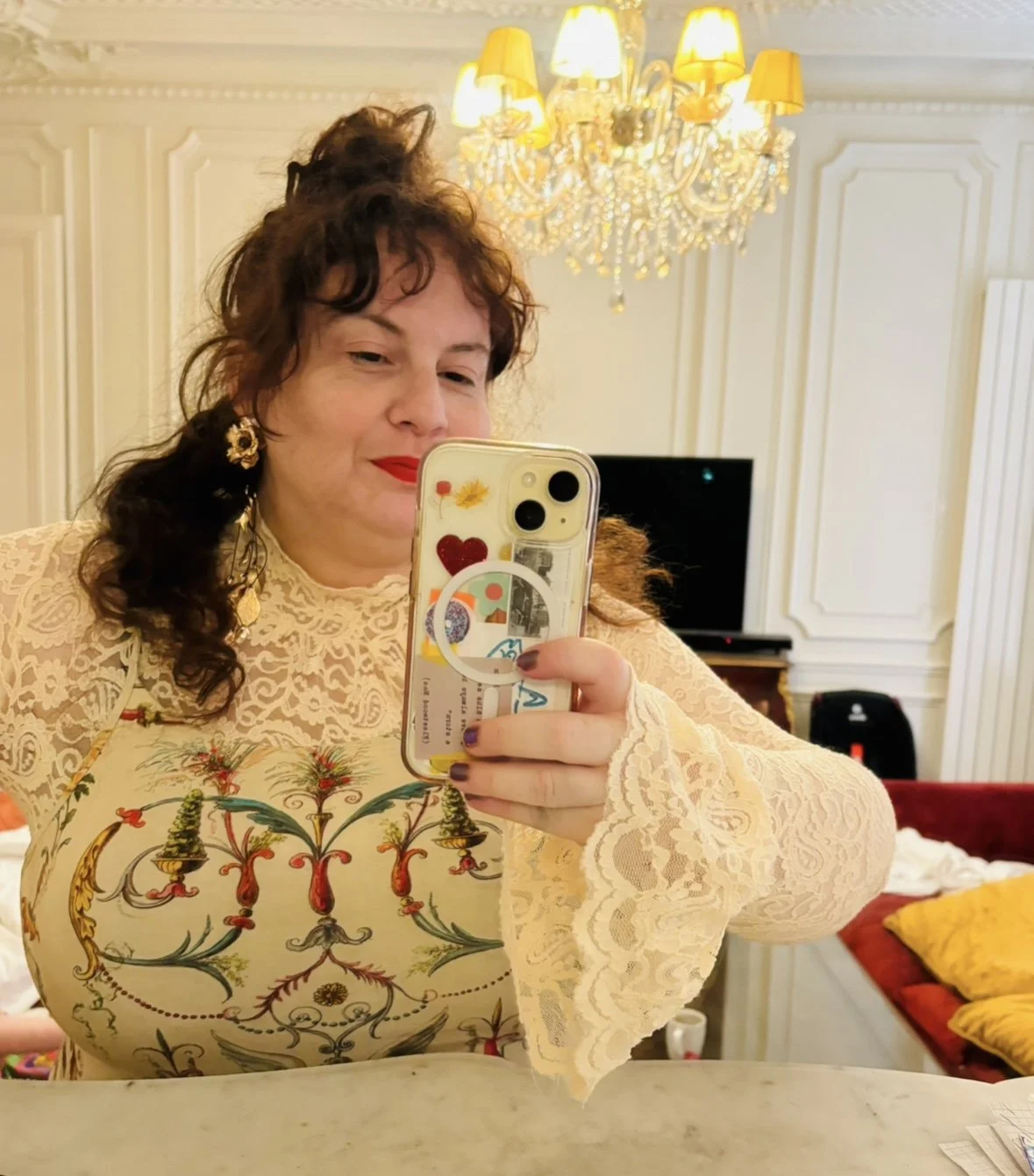
Photo: Dorothea Lasky.
Mother is a haunted book. In its first poem, also called “Mother,” the reader takes on the perspective of a child speaker observing a dead, pregnant bird whose baby is still alive in its womb. The child is horrified at the sight of the baby bird’s life completely encased in death. The baby bird calls out to the child, naming it its new mother. At the end of the poem, the child speaker leaves the reader with an eerie question, one that she is also asking herself: “But will you save it / Just like the others.” Will you accept the role you’ve been assigned—the role of motherhood—“Just like the others?” What happens when you say yes?
I am proud to call Dorothea Lasky one of my poetry mothers. Her work lifts you out of death like a second chance at life; it imbues you with a new awareness of your body, the life it lives every second, and the turmoil that created it in the first place. In her work, “nothing escapes time” but “time is a promise we’re bound to break,” holding you in the infinity of now, the endless transience of life. Her sharply oneiric, alarmingly hypnotic poems recount painful histories, yet every time I read them, I’m stunned by Lasky’s reverence for the living world and her capacity for joy. It’s no wonder that after her third pregnancy—after her third time watching life grow—we now have Mother, the result of love, precariousness, and fight.
INDOVINA: How did your process of writing Mother differ from writing your previous collection, The Shining? And when did you realize now was the time to write Mother, to give it shape?
DOROTHEA LASKY: I actually wrote The Shining and Mother around the same time. I wrote The Shining in 2021. I wrote Mother as an homage to Bernadette Mayer’s book The Desires of Mothers To Please Others In Letters, which she wrote during her third pregnancy. I wanted to write my own version of the book, so I started it when I first became pregnant and tried not to write any new poems after my daughter was born in early 2022. I used that incubation period of ten months to see what poems would happen. But I cheated just a little bit and there are a few poems in the book not written while I was pregnant. Originally, I wanted the poems published in the order they were written, but the amazing Joshua Beckman edited it with the best book in mind instead of having us adhere to the exact time sequence.
What’s interesting about The Shining and Mother is that they are both overtly centered around a theme and this theme inspires the poems within them. I’ve always been frustrated by the word “project” and its use when discussing creative undertakings. I don’t like the idea of having a well-conceived plan when writing poems. Having a plan is a kind of hubris, in the ancient sense of the word. If you hold onto a plan, you might piss off some poetry goddess, depending on who’s paying attention. But both Mother and The Shining are arguably “project books,” so they are sisters in that way. The Shining is loosely an ekphrastic “project” about the essence of The Shining universe, and Mother is a “project” of a third pregnancy.
I: Mother is one of the few titles from Wave Books that has a cover with white text over a black background instead of the opposite. The cover reminds me of your poem “I Played God,” where you say “Every woman celebrates / The night / God created everything.” What inspired the decisions around the cover for Mother?
DL: There were lots of beautiful options for the cover of Mother. I originally envisioned something that resembled a cemetery gate surrounded by natural, springlike symbols like flowers and birds, which would have been black against a white background. Cemetery gates are fascinating because they are iron, strong, ornate, and have that immortal quality to them. The materials used in a cemetery are made to withstand the elements because cemeteries usually don’t get much upkeep. But often the gates have iron flora and fauna around them. There are vines or birds around the iron, things that could be springlike, but they are all this dark iron color, and there is a morose feel to them.
As we were looking at different cover options, Heidi Broadhead from Wave Books said: What do you think about this one? She was referring to what would become the official cover. I hadn’t noticed it as an option because my name on it was so prominent. I was almost embarrassed to see my name so big. I wanted “Mother” to be such a huge, dramatic force on the cover, kind of akin to my first book with Wave, AWE, which is white with these big, black, pointy letters. At first, I didn’t like how my name overshadowed the title. But once I thought about it, I remembered my mother. When she would look at my book covers, she’d often say: Can they make your name bigger? It’s funny now, because my name is the first thing you see on the cover of Mother. So it grew on me. I loved the idea that the background was grey-black because it was the color of the cemetery gates and kept their essence.
I: I think there’s something special about the choice to place your name on top of the title, because in Mother, you talk about the aliveness and deadness of mothers, and how many mothers feel the need to kill off their identities as a sacrifice to their children. This cover is such a protest against that idea, because your name is evenly weighted with Mother, making it clear that you’re an individual and a mother simultaneously.
In my first semester at Columbia, I took your seminar, Unleashing the Poetic Demon, where we talked about the “poetic demon” as an equalizer and an advocate for the misunderstood. How did that concept inform your approach to writing Mother?
DL: It was such a delight to have you in the seminar! I find the poetic demon to be such a helpful lens when thinking about where poems come from. It is a force that advocates for the misunderstood. It sees everything.
Poetry is a trickster energy, and I don’t believe that you can sit passively and hope poetry finds you. Poetry appreciates when you suffer a little bit for it—the way a demon would want you to. Poetry loves when you engage with it in a constant way and worship it. It also likes to mess with people and have fun. It’s probably more ruled by Mercury than most other art forms.
The typical muse of poetry, in comparison, has always seemed a bit silly to me––that there would be this precious figure who would show up and hand you a poem. This suggests that a poem has a perfect form that you just have to wait for. The poetic demon lets you know that it’s good to have imperfections, encouraging us to have humility in the face of poetry.
The poetry demon affects all of my poetry, because I believe in emergence as opposed to top-down plans like we were talking about with having a “project.” There’s an unhealthy arrogance to feeling that you have the entire map when setting out to do something. I could have, prior to getting pregnant, mapped out a plan for how the poems would go. But you can’t do that with pregnancy, like with all creative processes, because pregnancy is also emergent and unpredictable. That truth is the essence of the poetry demon. I couldn’t have predicted how any of it would feel. That’s the lesson of Bernadette Mayer and John Dewey, too. Experiential creativity is when you let things emerge as you place yourself within your own process. You have to be open to it though. You have to be submissive to the demon to let the emergence happen, which is hard to do.
I: Color plays a huge role in your poetry. The whole rainbow makes an appearance in Mother, but especially orange, green, and red. I appreciate, too, how the color names are usually at their simplest: not “crimson” or “scarlet” but “red.” There’s confidence in the usage of the basic color name and not something more grandiose. How do you realize what colors are showing up for you as you write, or what colors need to arrive in any poem you’re writing?
DL: Color is a language. One that has an ever-shifting set of meanings. It’s not as if “chartreuse” always means the same thing in every poem, because its surroundings and context ultimately affect it. Chartreuse also means a multitude of things to each and every reader and its meaning is never wholly consistent. I love that. Whenever I can’t find language, color becomes that language for me in a poem. It’s the best description of the energy of anything I’m trying to describe. It energizes objects and events and words in ways other things can’t. In everyday life, nothing excites me more than color. I also love how much colors influence each other. How, sometimes, when you pair one color with the other, it is the feeling of that moment, and it becomes a language, like how different sounds create different tones together.
I: It’s the perfect metaphor for mother and child, because you can think of colors as the souls of a mother and a child being put in relation with one another, reverberating against each other in both harmonious and dissonant ways.
DL: Maybe this is silly, but I think people have essences that are vibrations that could be translated into colors. Our perceptions of colors aren’t necessarily “correct,” because they are subjective to our size scale. What we see as red, some beings on the nano-level see as gold. Where we are in size, space, and time affects the vibration we see as color. That’s how we possibly end up when we die: as a color frequency, or a sound frequency. I don’t think it’s a decorative, subtle, or random thing. Souls are vibrations.
I: Mother is such an incantatory collection. In “Food for Babies,” by evoking the names of foods one would feed children, you enter a nightmare space of being tuned out by your children that reminds us that mothers retain the same needs for love and care that children have. And in “Love is Red,” lines about love and stretching and monstrousness interlace in different orders and with slightly different syntax, like a spell that slowly metamorphoses over time, or like a pregnancy. How do you realize your visions for these types of incantations? What guides you when coaxing them into their most potent forms?
DL: I love this idea that “Food for Babies” also gives voice to the mother, because all of those interjections are from children about food. Communicating with children is kind of like a relationship with a demon. It’s akin to when somebody asks you to do a task, and you do it, but the goalpost moves, and now you have more to do. Children often ask for one thing, and then when you give it to them, that’s suddenly not what they want. I love this mercurial essence of children, but with food specifically, there’s a terror that comes with this communication, because neither of you know what they want. And you are the one who must feed them so that they will live and grow. It’s like a toxic work environment forcing you to look toward the next unpredictable step. Children and routines are constantly in flux. A lot of motherhood and thinking about death is accepting that flux is constant as well.
With “Love is Red,” I have this old writing exercise I do called “The Red Exercise.” It starts with a Gertrude Stein poem called “A Red Hat” from Tender Buttons, where she wrote, “If red is in everything, it is not necessary.” I want the exercise to make people think about what it means for red to be necessary. In the room we are in right now, not everything is red, but certain things are, and sometimes in meaningful ways. In the exercise, we also study objects that are red and how red affects a scene.
With this poem, I was thinking about redness with pregnancy. When you are pregnant, you want vitality, but red—or blood—is something you’re trying desperately to avoid. Bleeding is terrifying if you’re pregnant. My third pregnancy was very precarious. There was risk of a miscarriage early on, so I spent most of it on bed rest. That’s what Gertrude Stein was trying to say maybe––that red is never neutral. If this entire office was painted red, your first physiological instinct would be alarm.
I: Your mom was a painter, so I can see where you get your admiration for color and art.
DL: I absolutely learned to love color from my mother. I would say my happiest moments as a child were bonding over color and other beautiful things with her. They are still my happiest memories. Since she passed away, the only way I feel okay now is to think about color. Color almost never lets you down. Color rejuvenates melancholy.
I: When you spoke earlier about the process of writing Mother, you mentioned wanting to publish the poems in the order you wrote them. Although that didn’t happen in the finished book, Mother does feel like it was written in order, largely because there are no section divides; it’s “one continuous line,” as Louise Glück would say. Poem titles repeat throughout Mother as well. When did you realize Mother would have repeating titles?
DL: You know how the Fates have the yarn of everyone’s possible lives, and the portion they cut for you is your finite, decreed life? A poet’s total set of books that they will write in their lifetime is like that finite stretch of yarn. It is one long book. On a smaller scale, that’s how Mother feels to me, like one long string.
When I wrote my second book, Black Life, something clicked for me in terms of how to construct books. I found spaces in that book to insert the color black as an organizing principle. I’m working on a book now, called Pain, which will use similar organizing principles. This “organizing principle” method has escalated for me since Black Life. I love the dullness of a book title having multiple title poems. I hate the singular title poem, and the pressure on that poem in a collection. It feels like a thesis statement, with so much stacked on top of it. There’s an irreverence to having many title poems in a collection, so there’s less pressure on one. The title poems also work together as if they’re the same poem. I’ve tried to have sections in many of my books, but they often fall away. Milk has sections, but I also love a sectionless book that feels like one long string.
I: In Mother, you write very confessionally about the struggles of childbirth, fertility therapy, and being a mother and a daughter. You also write about the decentralization of self, the turbulence, the fear, the physical changes, and the exhaustive ferocity of love that come with being a mother. Mother, above maybe any book I’ve read, is not afraid of feeling, telling the truth, or embracing the reality of your felt experience. How did you develop the guts to write on such a raw level about your experiences, and what advice would you give to anyone who wants to write in a confessional mode but is afraid to step into those waters? How does someone get past all of that fear?
DL: The “I” of a poem is not me. My “I” is a mask. As a poet, I often feel like a method actor. I write poems about certain things I have experienced, at least in part, but it’s not fully me speaking. My poems are not diaries, or “me.” That can be a frustrating answer, but it does allow me to have total freedom to say whatever, and to get to a deeper place or a place of laying bare my experiences or feelings. If someone thought that a line in one of my poems was a personal opinion I carry, I would find that an unwise assumption, because I believe in the mask of the persona.
That is what the poetic demon gives us. It takes away the responsibilities we might feel in nonfiction. One may feel fear around writing confessionally and purely in that genre because you don’t want to put your personal life and feelings out there. But that’s the freedom of acting and of poetry. You can change details to protect the innocent, and you’re free of whatever assumptions anyone would make, because you’re writing poetry. The Confessionals teach us that all you need to do is get to a specific emotional place to find those language spaces. Then you are free.