
SPRING/SUMMER 2026
Editor’s Note | Aphelion - Spring/Summer 2026
Hengzhi Huang Yang
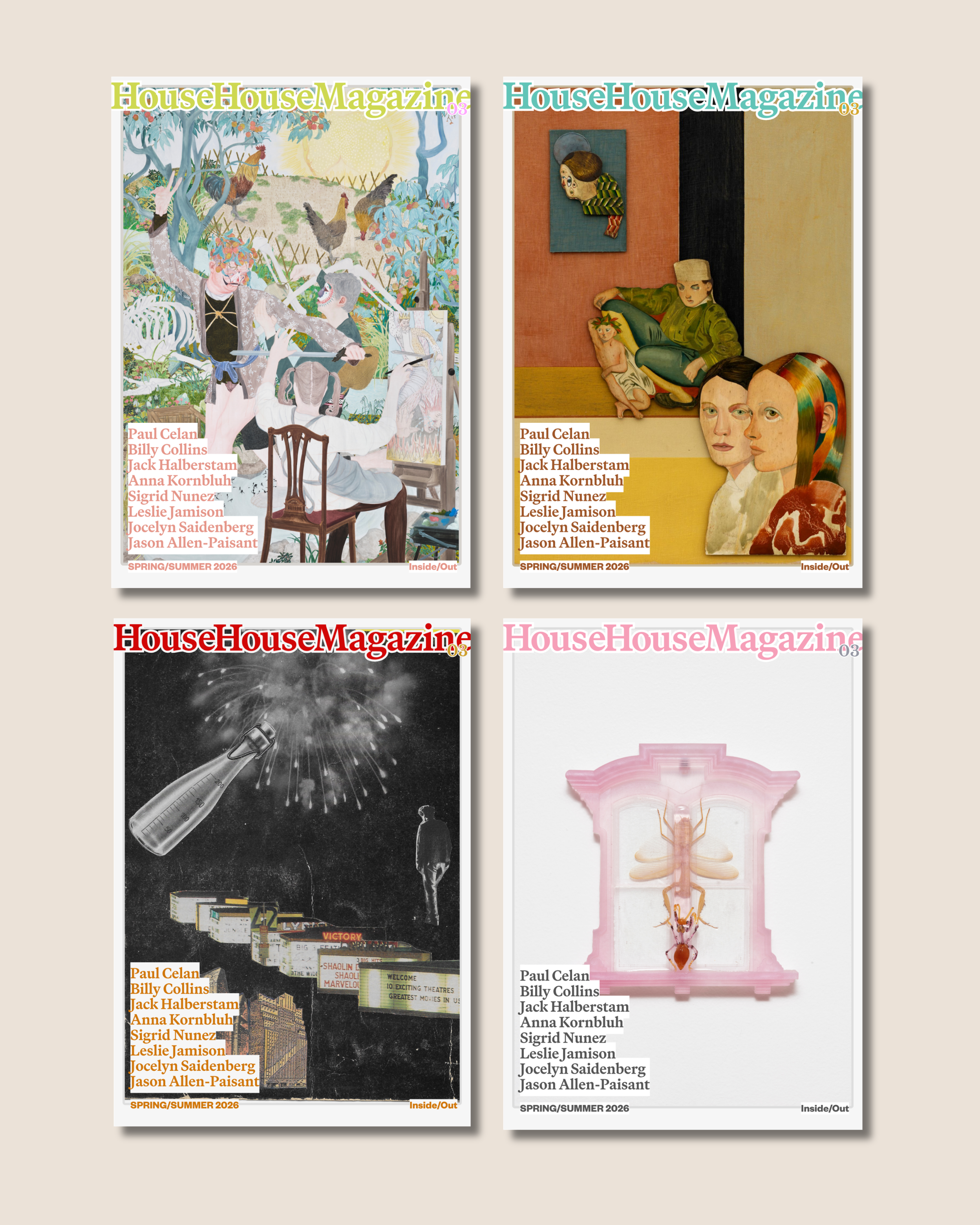
Editor’s Note | Aphelion
EVERYONE SEEMS TO BE HAVING boundary issues nowadays, in one form or another. Debates about the meaning of citizenship crisscross the very borders whose inviolability they assert. The ascendent nationalist tendency glorifies the particularity of the national character in the exact same terms, no matter the country. We feel justified concern about information privacy and state surveillance. In the air are fantasies of indoctrination on campuses and quarrels over what we should eat, drink, inhale, insert, inject, instill, and introduce into our bodies. How many times have we crossed the threshold of irreversible climate catastrophe? Arguably, too, what is really at stake in critiques of autofictional writing or personal narrative may be concerns about the dubious pleasures of oversharing and voyeurism. Our age’s discontents are mixed and disparate, but they share an eerily similar topology.
“Happy are those ages when the starry sky is the map of all possible paths—ages whose paths are illuminated by the light of the stars”—so opens György Lukács’s Theory of the Novel. Modern life, for Lukács, involves a sort of introspective turn in philosophy; one truly learns how to look inward and realizes that we, at the end of the day, each have a distinct inner life. This realization, despite our contemporary fetishisms of the self, can be rather frightening: a rift between “inside” and “outside,” between “the self” and “the world” is opened up; what’s “subjective” is now incomplete and incomprehensible to others; one’s beliefs and actions are no longer Lukács’s “well-fitting garment for the world” but a shrunken jacket to cover up the disenchantment.
Perhaps this anxiety of the inner self is the origin of that obsession with “objectivity” that entrepreneurs, tech gurus, and Silicon Valley lobbyists all exhibit. With some of the wealthiest and most powerful men in the world all claiming to be “outsiders,” one cannot help but think that there is a connection between this self-imposed alienation and their unceasing desire to control and dominate—at the heart of both is the denial of any kind of introspection and the interiority of others. Where can genuine introspection and inquiry about the relationship between the self and the world begin? How are we to rethink these boundaries? These are the questions that this issue of House House Magazine takes up.
Paul Celan knew solitude as much as he knew society, finding a new language in painting to cure the ills of words written “under an age-old load of false and distorted sincerity” and to converse with his more artistically minded friend, Edgar Jené, a man who, Celan professes, must have known “the son of Aurora Borealis.” Over four decades, Ian Hamilton Finlay and his collaborators transformed their willed solitude in a derelict Scottish farm into their life’s work, interweaving classic myths with modern history and traces of warfare. A different kind of mythology holds a similarly special place for Jorge Luis Borges and Steely Dan, as they smuggled a fabled beast across state lines. Somewhere many space-times away, a post-war sci-fi novel by a brilliant yet obscure Belgian novelist is discovered by her young Anglophone audience, triggering a whirlwind of blog posts and short videos that establish the book as an international bestseller. Contemporary writers and artists, too, fight over the airspace to be heard and—if they are lucky—understood. What is counterintuitive at last is that we are in fact the farthest from the Sun each year in high summer, a critical distance that, I would like to imagine, places us instead closer to the stars—and even if they no longer guide us, we can at least appreciate their beauty.
—Hengzhi Huang Yang, New York City
With the Editors.