
SPRING/SUMMER 2026
Emma Copley Eisenberg Imagines a Truer American Fiction
interviewed by Eve Jones
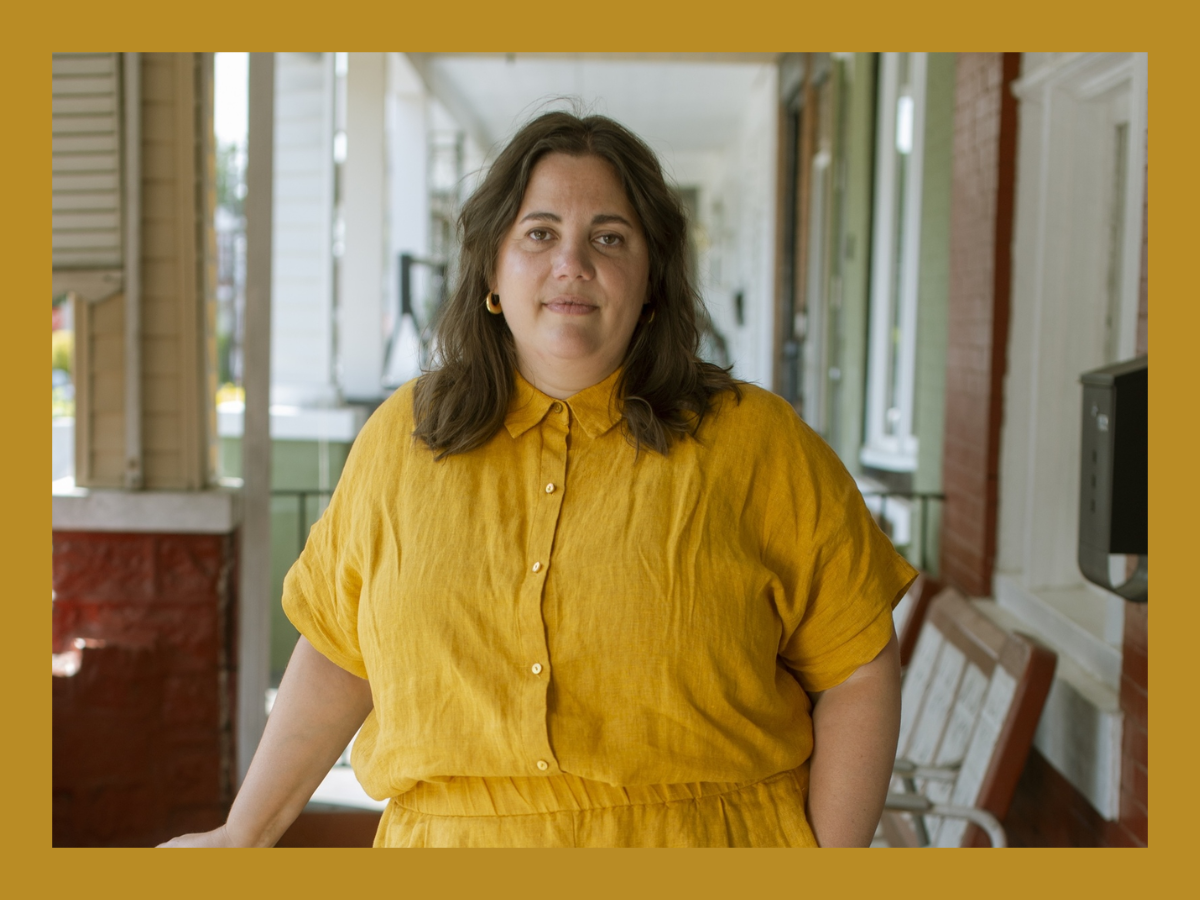
Photo: Emma Copley Eisenberg
Emma Copley Eisenberg is the nationally bestselling author of the novel Housemates, nominated for a Lambda Literary Award in Lesbian Fiction and the VCU Cabell First Novelist Prize, as well as the nonfiction book The Third Rainbow Girl, a New York Times Notable Book and Editor’s Choice. Her fiction, essays, and criticism have appeared in The Yale Review, Granta, The Paris Review, The New Republic, The Cut, TIME, and The Philadelphia Inquirer. She lives in Philadelphia, where she co-founded Blue Stoop, a community hub for the literary arts, and is a 2026 Pew Foundation fellow. She’s received fellowships and residencies from Yaddo, Bread Loaf, Tin House and others, and has taught creative writing at Wesleyan University, Haverford College, Bryn Mawr College, Temple University and independently.
Her next book of fiction,Fat Swim, which includes the Pushcart Prize-winning title story, will be published by Random House on April 28, 2026. We spoke this March about Fat Swim, as well as about sensation, politicized bodies, queerness, fatness, defamiliarization, Jonathan Franzen, and Facebook Marketplace. Our conversation has been edited for clarity and length.
EVE JONES: So Fat Swim, which I had the pleasure of reading, falls into the genre of “fiction,” as opposed to a “novel” or “short story collection,” which I've noticed is sort of having a moment in the last few years. How did you approach this kind of project, as opposed to writing a novel or a short story collection?
EMMA COPLEY EISENBERG: Thank you for seeing us, because we agonized a lot over the subtitle! I appreciate that you think it's having a moment. I think people are still often very confused by anything that is fiction but isn't a novel, including short stories. So I think for me, the book changed so much. This is my oldest book and my newest, if that makes sense, because I got my MFA in fiction, and I was writing short fiction in that program. Stories are my first love and maybe my most fluent form. I feel the most comfortable in them. I grew up reading stories in some ways more than novels. I'm not sure exactly why that is, but I was of the right moment, I guess, to be reading a ton of Lorrie Moore, and Karen Russell, and Raymond Carver. But projects mature at different speeds. The world was changing very rapidly in 2015, just as it is now. And I took, in some ways, a detour. I wrote a non-fiction book and then a novel. There are stories in this book that are as old as 2015, and I just kept rewriting several of these stories over and over again, and then wrote four brand new ones for the collection. So it's both my oldest and my newest. It has some essayistic pieces, so it didn't make sense to call it a novel. I don't see it as a novel. I very much see it as stories. But at the same time, it does have a common plot. I think so much of plot to me is logic, and we arranged it that way. So for me, it's like a sequential journey meant to be read in that order, which is a little bit different than a story collection.
EJ : Regarding the more essayistic short stories, you said in a prior interview (sorry for my internet stalking) that a short story has its own momentum. Do you still find that to be true when trying to connect everything together? And with the more essayistic short stories?
ECE: I do stand by that. And I think again, plot in a short story can be incidental, and certainly is incidental in some of these stories. “Camp Sensation” is a little more traditionally plotted because things happen and cause other things to happen, even though it has some surreal elements. But stories like “I Want a Friend,” or “Sundays,” or “Swiffer Girl” are in many ways more so asking a question and then trying to answer that question over the course of the story. So to me, that's still a story because it still has a uniting logic, something that develops or deepens or accrues movement. But the character is often the same at the end as they were at the beginning, except they've wrestled with a question, usually over the course of the story. Those can be some of my favorite stories. I mean, Lorrie Moore certainly did that. Sheila Heti, some of Miranda July’s short fiction. You know, many, many people who I love write on that edge that almost feels like autofiction, or essay, and I think that's because it's not using the “scene” in the typical way, where something happens in a scene which leads to the next scene. And I've always gravitated towards both kinds of storytelling—storytelling that has a lot of scene and storytelling that's more like philosophy, almost.
EJ: Awesome. Can I ask what you wrote first? I'm just very curious.
ECE: The oldest story is “Ray's Happy Birthday Bar.” And then there was another story in there that had those same characters. I actually wrote a whole novel about those characters and then never published that novel. The oldest ones are “Ray’s” and “The Dan Graves Situation.” Those are older, and you can see those are very, like…
EJ: They're very standalone.
ECE: Yes, and they're very like: scene leads to next scene. I was really trying to understand what a scene is and can do. And then the newer ones, “Lanternfly,” “Camp Sensation,” and “Beauty,” are very strange. And I really completely rewrote “Swiffer Girl,” almost from scratch, even though it did previously appear in McSweeney's. And I love Patrick Cottrell, who is the editor. He did an incredible job, like helping me figure out what that story was.
EJ: Because you mentioned “Beauty,” what inspired you to write it “for Jonathan Franzen?”
ECE: I know, people are confused. They're like, Do you love him?
EJ: I didn't quite get that impression.
ECE: No, indeed. The main character in Crossroads is named Marion, and there's a line in there that talks about how there was “no relief from what time had done to her body from any angle.” And she's also introduced as “the overweight person who was Marion.” There was just such a cruelty, I thought, in the way that she was written. And her body was presented throughout the book from many different points of view, so it wasn’t—It's tough in fiction. I never want to be policing the ethics of a single character, but I think you can see across a whole novel, or across a body of work, when there's an author's limitation coming into play. The cruelty with which her body was described and the sense that she was really not a human person separable from how gross the book found her body to be, was one of the very first moments where I was like, Oh, this is a limitation of the book, it's not a true thing. You know, it's not true that she's gross. It's something that lives inside this particular book and this particular author. And so, in some ways, I'm grateful to Jonathan Franzen for helping me realize that. But in other ways, I wanted to write a beautiful Marion, a Marion who was also, like, fleshy and fat, but sexual and ambitious and smart and complicated to be a counterpoint to his Marion.
EJ: Yeah, I mean, you write about fat characters with a love and a frankness that I honestly never see in other work. It really is one of the things that’s so refreshing about your work, and that makes me love to read it. Not the only thing, but certainly one of them. And you've often said that if you're writing about America, you are, you have to be, writing about fat people, which I certainly agree with. But do you have a theory as to why so many other writers who say they're representing the world totally ignore that aspect?
ECE: I know. It really boggles the mind, especially because I went to a very traditional MFA program where mimesis, or representing the world as it is, was certainly part of my training. And so it just continues to feel so at odds with like that project, or that supposed project, of realism. Not to say that all literary fiction is realism—certainly there're so many global traditions and also American traditions that are non-realist. But I think, for us as a country—especially one that prizes the kind of work that we do, both in literary fiction and big commercial bestsellers—the books that do really well or win big prizes purport to be representing reality in America in a way that often feels completely unrecognizable to me. And that has a lot to do with who the characters are, and how the characters are described. In general, the body is often forgotten. We're seeing the literary community changing back or returning to how it was before, with this assumption that thin, white, educated people were the people reading literary fiction. I mean, that's always been the case to some extent. I even remember Jonathan Franzen's war with Oprah, about what it means to be an Oprah's Book Club pick, and his sense that he really wanted to be read by highbrow, educated, urban, white, and I would add, thin bodies. And I think the publishing industry has historically had such a class … there's something here about class and fatness that I was trying to flesh out in myNew Republic piece. I don't think I have enough data yet, but my hunch is that literary publishing has always been the zone of the elite class. There is something really challenging and scary to rich highbrow people about unruly, weird-looking fat bodies. I think there's just an affect of aversion, particularly among rich urban people. And then I also think that it's just impossible to escape the assumption that people want to be thin and that they want to lose weight. And so, as people are writing, it shows up as a baked-in assumption that no one even questions. The people who are in the room—disabled people, fat people, and people in the body autonomy space—are often not at the table, so it just goes by unnoticed.
EJ: This relates to the defamiliarization of bodies. You play with defamiliarization in a way I find really interesting in both Housemates and Fat Swim. For example, you use “Kit Kat,” but not “Blundstone” or “Facebook Marketplace.” And it's sort of a similar technique you're using for bodies as well. Do you find the way you represent the thing-ness of objects to reinforce the thing-ness of bodies? Or is there a dichotomy you're trying to present there?
ECE: Oh, that's so cool. I didn't really think about that, but I think it's very true. I'm trying to name the thing-ness, or be precise about the thing-ness. Especially if it's a thing that I find interesting, or pleasurable, or that doesn't have a lot of power in our world. But if it's something like Facebook Marketplace, or, in the case of Housemates, TikTok or Walmart, I don't feel that it's necessary to name those because everyone already knows what you're talking about. It's almost odd to name it, because the way we think about it is so disconnected from its name. To say Amazon is “the everything store?” That is what it is, even more so than what its name is. I didn't do this consciously, but you're helping me see that I did do it a little bit with bodies too, in the sense that I try to be very visual with the reader. I try to show the reader what a person looks like visually. I use words that you could map onto a page and would help someone draw that person from scratch. Sometimes, this really is a craft issue. I see it all the time with my students. They will use words like “beautiful” or “ugly” or “rich” or “colorful” or “disgusting.” And I'm like, but my “rich” isn't the same as your “rich.” My “beautiful” isn't the same as your “beautiful.” So I defamiliarize to show that the characters are seeing other people in ways that are unexpected or different from how we might normally see them. Especially with “Beauty,” or with “Lanternfly.” Those are stories that are both about looking at others, in a way, and being looked at, and just like how complicated a phenomenon that is for all of us. And I think we tend to ignore it because we're so used to it, or desensitized to it. So in some ways, it's defamiliarizing. But I also am trying to resensitize us to what a strange thing it is to have a body and what a strange thing it is to look at other people and be looked at.
EJ: Yeah, there's a similarity between the ubiquity but also strangeness of Amazon, and the ubiquity but also strangeness of the human body. You know, like it's we all… but none of us know how it works. We just know that it’s there.
ECE: Exactly. Just like putting your face and your likeness on someone else's phone to be consumed at two in the morning when they're having an anxiety attack. What a strange, strange thing, yeah? But we've accepted it as so normal.
EJ: Related to that, in the fiction world, we're sort of realizing—sometimes more slowly than I'd like—that fiction has to incorporate online life. At this point it’s deliberately obtuse to ignore that people are spending so much time on the internet as a general rule. What is your philosophy regarding involving the digital in fiction? How do you go about representing that when, again, you're so focused on the sensory, and it's sort of the least sensory we get in everyday life?
ECE: That very contradiction also feels interesting to me. I feel evacuated from my body, or completely separated from my body when I'm on my phone. And in another way, it's where I'm taking in information and comparing my body to someone else's and seeing what their body looks like and what it's doing. There's just a very strange contradiction there. In my earlier fiction, like “Ray’s Birthday Bar” and “Dan Graves,” there's much less technology. I think I was drawn to different kinds of stories, and also a little bit afraid of how to do it well. And I definitely had people being like, If you put this technology in, your stories will be dated, etc. But that turned out not to be the case, because, one, I believe in making a record of things as they were, even if they are no longer. Housemates is already obsolete in many ways, in terms of the way it talks about technology, which is freaky. I wrote it—
EJ: It’s only two years old!
ECE: I know, and TikTok is already completely gone. I deleted my TikTok. R.I.P. to my nail videos. But yeah, the only constant is change—the cliche turns out to be true. So I tried to dramatize that contradiction like you were saying. Sometimes, I go online trying to connect with my body, to learn about what other people are thinking, about who they are physically, to look at exercise videos, to look at nail videos, to look at fat people wearing beautiful outfits. But at the same time, my body is static and not involved, and that weirdness, I just hadn't really seen it explored on the page. Except maybe Patricia Lockwood, or Lauren Oyler, or Several People Are Typing by Calvin Kasulke. Other fiction certainly is tackling that in a much more central way. But I think technology intersects my interests when it is involved in that contradiction of I'm me and I'm not me, I'm physical and I'm not physical.
EJ: It's especially interesting in that context because what you are just describing is the way most of us interact with our devices: in a way that’s sort of auxiliary to our lives. But then also ubiquitous. Especially on public transit.
ECE: Yeah, bringing your phone out into the world versus being on it at home also has a different impact. In the story “Beauty,” I was really drawn to this real-life creator, whom I put in the acknowledgments because she's really interesting. She's basically a performance artist making these totally batshit and delightful and scary videos. And I think a part of me began with, what would it be like to be a body making those videos for other people's consumption, at the same time as a lot of her content is about saying No, and actually refusing to be looked at.
EJ: You also write about queerness a lot in Fat Swim, which I'm sure you'll be shocked to learn is part of why I like it as well. Housemates thinks a lot about our connection to older generations of queer people, specifically queer femmes. Who were some of the queer artists you were thinking about while you were writing Fat Swim?
ECE: Oh, so many. Looking at my bookshelf, James Baldwin is a huge touchstone. No surprise there. In the queer community we often want to talk to each other, and we don't want to be misread, or we don't want to be taken out of context and weaponized in ways that feel scary outside the community. But at the same time, I can't write fiction that toes a political line or is restricted by what I think is morally or ethically good. So I'm really interested in this gap between how we think about our bodies politically, in ways that are essential and that create coalitions between people in public, and then how we also secretly feel about our own body in private, and how those things are often really not aligned. And so in that regard, Baldwin is really exceptional. Also, Sarah Schulman was a big touchstone for me. Her fiction and her nonfiction, actually—that kind of dry, really rigorous, but also funny and also sad and very clear-eyed, not toeing the line for any particular idea, but just really looking at what is true.
EJ: Awesome. I'm a huge fan of both of them. On the other side of influences: you come back often to this idea of a disembodied voice in one's head that's often similar to a mentor or authority figure, which is certainly something I've experienced. And I can maybe infer it's something you've experienced. So the question is, how do you find that you interact with this voice while writing, and do you find it useful to put it aside? Do you try to listen to it more or less based on certain stories?
ECE: Oh, that's such a lovely question. Very honored to be read that closely. Yes, I think I do experience that in an everyday capacity. I do talk to that voice a lot, and then I say to it, Just shut up and let me live. There's an old Jewish man who lives inside my head who is not exactly my dad, but a guy who’s sort of like my dad. And there's also a proper, very sensitive to being embarrassed, beautiful, femme white lady who lives in my head too, and is like, You're doing the wrong thing. This is gross. This is not okay. And so I do have to talk to those voices all the time. I heard some Anne Lamott thing where she thinks of all those voices that are talking about her writing as little mice. And before she sits down to write, she'll turn the volume all the way up on the mice and hear them. And then she'll trap them in a glass ball, and put them away. And that resonates for me. I do appreciate that Melissa Febos once said, you can't write for the bad faith reader. You have to write for the reader who wants what you have to say with maximum nuance. And so I try to keep that in mind too.
EJ: Yeah, that is a lot nicer of a way to put it than the way I've heard it put previously, which is you have to delude yourself that no one's going to read it.
ECE: Deluding is also good.
EJ: Imagining a good faith reader seems a little bit more pleasant!
ECE: Yes!
EJ: There are a few very interesting children and adolescents in Fat Swim. What do you think are sort of the advantages and difficulties of writing children in a book for an adult audience?
ECE: I became aware of that when people started to have reactions to this book early. They were like, What is with all of the weird children who are looking at the adult world? And also, isn't this uncomfortable that full-grown adults are engaging with children in ways that are on the line of inappropriate? And I was like, Huh, I am interested in that. I didn't really know that consciously either. “Fat Swim,” the story, is about someone named Alice, who's eight years old. I think that I got really interested in her as a character because that's the age where you start to figure out: I do have a body, and it means something. You're starting to look at adults and ask questions about yourself in relation to adults. And so that character came to me because I was an adult at a fat pool party, and I was like, What if there was a child here? What would that mean to the child? What would that mean to me as an adult? And I think we dismiss and do not understand the complexity of the experience of being a child figuring out what a body is. People are always saying, Oh, your body's changing. Or people talk about it in the context of puberty, as if what a child had before was perfect, and untouched, and so totally articulable. But it's not. Being a little kid, too, is completely strange and completely unclear, and then, as you get older, every sort of new thing has to be incorporated into your sense of who you are as a physical person.
And then, there's a teen in “Beauty” who's very lonely. My editor pointed out that, in some ways, “Beauty” and “Fat Swim” are almost the reverse of each other, because in “Fat Swim,” it's a child looking at a group of adults, and in “Beauty,” it's an adult looking at a child. But in both stories, there's a question of, Is this okay? Is this appropriate? Is there sexual desire between this adult and this child? And if so, what does that mean? So, for “Beauty,” I think people find it much creepier, perhaps because it's from the adults’ point of view. But I think as an adult, especially an adult who is looked at as disgusting and strange because she is fat or non-normative, there's something about being in conversation with the child, someone who's actively figuring out all those questions, that can feel really healing, or like a relief, too. So both ways convey important information, and we don't often allow that communication.
EJ: It's interesting, especially seeing yourself through the eyes of a child. I find—and this is not the same, but it is, I think, maybe a similar experience—of being gender non-conforming and watching children try to figure out what you are.
ECE: One hundred percent! I was just at a pool party with my partner, who had top surgery, and my friend who is on T but does not have top surgery—and this really sweet, interesting child. And she was just kind of looking at me, and then looking at my partner and looking at my friend, and it was kind of like that Math Lady gif, where she was just like, does not compute. But it wasn't hostile, that's the thing. She wasn't viewing it in a hostile way like an adult who has learned to be angry about gender fluidity. She was literally just learning and taking in information and then being like, What does this mean? And it was amazing to watch.
EJ: You’re focusing, I mean, obviously, on sensation in Fat Swim, which I always think is interesting with writing. Because in some ways, it's one of the least sensory of media, in that you're just looking.
ECE: How dare you.
EJ: Or with an audiobook, you're just listening. What do you think are the strengths of writing about sensation, as opposed to trying to represent it through the same sense that you experience it with?
ECE: Damn. It's so true. I think that the major thing that fiction can do, essentially, is conjure a sense of being inside someone else's consciousness. I do believe that fiction is best at that. Better than film. Don't come for me.
EJ: No, I completely agree.
ECE: Though certainly, there are some films that do it. And better than songs. Although, the experience of being in a song is incredible and so different. But I think the point of fiction is to conjure what it's like to be in someone else's reality—both their mental reality and their physical reality—and part of what is missing from a lot of literary fiction in particular is the physical reality piece. And so, all the characters in this collection are asking the question of, What is the relationship between a self and a body? Is “me” in my mind, or is “me” in my body, or both? And how do those things relate? And I think that fiction is the best medium to ask those deep questions and then explore them tied to a specific human experience. It's uniquely qualified to do that. However, I do think that I worked really hard at, and I'm sure failed in many places, to conjure specific sensory experiences, some of which are out of the grasp of words. And a lot of what I'm interested in is outside knowing, outside saying, outside being articulated. I do think that's kind of what all art is reaching for. And fiction is able to reach for some kinds of those things. And other art forms are much better at reaching those somatic places. I would say music is probably number one for that, and probably film too.
EJ: Yeah, it's a good thing we have all of them!
ECE: Exactly, let us not choose!
EJ: And that would be a great place to end. Except I do have one more question, which we ask most people we interview because we're always looking for more great stuff to read. So, besides Fat Swim, obviously, is there anything you've been reading recently that you'd recommend?
ECE: I did really love Jordy Rosenberg's new book, Night Night Fawn. It’s really ambitious and really funny, and it kind of walks that line of satire with an ethical core that I'm always also trying to walk. We have a very similar biography, so I think it gets me where I live in terms of grumpy Upper West Side Jews with a lot of feelings about the body and about gender. And then, what else? I'm honestly in a Joy Williams moment. I never really did Joy Williams in college, so I'm having my The Quick and the Dead moment. And then poetry too. I'm reading a lot of poetry right now, and it's exciting to see so many poets come over and write novels too. I'm like, Welcome, join the party! But yeah, Megan Fernandes, Ilya Kaminsky. Whenever I'm stuck, or I just want to feel a blast of aliveness, I go back to those two.
EJ: Great answer, especially because Ilya Kaminsky translated one of our poems, which is very cool.
ECE: He’s an incredible, gracious translator, reader, yeah.
EJ: That's all I had for you, because you answered my What are some of your favorite short stories question earlier.
ECE: And I will shout out: Raymond Carver has a story called “Fat” that I think, in different hands, could be really messed up and violent. But I don't know, call me nuts, but I actually love it. I think it's a really tender story. There's a line in it that is, “he was fat, but that is not the whole story.” And even though that framing is quite simplistic, there's something in there. The character who is telling the story is really reaching to try to understand this man who comes in and sits at her intersection at the diner. She's really trying to understand who he is. And I find that quite beautiful.
EJ: Yeah, I'll have to read that!
ECE: It’s very short.
EJ: Yes, it’s Raymond Carver!