
SPRING/SUMMER 2026
Geoffrey Nutter Is the Poet Dad of the Internet… & Much More
featuring Elaine Nutter-Diaz
interviewed by Hengzhi Huang Yang

Photo: Geoffrey Nutter. Credit: Hengzhi Huang Yang.
In what now seems almost like a former life, Geoffrey Nutter grew up in Sacramento, went to college in ‘80s San Francisco, then to the Iowa Writers’ Workshop, where he took everything the generation that came before had to offer and studied with mentors such as Jorie Graham and Marvin Bell. This Geoffrey Nutter went on to write half a dozen critically acclaimed poetry collections—A Summer Evening (2001), Water’s Leaves & Other Poems (2004), Christopher Sunset (2011), The Rose of January (2013), Cities at Dawn (2016), and Giant Moth Perishes (2021)—in a prolific and carefully cultivated career of more than two decades. To some extent, he had become a “poets’ poet,” known within the poetry community for an unbridled and imaginative style that mixes narrative, memory, music, and aesthetic play, swerving from meditations on natural landscapes to sci-fi fantasies and Victorian fairy tales. (A critic from The Kenyon Reviewcompared his poetry to the idiosyncratic films of Wes Anderson.) Yet everything changed, quickly and decisively, when the short videos he made with his daughter, Elaine, documenting his routines of writing and teaching, started to blow up on social media.
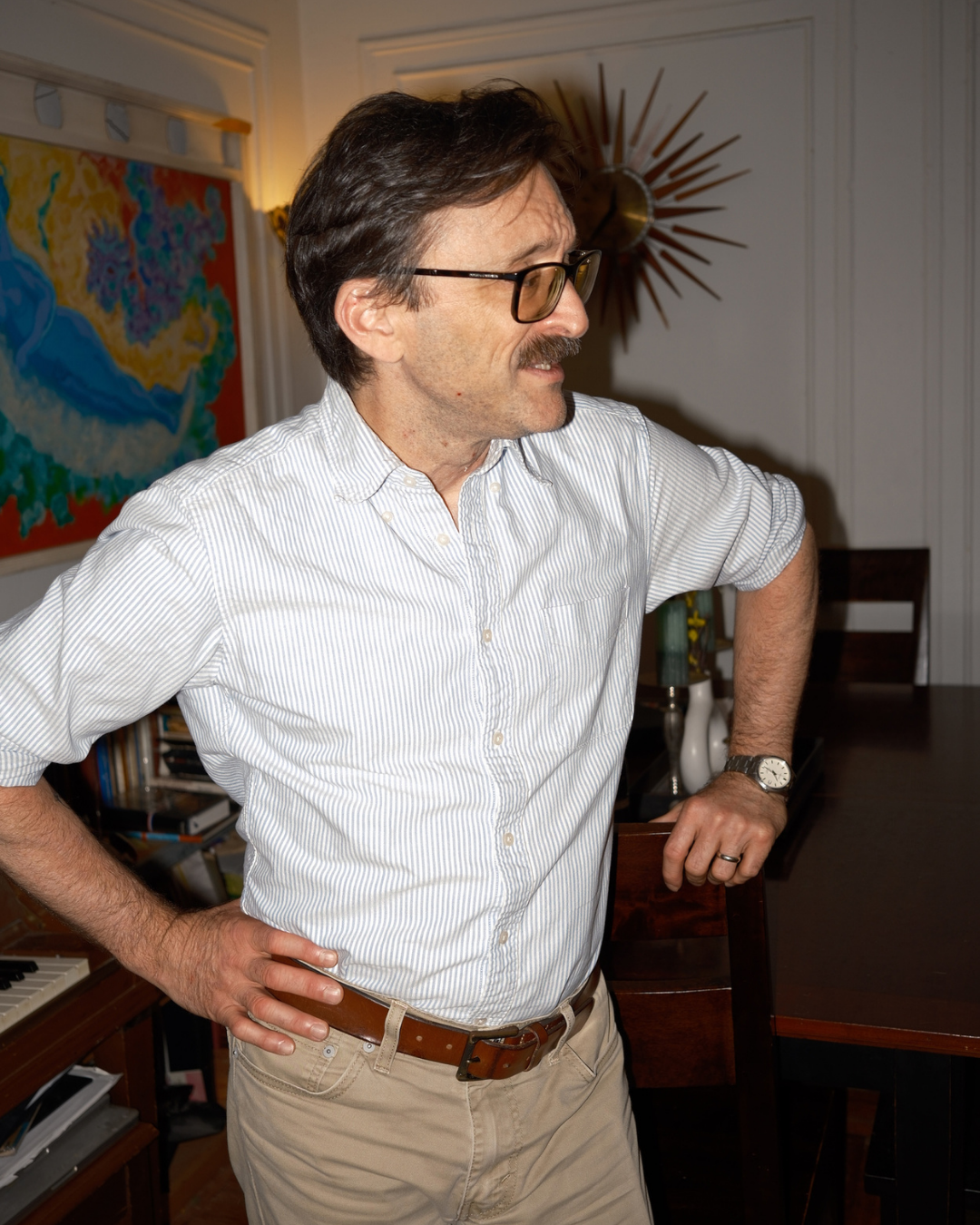
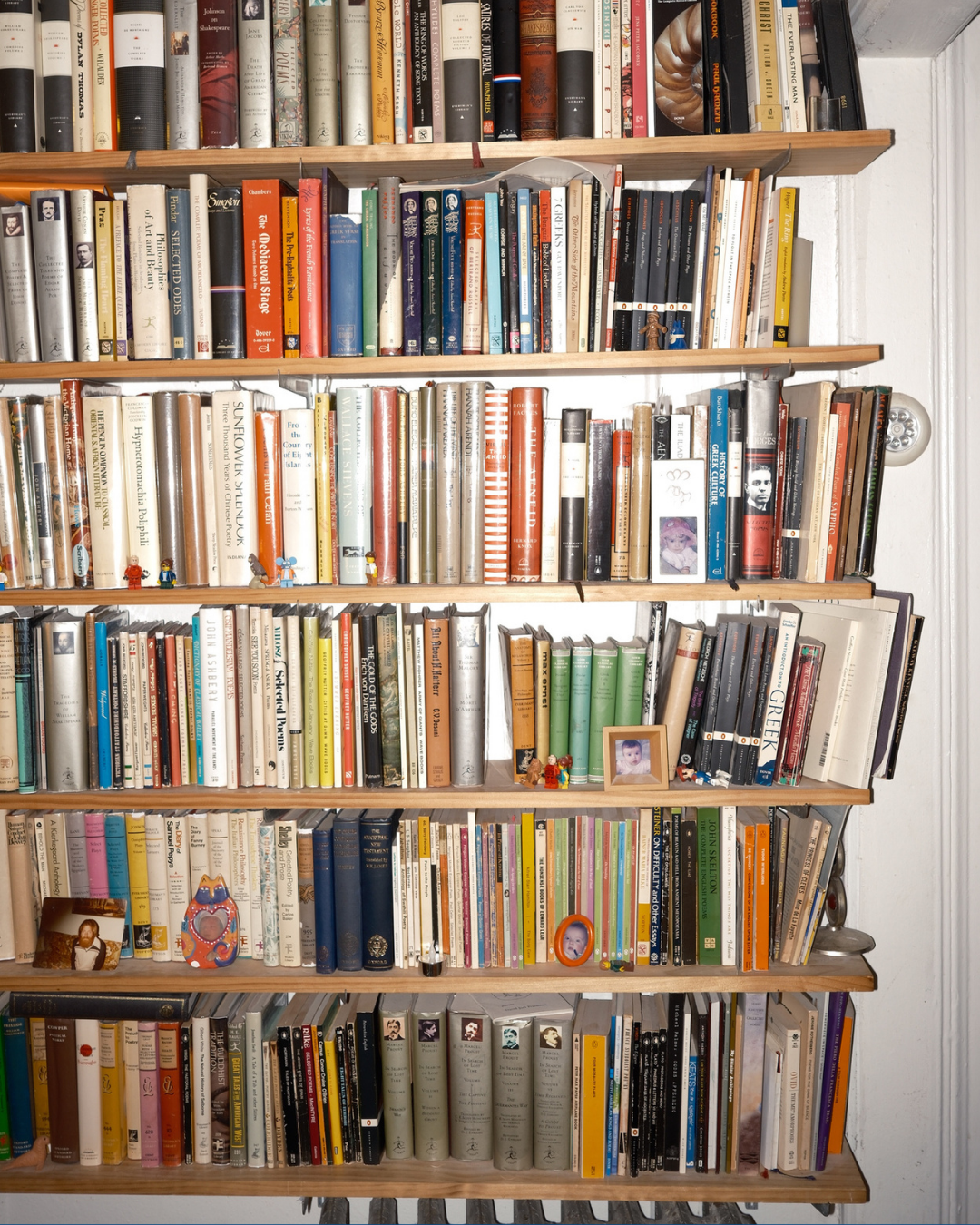
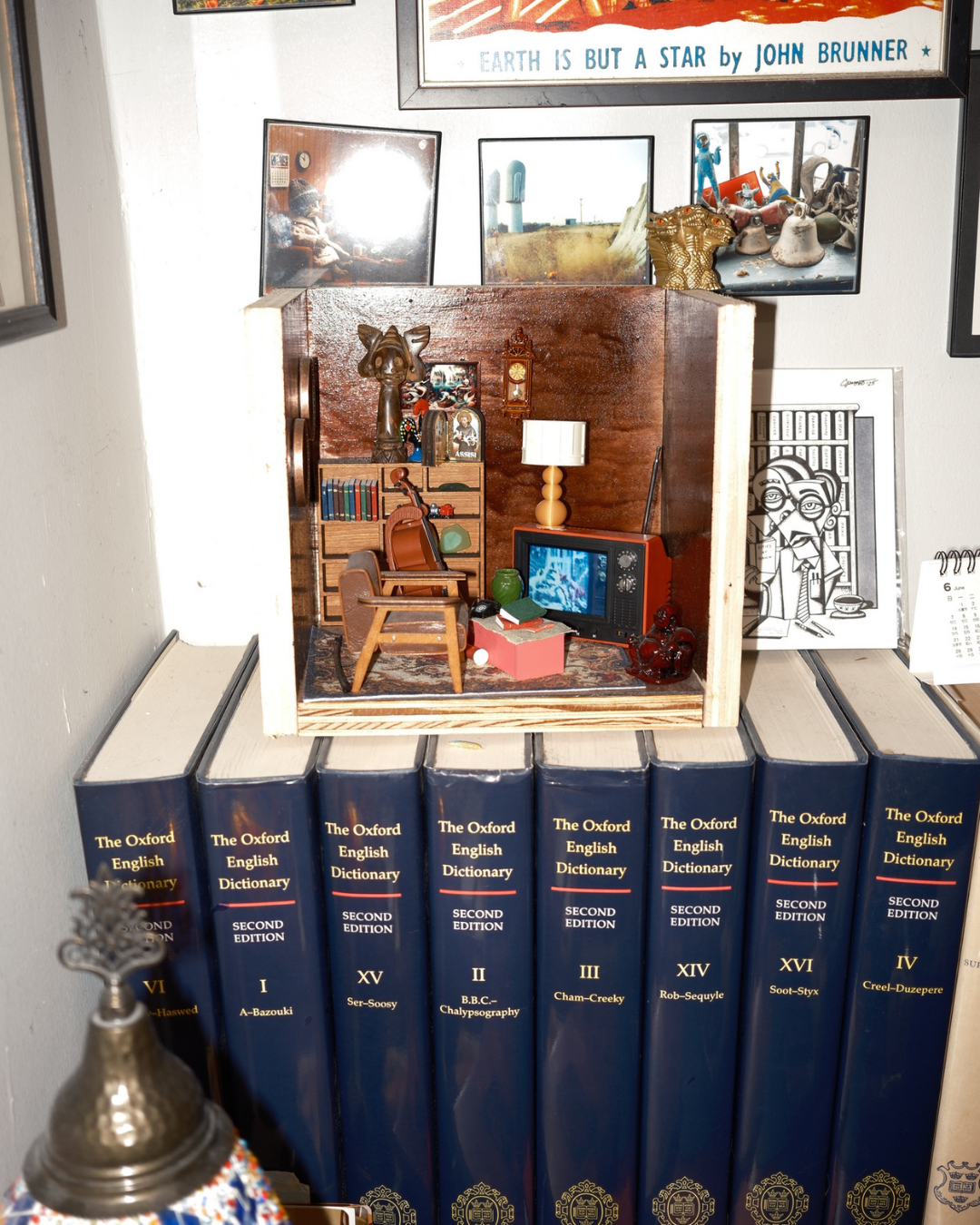
What does it mean to profess poetry today to more than 230,000 eager followers on Instagram and TikTok, especially when the audience is so young and wonderfully heterogeneous? This was the question I had as I spoke with Geoffrey and Elaine earlier in June. Two weeks later, he invited me to his home up north in Inwood, showed me his typewriters, books, comics, fountain pen collection, and his beloved, magnificently packed office, where I took these photos for the interview. On the subway and in the shade of Fort Tryon Park’s verdant summer foliage, we discussed his influences from Wordsworth to Alexander Pope, the workshops he leads, his reflections on becoming a somewhat public figure, various book cover designs, a recent trip to Yangshuo, the poet’s way of seeing a richer and more dynamic world—the intensity that poetry brings to living that Wallace Stevens speaks of when he states that, “Poetry increases the feeling for reality.”
We spoke twice on Zoom and in person. Our conversation has been edited for clarity and length.
HENGZHI HUANG YANG: Let’s begin from the very start. When and how did you decide to start @wallsonglass/The Poet Dad on Instagram and TikTok? Did you expect the kind of following that you received on the internet—I wonder if that changed your outlook on the state of literature in general (maybe you were more skeptical and uncertain about the appeal of poetry with young people and then became much more optimistic, or did you always believe in the project)?
GEOFFREY NUTTER: Actually way before social media, I started “Wallson Glass,” the seminar series, in 2013 simply because I wanted to reach more people. I wanted to do some other teaching, with people beyond my university classrooms, and it started out as poetry workshops, which I was doing literally from my apartment. I did it at my home in New York for six years. Then, with the pandemic, I started doing them on Zoom. I didn’t even think doing classes online was possible until, of course, we all became so accustomed to Zoom during the pandemic, changing everything. As for the name, Wallson Glass doesn’t mean anything, haha, or maybe it means something very secret—but I didn’t want to call the website “geoffreynutter.com”. It gives me a slight air of plausible deniability, I suppose.
HHY: Always good to keep your reader in wonder, I mean, that’s part of the beauty of poetry. A “hymn to possibility,” as with John Ashbery; it can be anything you want!
GN: That’s perfectly right. So when our social media presence started, it wasn’t even really intentional, Elaine just spontaneously started it.
ELAINE NUTTER-DIAZ: We did not plan any of this in the slightest. It was never like a “game plan” or anything on my mind. I was in college, in quarantine, and online after 2020. I knew that he was doing these workshops, and I wanted to help—there were also little things that he said to me at home that I thought were inspiring and wanted to share. I was posting on my personal account (not really anything related to poetry). I just remember one Thursday, I saw him kind of dispirited because no one had signed up for that Saturday’s poetry workshop, so I made a five-second video simply being Hey, sign up for my dad’s poetry workshop, a bit of a sad video with a crying emoji. That video was met with so much love and it blew up.
I remember the following morning—the Friday morning—he was out and he called me, and he was like, I'm getting dozens of sign-ups… what’s going on? And then I told him about the video. He had so many people signed up for that Saturday, and so many even for the next week. So from that day on I just started posting fun little videos, but consistently, again, it was never like a topic of serious conversation, really.
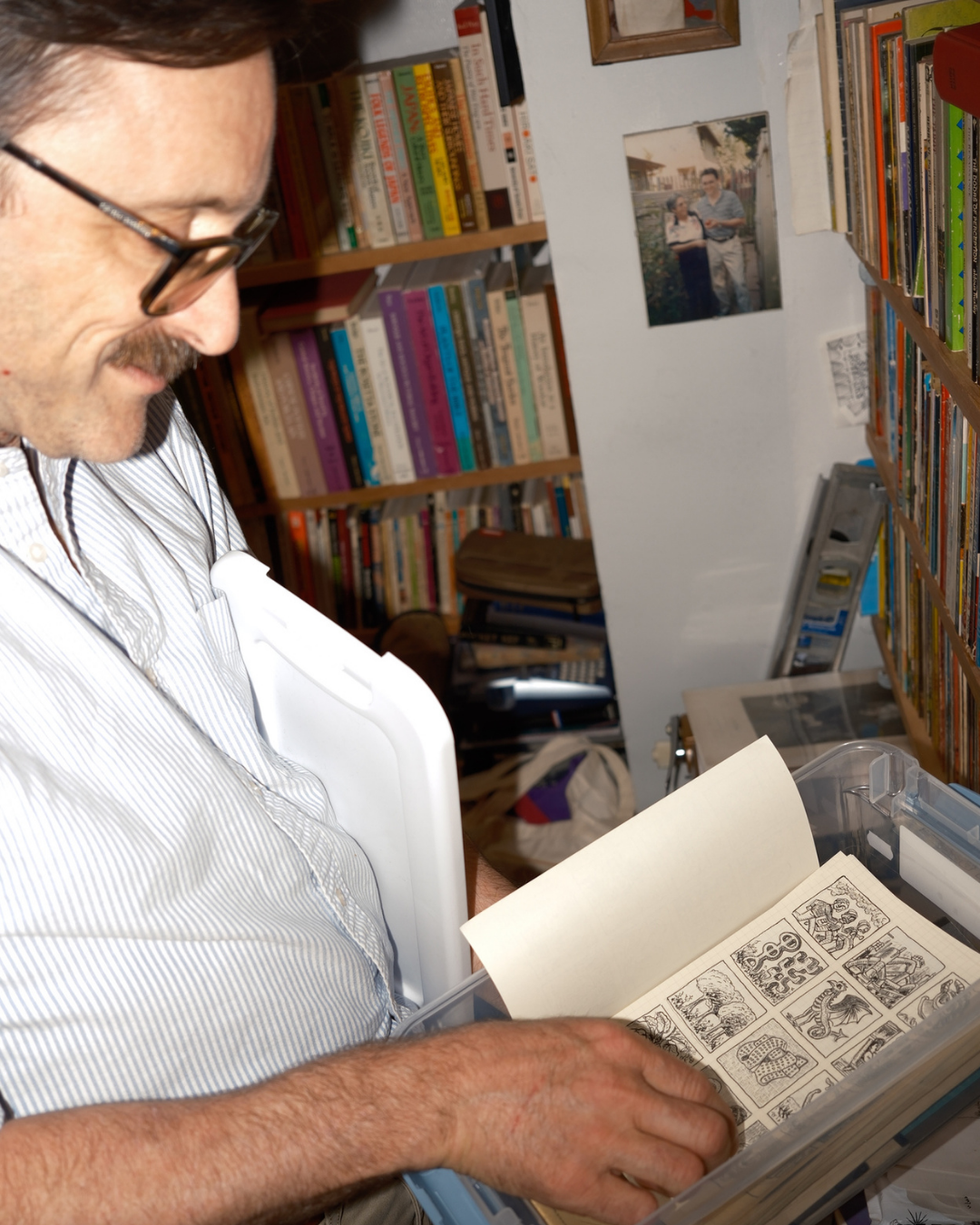
HHY: That’s awesome. The popularity and reach of everything you do makes me a lot more hopeful about the future of poetry, and if there is the “right person” to go viral online as such, you are absolutely the one, having worked and taught many, many years prior in the field. We will certainly talk about your own books, style, and influences later in this interview. But I believe why people immediately adore these videos is that there is a kind of authenticity and intimacy in these videos—paying attention and tribute to the most minute, fleeting details of daily life. These are videos about birdwatching in the park, unboxing books, editing your students’ manuscripts, going to a stationery store, yet they are transformed into literary and poetic moments of inspiration.
Many previous critics and poets have spoken about this notion of practicing poetry as practicing an artistically different way of living—of looking at, of being in, and of experiencing everything around them more thoughtfully, where heightened forms of noticing and describing reflect the poet’s inner life in a radically human manner. Deep down, for me, your online persona conveys partially the young people’s desire for this thoughtful inner life. What do you think is special about the poet’s way of seeing the world that you almost come to represent?
GN: Great question. I see there are a few aspects of the question that you are asking. I imagine that most poets look at the world with a certain amount of curiosity and also love for the objective world of things and phenomena. We try to cast the experience of being in the world into language that is surprising and precise and, crucially, that moves with a kind of force or momentum or life. Or make a language experience that itself is a fresh experience of the world, one that electrifies our consciousness because to a large extent language is consciousness.
There are many different ways to be a poet in terms of living a life. A poet can be a businessman, a priest, a monk, a soldier, a mother, a hydrologist, a professor, an architect, a school teacher, rich, poor, sick, healthy, atheist, religious, etc. You don’t even have to be a good person, necessarily. (Though abjectly sociopathic people will likely not be interested in it or capable of it.) But you have to be able to devote plenty of time to reading, writing, and looking at the world around you…
I think that as poets we’re, in a sense, working to “increase the surface area” of our lived experience, or our imagination. Language expands and multiplies reality and experience. Not all language, of course. Some stifles the imagination and aims to sell or manipulate, or makes us feel diminished. But language can also enlarge our experience, reinterpreting experience, and can add or make visible different facets and dimensions of our experience of the world.
Also, something about the “work” of being a poet: I think a poet has to be comfortable “doing nothing”—or rather, just being. Wandering, looking at things, being in nature… I think there is something subversive about this in a culture that values production and commerce—and entertainment, which is intertwined with these—over all else. And the moments of “doing nothing” are, in a way, preparation. That is our “work”.
HHY: There are no periods of complete detachment or alienation from work and life—the poet is always sort of in the midst of their richness.
GN: Exactly. That’s the ideal, right? In a good and meaningful way.
HHY: This is where the “poet dad” aspect of it all comes in, too, I think. We all wish we had a poet dad ourselves, who could always be and speak with us eloquently about books and artworks, showing us that any emotion and perception is interconnected to one another, sharing a history with writers and artists who came before, and ready to be made into a new poem. For many young people on the internet, you might be their initial guide to thinking about their life and experience this way. How do you approach this idea of being the internet’s poet dad, introducing the love of literature and writing to such a broad audience?
GN: I love talking to people, so it’s very exciting to me that I sort of have this public-facing part of me. This is also a distinctively new identity, since being a poet involves much solitude during which you just have to work out the things you have in you. It is difficult to represent the poet’s writing process per se—though it largely consists of sitting for long stretches in front of blank sheets of paper—but it is possible to represent the way of thinking, of looking, of relating to history and theory, and everything surrounding the process.
What is amazing about this online platform is that everyday, we get to hear people from all over the world, of different ages, from different countries—in Asia, Europe, the Middle East, Latin America, etc.—who aspire to be poets, and you know, want to talk about that, or want some inspiration as they’re not sure about it, eventually came across Elaine’s videos, heard me talking about Homer, T. S. Eliot, C. S. Lewis… or the story behind one of my poems, or saw these beautiful, you know, very aestheticized snapshots of a writer’s life. If I can be a “gateway drug” for people to make that important decision for themselves to become a writer—then I think that’s a really great thing. And I’m happy and proud to be the “poet dad”.
HHY: On a more personal note, running the account and creating these posts together must’ve been such a wonderful father-and-daughter bonding experience as well. How do you see building the online community together changing your relationship? Any fun stories about making a specific video together?
GN: Because we never really plan for the short videos, they just became a way of documenting our lives. Thinking of special experiences, our recent trip to China was definitely one of them. I went for some teaching work and she had come along.
I went to train a group of professors who teach in bilingual literature / creative writing programs. Professor Dai Fan of Sun Yat-sen University in Guangzhou brought me out there, after having brought me out for a month-long residence in 2019, just before the pandemic. We had eight days of writing workshops and lecture sessions in this absolutely amazing place called Yangshuo. It was like another world—a strange and fantastic landscape. Elaine and I decided that she would come along and make it a father/daughter trip. We went to Beijing and Hong Kong and Yangshuo, then ended the trip with a few days in Seoul, Korea.
HHY: People seem to love the short travel video diaries of you visiting the Great Wall and the rivers in Yangshuo and talking about the idea of the sublime in nature, or befriending passers-by with a common passion for Ancient Chinese poetry.
EN-D: Totally. And while I was making these videos, I wasn’t even having a conscious goal of, say, Okay this needs to be done today in such and such a specific way; they are just fun to create. A lot of them were just me following my dad around Beijing, or Hong Kong, or South Korea, and constantly surprised and impressed by the things we saw and the people we met.
GN: We had some really incredible experiences. Elaine has this amazingly sharp eye, and took little videos of things like an otherworldly dinner we had at a strange little restaurant we stumbled into one night in the hutongs in Beijing, where we met a group of men and befriended them through an ancient Chinese poem; and one video of us wandering around an abandoned temple in Yangshuo; another of me getting a tattoo in Hong Kong and browsing in a stationery store; and just talking to some of the amazing people we met. It would not have been the same without Elaine there. And she is an amazing travel companion.
HHY: What’s endearing is that there’s this genuine feeling of love and admiration that comes out of these videos. You look up to him especially as the viewers also look up to him as the writer and poet that they might also want to one day become.
On this topic of aspirations and role models, in one video, Geoffrey you mentioned growing up in a place where poetry and art weren’t exactly celebrated, where there were no writers and nobody to really look up to. I’m curious about your life prior to social media, about how you convinced yourself that all of this is possible on your own?
GN: When I was a kid or a teenager, I remember reading poetry in my English classes. I didn’t understand it at all, but I did know that something was very, very appealing about these poems, and they just sounded musical and sounded beautiful, and that’s what appealed to me immediately. But my early influences were just like incredibly old stuff, you know, Alexander Pope and Wordsworth, and I didn’t even really know there was modern poetry.
What’s so funny about this is that years later I realized that my high school English teacher had given us an Elizabeth Bishop poem that I remembered, for example, but at the time I almost ruled out the possibility that this amazing verse could even be written by a living poet. My first time discovering there are living poets out there was some event in downtown Sacramento in my first year of college. It was a 24-hour marathon poetry reading on the sidewalk in front of a cafe with local poets, and I was like, There are “local poets!”—there are these oddball, crazy, living people in Sacramento who call themselves poets!
I had sort of lived up to that point where you tell people that you want to be a poet, secretly, of course, you doubt if you are one already. I knew I wanted to be a poet, but telling people seemed weird and pretentious, and I think many young aspiring writers, especially younger ones, can relate to this feeling.So there was that kind of torture about I can't really call myself a writer, but still there was the desire to be one. There was a kid in my high school who was considered “the writer”—he was just this quiet guy who was known as the aspiring writer at our school. There was a great glamor attached to this, for me. But I wanted to be the writer! Well. While in my last year of college in San Francisco, I met the poet Randall Potts, who told me that you could go and get something called an MFA (he had just completed his), and there was this great place called the Iowa Writers’ Workshop. That changed the course of my life. To go to graduate school and study poetry writing is to be around people for whom writing is the most important thing—for two years, before you’re back out into the world where nobody cares as much. But those two years are vital!
HHY: It’s very interesting to hear that your earliest influences are classical poets and most of the poems that you discuss in your videos are from classical poets as well, because I would describe your style to be incredibly modern and contemporary. It is not typically “MFA-esque,” either. I mean, I see a lot of Ashbery, that kind of surrealism, those mixed metaphors and images, juxtaposed with that longer free-verse prose form with the structure of a narrative that perhaps Robert Hass had pioneered. Lastly, there are also the scattered elements from Ancient Chinese poetry: you made the fantastical landscapes of Yangshuo really come to life in a recent poem in The New York Review of Books, for instance.
How does somebody like Wordsworth and their style and their form from 18th-century Britain connect to what you do? How did reading classical poets shape who you became? I think this will give the young audience today some reference about how that translation/transition happens.
GN: For one thing, these are some of the poets I first fell in love with. I liked how they sounded. As a poet, you absolutely must know a lot of poetry. It makes you aware of possibilities, and of what other people have done and what you can do. I think we’re in constant conversation with the poets who came before us.
I imitated these old poets before I was really aware of any modern poetry… so I was kind of apprenticed to those old guys. I couldn’t read Emily Dickinson for some time (now one of my favorite poets) because she was too weird and resistant and her poems refused to satisfy the need for closure and resolution (unlike a Wordsworth, for example). Same with Whitman—his poems just didn’t look like poems. Obviously I had little guidance at this time—or just didn’t reach out and ask questions. But at some point in high school I discovered T.S. Eliot and that was pretty life-changing.
I try to remind my students that these dead writers who seem so separate from us were just people like us. Poetry is precisely about understanding each other, if nothing else, over long, almost impossible distances and historical eras. So I try to tell my students that we’re sort of like citizens of “the nation of poetry,” and we share so much in common with others in this realm. I try to urge my students not to look at Wordsworth, Sappho, Dante, or Keats as monumental figures just to be worshipped and studied in literature class—but rather as our friends, in a very literal, intimate sense. They contended with awareness and apprehensiveness about mortality, transience, and their place in the world; in their poems they are trying to figure things out, just like we are. We all ask the same question, What does life mean? What does it mean to be living in a mortal body in a world of things? Why do we die? What is this world we live in, so beautiful, so strange and sometimes so terrifying. etc. A poem is a living document of a moment or experience. I tell my students, “Someone just like you sat down one day or night and wrote these words and now you’re reading them. And there is something immediate and even intimate about this experience. Do not think of these as merely texts to be studied and analyzed, but as love letters to fellow humans in the future.”
As far as the poetry itself, I think that young people have to read a lot of poetry. In order to learn, we have to be reading all the time, and we have to be really familiar with our tradition, and when I mean our tradition, I mean poets at large from all eras and languages. We must have these rhythms and images surging through us always. The way I move through the environment is always a conversation with the dead poets. Ultimately, why wouldn't you want to know everything that you could possibly know about poetry, this ancient art people have been practicing for thousands of years? Again, we have some important things in common with the dead poets: a love of poetry and an overwhelming and inexplicable compulsion to write it; and, like those poets, we live in our historical and cultural context but also, importantly, outside of it. We share these things with Emily Dickinson and Keats and Basho, and you can read things that Keats and Basho and Saint-John Perse wrote about poetry that are nearly identical. Poets from all eras and places could sit down and have a beer together and be able to understand something very essential about each other and agree on some very essential truths about poetry.
HHY: It’s important to know your “ancestors” as a poet.
GN: Absolutely.

HHY: Oftentimes, the best a teacher can do is truly to channel the spirits of the people who have contributed to our shared tradition of poetry in the past, by offering the students more books to read. I remember watching this recent The New Statesman interview with Ben Lerner in which he described teaching Ocean Vuong—two poets doing very different work—by guiding him to new books. Is that how you approach your workshops? How do you teach for your workshops and, for social media, do you see there’s a difference between introducing books to a general audience and just introducing specific books to one specific student?
GN: Overall, I believe my job, both teaching in colleges and on social media, is to show possibilities. I give readings to my students at NYU, just as I would recommend a book online or in my workshops, to illustrate for them what is possible and what has been done. Here’s what Gertrude Stein did, and here’s what Frank O’Hara did, and here’s what Marianne Moore did—here are people who were using language in this absolutely incandescent way 100 years ago. Now it’s your turn. What are you going to do? I want my students to feel these writers’ presence when they are writing.
Why shoot for anything less, right? A poet naturally wants to write a line that is in conversation with others, on the level from which it can communicate with the poets of the present and the past. So we have history in front of us all the time, and I want to make my students aware of that, not to intimidate them but to at least let them hear the whispers of the dead poets—who are really quite alive.
HHY: In a way, reading these poets’ works takes one out of the immediate present where a lot of chaotic and attention-draining things are happening, and provides them a peace of mind and a reassurance that they belong to a tradition—and a universal tradition. It’s fascinating to me that you have a considerable presence on social media platforms yet also actively work against the presumptions of these platforms as you hold a position opposite to what we may call the mindset and pressure of “optimization.” Your videos are simple, not glamorous or flaunty at all.
GN: Yes, I’ll tell you, I’m also extremely touched by how much people identify with the way of life that I have come to “represent.” I mean, in case it’s somehow unclear, my life is hardly one of wealth and fame. But being a writer, and especially being a teacher has been such a tremendously rewarding life regardless—teaching university, teaching community college, teaching high school, I’ve done all of them. After my MFA, for many, many years, I thought I didn't want to get a teaching job after Iowa. I worked all kinds of jobs throughout the years. I’m glad I’m finally doing what I’m doing.
It’s astounding to me that this many people still appreciate and believe in a life surrounded by books and intellectual conversations. Elaine sometimes makes these videos of me having conversations about poetry or literature with others. There was this one time we were having dinner with my sister and my niece, where I had maybe said something about the etymology of a word, she recorded a 10-second snippet and it’d gotten something like a million views—with so many people commenting how much it meant to them, that they wish to be in that conversation, they wish to have these conversations themselves. It was touching to me, because young people want to have conversations about ideas, but it was also a little sad for me, because not everyone is getting that. So, of course, I guess if it shows this literary way of living—which is not in any way ostensibly glamorous—glamorized, I’m all for it.
HHY: There is that analog, pre-digital quality of your videos. It seems paradoxical on social media, showing a sense of physicality and space with your personal collection of fountain pens and typewriters, and your cozy office, but it works. Was there any intentionality that went into that?
EN-D: So… One thing is that I’ve always been a lamp person. I love really good lighting—I think they can create a feeling of space. When we make these videos, as we said before, it’s not like we’re totally curating a set, but sometimes we’ll place the lamp a certain way, turn off the overhead light, or move things around. But people in general love seeing his typewriters, his pens, even like the smallest details that I wouldn’t notice. People will be like, What is that? And maybe we would make a video on it or not, but we’ll get comments, just like asking about the very specific things that he owns and that we just accidentally get in the video.
GN: A writer naturally loves stationery stores, and there is so much to love about the materiality of this thing of writing that we do. I love typewriters; I love the sound and the touch when I type on them. I’m not a Luddite, you know, I’m definitely not against technology. I move over to the laptop when it’s time for editing. But I see these things as technological in their own ways.
The book is a technology that is not going to be improved upon. On the other hand, I acknowledge that there are good ways of getting our work out there now as poets. Occasionally Elaine will put up one of my poems, you know, she’ll snap a picture of my typescript poem, (we’ve done that lately), or I'll read and record something, but that way you still will never get the satisfying weight of the book when you hold it in your hands, or you won’t get to flip through the pages.
Being able to publish quickly is also a little bit of a hazard for young poets. I think that young poets would be best served by just slowing down a little bit and maybe waiting for the publication of their first book. My first book wasn’t published until about eight years after I was out of graduate school—and thank goodness that it wasn’t published sooner, so I could make it fully into what I wanted it to be.

HHY: I’ve actually first encountered your books a long time ago before your social media presence. The Rose of January, Cities at Dawn—these are beautiful books both inside and out. The publisher, Wave Books, also has some other great designs like Maggie Nelson’s Bluets and Don Mee Choi’s DMZ Colony. Do you communicate with your publisher and designer for the layouts and physical presentation of your books?
GN: Wave Books has been really good about engaging with the poet in the design process, and their book designer Jeff Clark is a fantastic designer and poet, so he understands it from a writer’s perspective. For my last two books—for Cities at Dawn, I had requested them to do a “brutalist font” for the cover. I remember asking, Is there such a thing as a brutalist font, just like brutalist architecture?—because the book deals with systems and industries.
And for Giant Moth Perishes, Jeff did this kind of incredible job where—I’ll tell you this secret—since I had an epigraph from Walt Whitman, he somehow was able to take the font from the 1880 facsimile of Whitman’s Leaves of Grass and made it into a font for this book. And I had only found out much after the book’s published when I went back and searched up the original copy of the Whitman book to remind myself of the epigraph in full. How crazy is that!
HHY: That’s incredible! So much one can possibly know about an author with only their books are the writings and the designs. Without knowing the face of the writer, the book’s cover serves as almost the face of the writer. I remember getting so bewildered when first seeing your TikTok videos, thinking, Is this the same Geoffrey Nutter that published these wonderful prose poems?
In a way, you’ve lived all these different, meaningful lives. You’ve written half a dozen critically-acclaimed poetry collections, taught at various universities, and even blew up on the internet as a poet—what’s next? Tell us more about your vision for Wallson Glass, for these international workshops in the future. You host workshops for different areas of the world—that’s kind of my understanding—from Asia to Europe; it is hard for me to even begin to imagine how you put it all together.
GN: It’s a total mix. I teach at different times. In the spring I did 1 PM in the afternoon, a weekly 6-week workshop that’s mostly for the folks in Europe. I started doing these Friday morning sessions, so that people in Asia could come at a fairly reasonable time. I have people sitting in my Saturday workshops even though it is 2 AM in the morning for them. The time difference doesn’t stop students from Pakistan, New Zealand, Indonesia, China, Slovenia, Finland, Iceland, India and the Philippines. I’ve also realized that people sometimes want me to go more in depth into specific poets, poems, or ideas, so I started doing little lectures.
I recently held a session focusing on a Wallace Stevens poem, and there was a snippet there where I talked about Homer, which Elaine filmed and went viral. So I decided to do something on Homer. Again it was so amazing to see people from India and the United Arab Emirates coming together to talk about Homer.
As for larger plans: I want to grow even more and be a force that brings people from all over the world together—as it does now, but I know there are many, many aspiring writers all over the world who I hope to reach. Ultimately, I think poetry—like art, like beauty, like the soul itself—is an end itself, and—as Wallace Stevens said of ice cream—an absolute good. I think poetry is a force for freedom—intellectual and spiritual freedom. It is aspirational and cultivates a way of looking at the world that is charged by an energized uncertainty.
For many years the poet David Joel Friedman and I used to get together and write on Saturday or Sunday afternoons. After we read our poems, he’d say, Today was a triumph for poetry. My sessions with David were part of what inspired these sessions of writing “alone, together” and I want to bring that spirit to these sessions. I think when we get together and write, something happens, something important and world-changing. To say, Today was a triumph for poetry is like saying Today was a triumph for imagination, for seeing, for the energy and electricity of the word, for friendship, for the experience of being in the world, for surprise, for beauty, for the freedom of the spirit, for possibility…
HHY: There’s definitely something utopian about how international this community is, but how do you make sure that your audience can understand you despite coming from different cultural backgrounds and having different English-language-proficiency levels?
GN: I’ve been amazed at how universal the need to write poems is. And how universal the need to read poetry is. I’m so touched when I hear from someone who feels the compulsion to write poems. Of course there needs to be a certain amount of English proficiency in order to get anything out of these sessions—though this can be done with a translator, as I did in China when I was there the first time. But there is something about poetry—what it does and what it can do; what it represents to people, and how it seems to be associated with freedom: freedom to express and feel and be—that is universal. Of course young people are at a stage in life where things are new, they are trying to figure things out, experimenting with identity, feeling things very strongly, willing to try new things, and feeling the exhilaration of hopefulness—these seem to be some of the universal qualities of youth. But they are also qualities that poets necessarily retain throughout their lives.
HHY: Have you ever thought about bringing in other writers for your lectures and workshops? And, at the end of the day, what would you want the legacy of your social media presence to be?
GN: I keep thinking that I’m going to bring other people in—many of my colleagues from NYU would be perfect. I want to keep growing this platform and I want to bring other people in with me. We also keep on getting invitations from translators and scholars across the seas—we had someone from Turkey reaching out and wanting to host us there; we’re talking about taking a trip to Cambodia. I’m very open to collaborating.
As for the legacy—I understand that not a lot of non-poets read poetry. That doesn’t bother me. I’m not interested in converting anyone. If poetry is not important to you, fine. I’m not interested in making poetry easier so that it will appeal to more people. I think many poets internalize the general culture’s disdain for poetry—there is a kind of “Stockholm Syndrome” where we poets begin to identify with the contempt of a culture that values entertainment and profit and violence over all else. So we feel we have to make poems about pop culture or current events or whatever, avoiding difficulty at any cost so people will see us as “relevant”. If poetry is going to be for a few, fine—let the curious few who love it learn about it and seek it out. But there needs to be an openness to difficulty, because there is an element of difficulty in being human, and in communicating the experience of being human—being a human being is hard, and why should poetry be easy? Beauty and difficulty are very important to me, but do not have to appeal to everyone. But when I see the videos on social media of people walking into a gallery of Mark Rothko paintings or other “difficult” art objects, for example, and mocking them, I feel like saying, Look—you’re doing the work of capitalism and power and oppression for them. Because power loves to mock beauty and difficulty and complexity. And poetry and art must speak truth to power, which means it’s going to be mocked and ignored by many.
Poetry doesn’t consume or devour your attention—I was going to say it asks for it, but that doesn’t even seem right. It stands there, at the ready, prepared to come fully into its own through its encounter with you—but you have to be prepared to meet it on its own ground. So much of our culture is about entertainment and distraction and rage-baiting, consuming our attention but leaving us feeling depleted and frustrated—or angry, indignant, and helpless. Good poetry—and good books and art in general—never leave me feeling this way.
I’m here for those odd people who feel drawn to poetry and a life where books matter. I want them to not feel so alone. I want to make poetry easier to approach, in that I want people to understand that poets generally mean exactly what they say—poets want to be clear when conditions allow. But I don’t want to make poetry itself easier.
Then again, as I said, if someone sees our videos and this life of books and poems seems appealing—that is a great thing. I welcome them into this strange life.
Elaine is great at social media. She is an artist when it comes to making these fantastic videos. She’s been making short experimental films since she was in 6th grade. She has the instinct for what reaches and touches people, but the algorithms are also unpredictable. The algorithms might decide to let millions of people see our videos one day, then to have 17 people see them the next. It’s frustrating because this has nothing to do with the beauty of the videos themselves. But anyway… this social media success will pass—as everything must pass. But after it does, I’ll still be doing what I’ve always done—I won’t stop writing or teaching when there’re fewer people seeing our videos. I’m here in the role of the poet that has been passed down in the tradition for thousands of years. I’m realistic about how everything passes but whatever happens I’ll still be here.