
FALL/WINTER 2025
Kay Poyer Believes in the Horror of Intimacy
interviewed by Emerson Rhodes
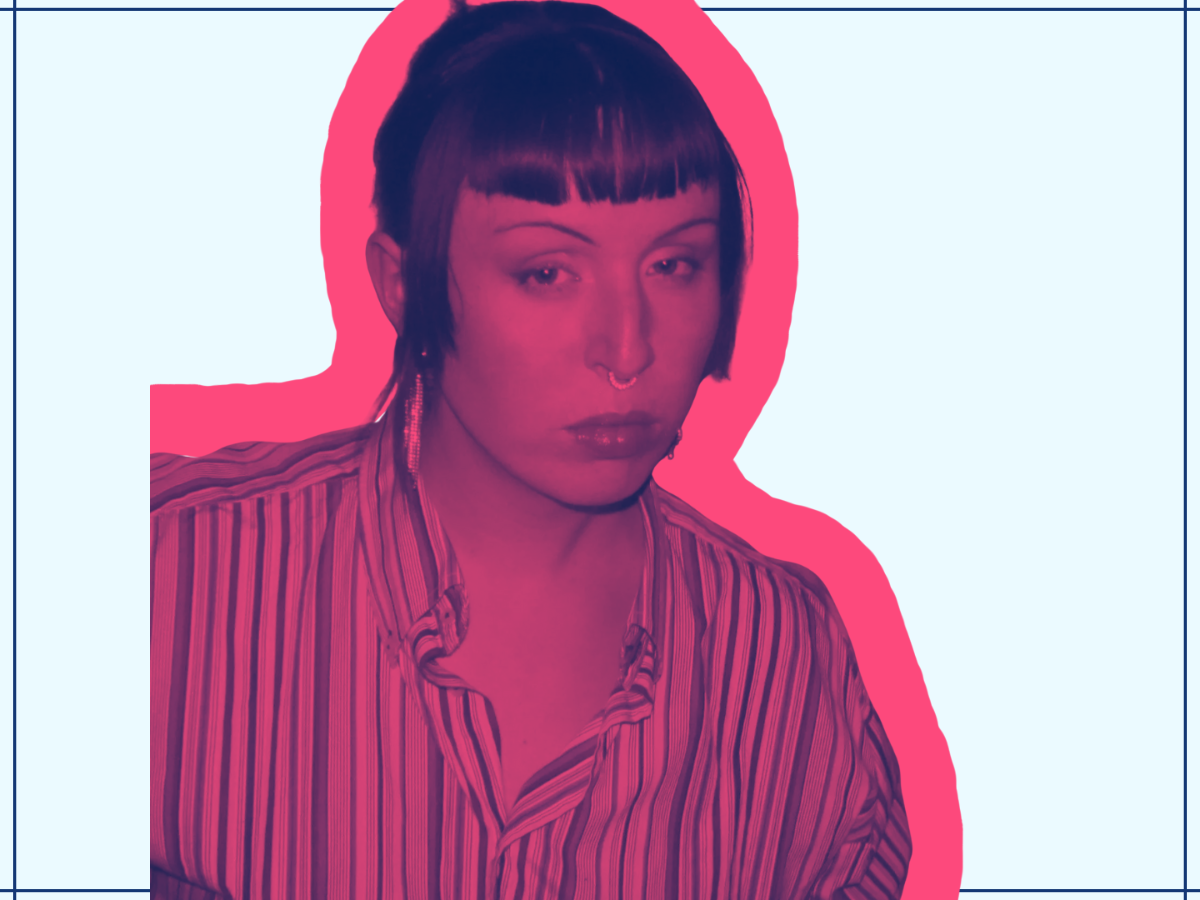
Photo: Kay Poyer
Kay Poyer is an online personality and writer. Amassing over a million followers across all her platforms going by @LadyMissKay, Poyer has carved out a niche for herself as someone who is refreshingly honest and critically necessary. Kay Poyer has branched out in recent years, writing on her Substack, The Quiet Part.
EMERSON RHODES: I've been a big fan of yours for a really long time. I think the video that I first watched of yours and, to this day, one of my favorites, is a video where you go, I just think Benson Boone needs to show pole and that would fix him. Do you feel that you still agree with that? Do you feel like other pop stars should be maybe a little bit more sexed?
KAY POYER: I would actually be very careful with that take in the future. I feel like it was more acceptable because we were talking about a male pop star. I mostly made that joke about him because he's the Mormon pop star, which is just such a weird concept to me. But, no, I wouldn’t say it’s for everyone. Specifically for him doing a Freddie Mercury impression, the fact that there's no sex appeal to it is just crazy, because a lot of Freddie Mercury was raw sexual energy just flying around the stage. For Benson in particular, there's something about him that makes people uncomfortable because it feels neutered when it should feel sexy. So I think that was really just for him.
ER: On the flip you've talked about Sabrina Carpenter's new album cover, and you said you were bored by this very cis-gendered heterosexual era. Do you think that holds true for the culture at large? Do you crave certain things to be more or less sexy, or sexed just generally?
KP: Right now, I really, really want everything to be super sexy. You can feel the pendulum of culture swinging very, very quickly conservative. Growing up, I remember things being much more conservative when I was a kid, and then slowly getting more progressive. And so you can feel it in the air when it shifts back, and it makes me crave things that are dirty and raunchy and homosexual, especially the more and more that I feel things kind of constricting around us. I mean, in general, I think sexiness is a good thing, but at this point, I really want things to be erotic. That's much more intentional. That's a lot of what we're missing that we get specifically from queer ideations of sexiness.
ER: Yeah, 100%, touching on sort of these ideas of the erotic or the sexual, do you see your own sexuality, or sexuality at large, as a resistance to modern conservatism, or the pendulum swing towards conservatism?
KP: Yeah, I guess I do. Particularly, very open artistic displays of it, because a lot of things that become weirdly hot kind of come out of taboos that conservative culture creates. The whole reason that certain things are sexy to some people is because they're not allowed to be doing them. Repression creates all of this tension; it's almost a cycle that feeds into itself, and I think sexuality is a really big part of that. I think it's just as important to explore those things and to kind of undo those taboos. I remember when I guest judged “Twinks vs. Dolls” [an annual wrestling competition/piece of queer performance art between the two groups]. I can't stress enough, nobody explained what was gonna happen that day at all, and I honestly had never even seen a video of it before. I just said yes and showed up. But I told them, I just want today to be really gross, and like, as homosexual as it can possibly be. And then they covered a bunch of trans girls with cheese. It was perfect; it's gross, it's weird, it's very public. And I think that's a good thing. You know what I mean? It makes the mind a richer place.
ER: And would you say you were twinks or dolls, in the war?
KP: Dolls, for sure, everybody was. It was kind of almost forbidden to side with the twinks. I learned from asking around. I feel like you can side with twinks in the privacy of your home.
ER: I guess, sort of in a similar topic to sex, a lot of your content, or a really large motif in things you post about, especially on TikTok, is to talk about dating. Do you feel like the search for love is a dominant force in your life?
KP: Oh, for sure, unfortunately. I would love for it to not be that way. I feel like there are two versions of me. There's an absolutely batshit, insane single version of me, and then there's me who has a boyfriend and is kind of boring, but is objectively, much more…I don't even know what the word is.
I was with my ex for four years, and so I didn’t want everything I talked about to be about dating. But I was like, Yeah, I haven't been single in four years. So of course, it's all going to be about dating. And I have discovered quite a lot in that time, because when I got with my ex, I was 20. I didn't know anything about anything. It's been such a rich pool of experience to dive into, because I never really had time to have a messy early 20s, dating, hullabaloo. So I was like, Well, I guess it's time for that. And it's been a huge mess. It's been really fun to write and make videos about it, because I don't like keeping secrets. I want to share everything.
ER: I'm glad that you brought up writing, because one of the things that I found very interesting about you as a person online is that you have this TikTok, which is very comedic in certain ways. It's very blunt, and you come off very strong in it. I think in a lot of other interviews, they refer to you as an older sister type, giving advice and such. And then when I read your Substack, it's very serious and it's very vulnerable. I'm interested in why you have pivoted in this way or choose to seek out that avenue when it's very different from what you have done on other platforms.
KP: When I started writing more publicly and more seriously, it was because I got hooked up with Christian [her manager]. The whole reason that he got in touch with me was because he wanted me to do a TV comedy script. I had written before. I had enjoyed writing, but I had never considered doing it seriously, and he was like, Yeah, why don't we do this? Hopefully, someday this will still become a thing, but he and I worked on this whole pitch that started very much as a comedy, and ended up becoming an hour-long dramatic psychological horror series. It just took all these different twists and turns, and he pushed me to really figure out who I was as a writer during that time. Writing, to me—even though people know that it's me—feels a lot more anonymous. I like that I can really stew on every single word, and then by the time it's out there, I'm not reading it to you; you're reading it in the privacy of your own home, and it's your own thing. Sometimes I'll be reading comments, and even though I'm pretty explicitly talking about something, the way people will talk about it…they're definitely going on their own journey with it.
ER: Do you feel like your Substack is a more authentic version of your voice, or do you just again, feel like it's just a different side of yourself?
KP: I feel like it's more authentic in that I'll say stuff on TikTok, then forget I said it, and then someone will repeat it back to me, and I'll be like, Oh, I don't really give that much of a shit. I'm sure I meant that at the time. But on Substack, especially if it's one of the personal essays, those are just thoughts that I've been processing for months, and that's the end result. It's a little more raw, but I would say mostly they are just different parts.
ER: With that like a different part, do you find that your audience on TikTok versus on Substack are dramatically different or do you think these are like the same people seeking out different things from the same person? This is also a larger question about, how do you feel about your audience in general? Besides people with bangs with an attitude?
KP: It's not necessarily different. My audience is my audience, for sure, but I do find, usually, the way somebody will talk to me in public will be, especially if they've just seen me on TikTok, they'll go, You don't shave your pussy. They'll just point at me and say that, and I'll be like, That was three years ago, but yes, and it's whatever, and it's fun versus that small group of people who will come up and they'll grab both my hands and go: I love your Substack, and I love you. I always tell people that everyone who reads my Substack is actually cool in my book. Because that's what I do—that's the only thing that I'm serious about online. That's the only thing that I'm really getting to work on. I don't know, it feels weird.
ER: But you would prefer it if someone came up to you and was like, Oh my gosh, taking your hands, I love what you write and what you do, rather than someone being like, You're the girl with bangs, you don't shave your pussy.
KP: It's really just that you don't shave one. I get that a little too much. I’m at the bar, girl, I'm working on something right now, and you just said that to me. Of course, anybody walking up and saying something is really, really sweet. There was this one time in particular after a really nasty breakup: I'm holding a cigarette, a shot, and a beer. I mean, I'm crying, and somebody's like, Can I get a picture? I was like, You don't want a picture of this right now, but he did.
ER: On a similar topic, you've talked a lot on TikTok, and then also on your Substack, about working various odd jobs. And then you got really popular on TikTok, and now you're writing. Do you see TikTok as sort of a means to transition to writing full time? Or, if writing is your end goal, even? How do you see your journey so far, and then, what do you hope to eventually fall into?
KP: Unfortunately, I can't do favorites or a particular goal. I cannot escape the fact in my head that social media and all of that is not permanent. I don't think influencing or online content creation is a new, permanent piece of our society. I think it's like a time we're having right now. So, I really would love my writing to become something more serious that I can carry myself with, but it's definitely not like my one true passion. I don't even think I really have one true passion. I like just being able to create things, and specifically with other people. So I'm leaving everything very open for the future. Right now, social media has been a vehicle that has given me a lot of options and a lot of paths to explore. I'm trying to pursue writing a lot more seriously, and with how slow that stuff moves, in four years at the very most, I'm hoping I'll have something really cool to put in everyone's hands. I don't really ever see myself doing one thing forever. I had a natal chart reading. It said: You're just kind of gonna keep trying on different hats for the rest of your life. I said, Yeah, that's perfect. I love hats.
ER: Pivoting to your writing, one of my favorite things you wrote that actually wanted to talk to you more about, is your story “What a Good Man Does” on your Substack [a story about the rise and fall of a middling businessman]. I found it very interesting. It's fiction, which is, I think, on a platform like Substack, is a little bit rare. Just off the cuff, what do you think a good man does? What does a good man do?
KP: I wrote that about [REDACTED] I don't even know his name. That whole thing was supposed to be about him, or at least based on him. It was also definitely based on my father and a lot of people's fathers that I knew growing up. Just what a disappointment to be involved in the healthcare industry where your job is to reap the benefits of the suffering of hundreds of thousands of people.
I just really got stuck on this thought that for so many men, a daily part of their routine is to walk around and cause at least one person to suffer. Whether it's the wife at home or a bunch of people at his company or whatever. There was this one paragraph in the original draft, where I had this whole thing about him in the middle management phase, and he's making his way up, and he walks around his office sexually harassing the other men in the office with this raging hard-on he has. I wanted to show this man, no matter where he is or who he's around, is doing his best when somebody else is at a detriment because of him, and then he gets to die and ultimately be celebrated for that as an accomplishment.
ER: I find it really interesting because you are, I think, a political person. You voice your political beliefs online, so I find it very interesting that when it comes to talking about this specific political issue, that you pivoted to fiction as a means to discuss it.
KP: Number one, it’s a little bit harder for me to do fiction sometimes, but that came to mind, and usually when I'm writing, everything will kind of get built off of a single sentence or very short instances of action that I will keep replaying in my head, and replaying and replaying and replaying until I can sit down and build in the flesh around it. I'm particularly inspired by horror in general. I think horror is everywhere. And I don't want to be callous, but it was just very strange to me how people were talking openly about the suffering their families went through because of the health care system and denied insurance claims, and then we were told to be sympathetic to what happened to that man. Fiction felt the most correct, I don't know if I could do an opinion piece. I shy away from repeating the same exact thing everybody else has already said. So it made more sense to tell a story of this horrible monster, and then ask, What would you say about him after he died?
ER: Yeah, I'm really interested in what you said about horror. As a format, what does that mean to you?
KP: I've always really liked horror movies.I've spoken openly about this time in my life, but 19 to 20 was just so bad. It's a really crazy time to go through multiple traumatic events, back to back to back. The beginning of that chain of events was my mom committing suicide. I have spoken a lot [on Substack] about how it changed the way that reality felt. I found a lot of comfort in horror films, and I was seeking out progressively more intense films. I'm not saying I got into anything disgusting, but I was really searching beyond jump scares. I wanted movies that really explored deep, deep sadness and loss with no relent. You would think I would have wanted to pull away from that kind of stuff,but it was really comforting, honestly. A huge majority of horror films center around women being isolated in experiences of grief and, at a base level, demon movies, monster movies, all of these different little niches of horror, most of them are about a woman, just being cast into grief on her own.
It was really comforting. Death feels like something that is physical and there around you, when it happens that close and that traumatically. I feel like horror, to me, is in everything. It's very romantic, and I think it's a lot more than just a general sense of anxiety. If I leave a movie or if I read a piece of writing or if I listen to a song, and I come away from it feeling deeply and genuinely upset, that's horror to me, and that's what I like. I remember watching Tár with my ex-boyfriend, and being like, This is objectively a horror movie. Like, this is a really, really good horror movie. And it's weird seeing people not talk about it that way.
ER: I find that really interesting and also kind of leads me to talk about your own relationship with violence. Recently you talked about death threats at you, as a public figure, and then simultaneously you've talked about being, like, a gun owner, and I'm interested in, especially in times like these, what your relationship to violence is and how you kind of cope with that.
KP: To be honest, overall, I feel really, really lucky as a content creator and as a trans woman that my time on the internet has been really amicable. I kind of keep waiting for it to be: when is everyone gonna come after me? I did get a wave of death threats. But I also know I could send you the location of the Kroger in my neighborhood and camp in that parking lot for a couple of days, and no one is going to show up because it's just a bitter, sad thing people have picked up on the internet. I can't even fathom how we got to a point where a casual death threat is something you do with your Sunday, but it is. It's where we are.
In Texas, people really do have guns, like, everywhere, all the time. I also grew up in a hunting family and not in a Republican hunting family. It was just something normal that I was around as a kid. I talk about it in a very joking, kind of flippant manner online, because I think it's funny to be tongue in cheek about being a Southerner, being a Texan. I think a lot of people have a very unrealistic and kind of low bar idea of what Texans are like. But in all reality, I really do not ever want to be in a violent situation. Somebody is sending me a death threat because it makes them feel better. And so for me, it feels good to be like, come to my house. I will shoot you, bitch. And in a way, maybe that's a little bit erotic too. We have some kind of little erotic taboo thing going on with each other where we pass threats back and forth, but, at the end of the day, I do intend on keeping myself safe, but I will certainly be flippant about violence as a way to just remind people, if need be.
ER: You don't feel in any particular way, re: your Kroger location, that like, your life, given the things people have sent to you, that your life is in danger at any given moment?
KP: I mean, not any more than anybody else, particularly as a trans girl. But as a white trans woman, I am massively privileged, and I know my experience is a lot easier, but when it has been hard or threatening, it has never been because of the internet, just standard transphobia/misogyny. I remember there was one night when me and my girlfriends had left a club, and we were waiting in a parking lot for a car. A truck full of guys pulled up. They did not know who I was. They did not know who any of my friends were. And they're recording us. They asked one of us to talk. Heard the clock-y voice, because I'm not giving you cunt voice at three in the morning after I've been drinking—it's not happening. They're recording us, and they're trying to get us to come over to the car, and one of them's getting out, and he's getting closer, and that had nothing to do with me being famous; that had everything to do with we're stuck here in this parking lot waiting for a car. So, it's weird having a bunch of people know my name or whatever sometimes. But even then, most of the time, they don't know my name. They just know me as the girl who doesn't shave puss, and that's kind of funny. Every time someone has given me a real problem, it's been a rando in public who's just pissed at me about something.
ER: I don't want to, like, after talking about violence being: as your last words, but…
KP: Yeah, anything else you say before we come get you?
I think I actually really like that. You asked specifically about why the personas are so different on Substack and TikTok? Because that's something I've been really worried about, and that I've spoken about to my manager. I don't even know if it was a meme, but somebody made this post about It's so weird seeing the girl that you think is funny online suddenly pick up a guitar and try to release a single. It's kind of embarrassing, and I'm not trying to become a little indie whatever right now, but it's still kind of nerve-racking. Being the meme girl and then also being like I did write about my trauma, and you can read it, or even like I wrote a piece of fiction, and you can read it. It is kind of embarrassing, but I think it's really important for people to explore that, because the internet creates personality types that are much less broad-reaching than we really think they are. But I do think a lot of young people right now have a really hard time being vulnerable. There was some kind of five-year gap because I grew up on all the Be Yourself bullshit. I am meeting 20- and 21-year-olds who I don't think ever got told that. It's weird. I just think it's important to be the funny girl who also gets intensely serious sometimes. I genuinely think that's a really important thing to do, and to find as many ways as possible to make yourself feel vulnerable. The best stuff happens when you're vulnerable.