
SPRING/SUMMER 2026
Landscapes of the East and West: Paul Celan in Vienna
Anna Arno
translated by Soren Gauger
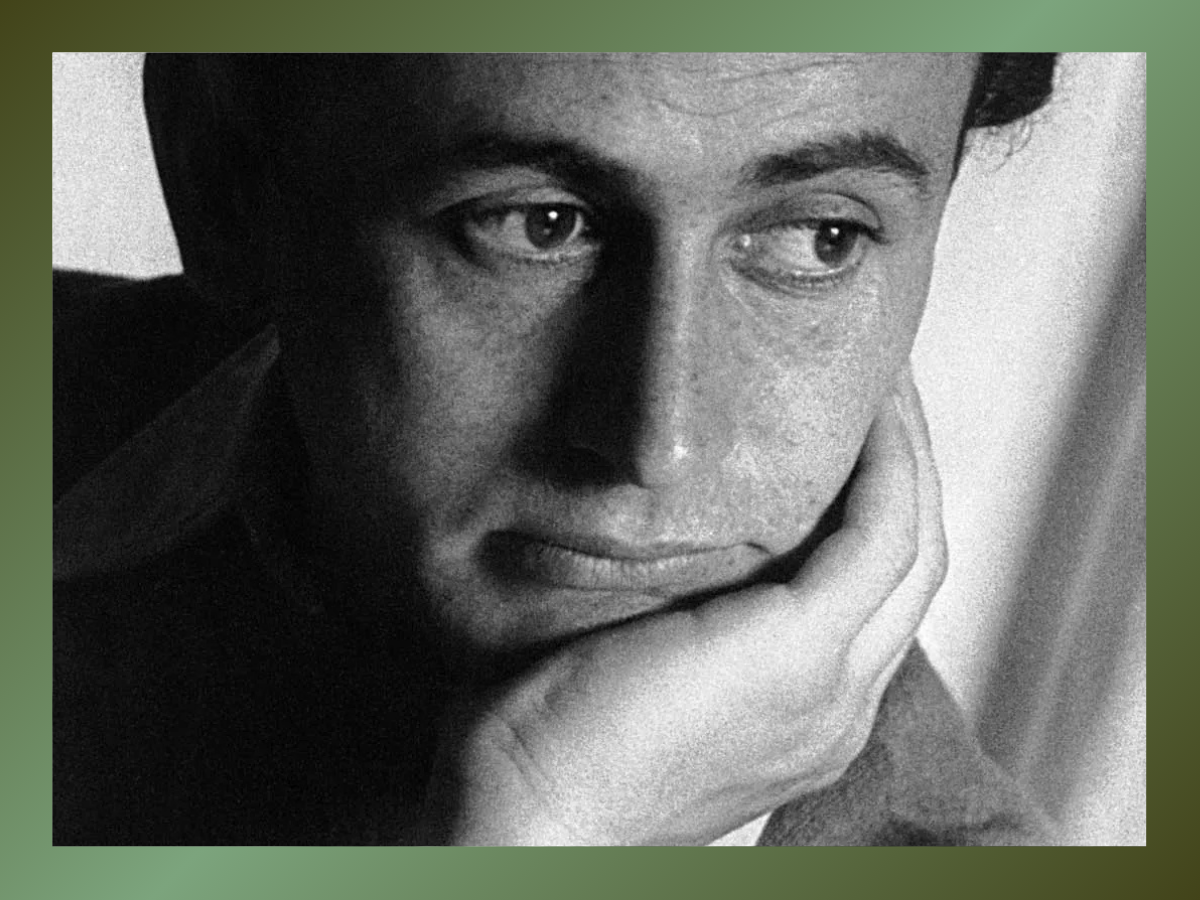
Photo: Paul Celan.
“I can only speak my truth in my own language,” Celan wrote to Ruth Kraft. He expressed his attachment to the German language most empathetically, even with a touch of pathos, in a letter to Max Rychner, editor of the Swiss Die Tat daily: “I must tell you how hard it is to be a Jew and make poetry in German. When my poems come out, they will surely reach Germany as well and—forgive these dreadful words—the hand that opens my book may have shaken hands with my mother’s murderer. Or something even more terrifying may occur. But this is my fate: to write German poems. And as long as poetry is my fate—I will be happy.”
In Bucharest, Celan discarded his earliest cycle, which he called Der Sandmann, and most of the poems from the Vor Mitternacht (Before Midnight) cycle, written in 1941 and 1942. In the best of them, the lyrical confessions are laced with “poison”:
Remember: a blackening leaf hung in the elder—
the alluring sign for the beaker of blood.
In “The Harmonica” he sketched a hostile, lethal landscape: “the icy wind suspends the gallows light of your lashes over the steppe.” Here is an erotic piece addressed to a loved one, saturated with disquieting metaphors: the snow is “sea-green” and “you eat frozen roses.” Celan was abandoning conventional metaphors, tears, or kobolds, drenched in moonlight. Sometimes he even discovers new meanings in old poems. One of his earliest pieces is “During a Journey” (“Während der Reise”), written on the way to Tours in 1938. It originally had the added note “in northern Germany.” In 1944, Celan gave it a new title: “Landschaft” (“Landscape”). The views he saw from the windows of the train recall pictures by a painter of the Worpswede school: the warped stump of a birch, a knoll, clouds, endless moorland. But in 1944, the “long-armed mills” Celan mentions are no longer symbols of the Northern European flatlands; they recall Novalis’s “death mills.” The title of another poem, “Chanson juive” (“Jewish Song”), he changed to “An den Wassern Babels” (“By the Rivers of Babylon”), to make the reference to the biblical exile of the Jewish nation legible.
Almost parallel to the Romanian publication of “Deathfugue,” Celan made his debut in his native tongue. Through the intercession of Sperber and Solomon, three of his works were published in Agora, in what proved to be its first and only issue. This was a pioneering journal for postwar Romania: it aimed to present the most compelling ideas in contemporary literature, to open a window to the world. As such, it included poems and essays in five languages: Romanian, French, German, Italian, and Russian, in the original and in translation. Among them were works by some of the great twentieth-century poets, such as Rainer Maria Rilke and André Breton, Henri Michaux and Umberto Saba, Carl Sandburg and Robert Desnos. Some outstanding Romanian interwar artists also appeared: Tudor Arghezi, Ion Barbu, Lucian Blaga, and Alexandru Philippide (employed by Cartea Rusă). Agora editor Ion Caraion recalled that Celan’s poems just fell from the sky: he had too much material in Romanian, and was starved for work in German. Three pieces were printed in Agora: “The Banquet,” “Water- Colored Animal,” and “The Secret of the Ferns.”
Celan illegally crossed the border in December 1947. He left at the last moment, guided by smugglers. Refugees had been fired at before, but by the year’s end, the Hungarian border patrols were hunting them down. Pushed back to Romania, they were arrested: they were stripped of their citizenship and their property was confiscated. Celan’s road westward was hard; with no regular connections in service, he had to go part of the way on foot. In Budapest he met other escapees: Isac Chiva, the journalist Jacques Schärf, and union activist Eftimie Gherman. To avoid falling into the police’s clutches and being deported, they holed up in the red light district. Ten years later, Celan alluded to this journey upon receiving the Literature Prize of the Free Hanseatic City of Bremen: “What was reachable, if distant enough, what had to be reached was named Vienna. You know how it went then, for years, with this reachability.”
Celan had spent all his Chernivtsi youth in the shadow of Vienna. In the postwar era and thereafter, the Austrian capital was an important gateway for over a million and a half emigrants, including Jews who had survived the Holocaust. In Vienna, refugees ended up in camps for displaced persons, and from there, after a few weeks or months, they managed to move on to other countries. Celan’s aim was Paris. His forced stop in Austria stretched out for half a year. He was hoping something would happen with the publication of his first book of poetry. Milo Dor, who befriended Celan in this period, later imagined the poet’s first steps in the city. He and Reinhard Federmann wrote a detective novel called International Zone. The title pertains to Vienna’s first district, which was governed after the war by the Allied occupants: the British, Americans, French, and Soviets. The Petre Margul character was based on Celan. The freshly arrived refugee “slightly befuddled, stood in front of the porter’s long countertop and stared contemplatively at the map of the East behind glass. This was an old-fashioned map with faded ornate lettering, its edges decorated with allegorical figures. Was Austria truly so large? he wondered, and only then did it strike him that the borders drawn on this map had long since ceased to hold. Only the mountains were the same, and the course of the rivers was unchanged. There was Bucharest. Still by the Black Sea, upon which also lay Odesa. Only one leap separated it from Vienna.” Initially, Celan made his way to the transfer camp in the American zone, set up in the former Rothschild Hospital. The building was overcrowded and dilapidated; it had no dining room, heating, or warm water. Luckily, Celan spent only two weeks there. On December 29, he checked into the Pension Pohl on Rathausgasse.
“A city fearful of its present, uncertain of its future” is the description of Vienna in the trailer for The Third Man. Carol Reed’s film was made about the same time as Celan was staying in Vienna: amid the ruins, in a humbled, wintry city. This was Vienna as described by the script’s author, Graham Greene. English officers bunked down in the Sacher Hotel, prostitutes froze outside the American Information Bureau. A Soviet soldier in a fur cap marched down Kärntner Straße, which had only just been cleared of its rubble. If Celan’s images of a lively artistic scene and deals struck at café tables had involuntarily persisted, he now had to bid them farewell. The famous prewar venues were demolished and closed down, and their regulars had thinned out, now scattered about the world. The officers of the occupying armies warmed up drinking ersatz coffee, and the blackmarket restaurants served broth simmered from bones. Smuggling thrived; water, electricity, and food were scarce. The city’s architectural symbols, the St. Stephen’s Cathedral, the Opera House, and the Burgtheater, were in ruins; the Prater amusement park was burned down. Seven years earlier, the crowd in the park had jeered at the Jews: they were rounded up and ordered to run in circles until they passed out… The famous Ferris wheel was reactivated, but the missing carts were eyesores. Max Frisch rode the famed merry-go-round: “The view over the gray city, the black towers, the distant Danube, which always reminds us of the Balkans—and of course beneath us the Prater itself: here and there a bomb crater, a puddle of brown water which refuses to drain away [. . .] then a ruin minus a roof, so that one can look inside from above, weeds and grass on the paths and squares, a signboard advertising fresh Würstl, elsewhere the remains of a merry-go-round, a wrecked slide down which one can slip into oblivion.”
Austria’s official policy conformed to the Moscow Declaration of 1943, by which this country was the first to fall victim to Nazi Germany. This half-truth allowed the country to avoid taking stock of their conscience. Frisch saw Vienna as an absolutely indifferent city, sweeping its fascist past under the carpet. “Aber geh! That is the magic formula that wards off all evil. ‘Come on, now!’ Here the deluge itself will stop in its tracks and subside, evaporating in the warmth of so much good feeling. Vienna is always Vienna. Why should they worry how things look elsewhere? Don’t talk of other cities: be glad that you are in Vienna. What has happened, after all? Even the Germans, who alone were to blame that Austria was on the wrong side, they dismiss with a shrug. Stop worrying, and try to be charming too.”
It was decided that only party members were culpable for war crimes. There were a great many of them, however: half a million people in a country of 6.5 million. The remaining “ordinary citizens” preferred not to hear about the persecutions, deportations, and crimes. According to the denazification law passed in early 1947, former members of the Nazi Party and its affiliates had to register in one of three categories: war criminal, guilty of collaboration, or culpable to a lesser degree. They faced sanctions: a bar from their professions, loss of civil rights, and confiscation of property. In 1938, people thronged to apply to the party and competed to get the earliest registration numbers. Now those same people asked their friends to testify that they had joined the Nazi Party not out of conviction, but had been forced into it. At any rate, it had been determined that an overly harsh reckoning would not be conducive to vigorous reconstruction. The spring of 1948 brought amnesty for all those found “culpable to a lesser degree,” allowing them to participate once more in social life, and even in politics as well. On the arts scene, Freudian denial was also the prevailing attitude, as if adopting a quote from Johann Strauss’s Fledermaus as their motto: “Happy is he who forgets what cannot be changed.” This denial was fed by the delusional conviction that in following Hitler, they had been beguiled by the “German religion,” as opposed to their native tradition. This led to an idealization of the Austrian and above all the Hapsburg legacy. Alexander Lernet-Holenia, who remained active during the war, though without supporting National Socialism, had his time in the spotlight when the war ended. “We must simply hold the course from which the madman’s dream diverted us,” he contended. “Ultimately, we need not look forward, it is enough that we peer behind ourselves [. . .] in the best and most valuable sense, we are our past.” Other key voices were missing: many literary figures, scientists, or intellectuals, such as Robert Musil, Elias Canetti, and Karl Popper stayed abroad. Local writers, apologists for the charms of this Alpine backwater, were a success. At a city hall exhibition of 1947, Wien baut auf! (Vienna Is Rebuilding!), buildings raised from the rubble and filled-in bomb craters were displayed to fortify hearts.
Vienna’s only clear attempt at reckoning was an anti-fascist exhibition organized in 1946, Niemals vergessen! (Never Forget!). Victor Theodor Slama, who made its poster, phrased it as follows: “The victory of the world’s democracies over fascism will not last forever. The inevitable social and economic consequences of every war lay the groundwork for pathologies of this sort, whose ripples can be felt around the world.”
Margul-Sperber was the first to hear Celan was safe. They were never again to meet in person, yet they remained in contact until Sperber’s death in 1967. During the first months in Vienna, their exchange was quite intense: Celan wrote often and effusively, with devotion and near filial affection. Margul-Sperber had no children of his own; Celan had lost his parents. The older man ensured that Celan found his footing in the West and, even before Celan’s departure, began ardently campaigning for him. He wrote to prewar acquaintances, sending Celan’s works around, stressing this was “the most powerful new voice in German poetry.” He did this at a difficult historical moment: censorship raged on behind the Iron Curtain and these letters could have endangered him. Still, he wrote. He enthusiastically introduced Celan to Ernst Schönwiese, the publisher of Salzburg journal Silberboot. “Years back, you told me I had a special talent for sniffing out talent,” he coquettishly recalled. Now he was certain his intuition was true. He assured his Swiss friend that he would not rest until he saw Celan’s book published. Schönwiese had set out to present important voices in contemporary literature in Silberboot. Before the war, he had published Hermann Broch, William Faulkner, Franz Kafka, Robert Musil, Rainer Maria Rilke, Marcel Proust, and James Joyce. After the war, however, he thought there were more important tasks than promoting the avant-garde. He hoped to use culture as a bastion against the enduring threat of National Socialism.
The editor responded warily to Margul-Sperber’s enthusiasm for Celan. He diplomatically responded that he had yet to “find his way in” to this poetry. He saw traces of Georg Trakl and Expressionism, but “perhaps one had to live a while in these poems, read them more often, in various moods.” To conclude, the editor advised sending Celan to a competitor: he believed Otto Basil, the Viennese editor of Der Plan, “would certainly be delighted to support him.” Launched in 1938, Der Plan had had an avant- garde and anti-fascist profile right from the start. In the new political climate, its editors sought to heal, as far as possible, the spiritual carnage Hitler’s dictatorship had wrought. They dreamed of a journal to help forge a democratic / republican consciousness in Austria, on the European and world stage. “The plague has passed,” the editor declared, “but the threat of its resurgence remains.” This was where, in September 1946, Ilse Aichinger published her “Aufruf zum Mißtrauen” (“A Call for Mistrust”), speaking out against the blind urge to reconstruct without heed for the past.
Margul-Sperber took Ernst Schönwiese’s advice in the fall of 1947, writing to Otto Basil. He portrayed Celan as a “the poet of our west-easterly landscape, whom I’ve been waiting for half a lifetime.” He attached a collection of one hundred and six poems, already titled Sand from the Urns. Margul-Sperber considered Celan’s voice “the most original and unmistakable of the recent German generation, the only lyric counterpart to Kafka’s work.” Basil found Celan’s poems “beautiful and significant.” Yet with the postwar crisis, he could not afford the risk of publishing an entire volume by a debutant. He did, however, place seventeen pieces in the following issue of Der Plan, scheduled for early 1948. This selection, in which Celan himself surely had some input, did not include “Deathfugue”—probably because of its length. There were, however, seven early poems from Bukovina, including “The Nearness of Graves,” “Black Flakes,” and ten lyric pieces written in Bucharest. Altogether, this was nearly half of the Sand from the Urns cycle.
The news of publication in Der Plan may have sealed Celan’s decision to leave Bucharest. At this same time, Sperber had recommended him to Max Rychner, an editor in Zurich, sending him a set of poems in late fall, and more in December. The editor responded to the first set, striking up a correspondence with Celan. The latter stressed that his hopes of seeing his poems in print inspired him to emigrate: “I set off for Vienna in order to publish.” He presented himself to the Swiss editor as a poet attuned to many languages, who was versed in the works of Sergei Yesenin and Comte de Lautréamont as well as those of Hölderlin and Jean Paul: “I realize how much I owe to the cultures through which I have had to travel. Yet I am quite keen to hear what my poems mean to people in whose language they were written.”
Celan’s debut in Der Plan coincided with the publication of his poems in Die Tat, preceded by Rychner’s enthusiastic introduction. Rychner explained that, for technical reasons, he had to limit himself to shorter works, “ because line breaks interrupt a fluid reading, which is integral to the rhythm.” He regretted this somewhat, because Celan’s poems with longer lines were especially powerful. Rychner had read the young poet’s poems carefully, but in his introduction he made a considerable error. Perhaps led astray by information on Celan’s origins in Bukovina and his Romanian works, he called him a “newcomer” to the German language: “A young Romanian, hailing from a Romanian-speaking village, who, owing to a remarkable set of circumstances, has learned German and ventured into the grounds of our poetry. In his own extraordinarily beautiful manner he has separated his voice from the chorus, in which he was initially a foreign element, and has been reborn as a poet.” In a letter sent to Celan in Vienna in 1948, he asked: “When did you first find yourself in German- speaking territory? How did you learn the German language?” He assured the poet that copies of Die Tat were also to be found in Vienna’s coffee shops. A satisfied Sperber wrote to Ernst Schönwiese: “Paul Celan’s poetry has been ‘launched.’”
Years later, Otto Basil claimed that Celan’s poems had moved him at once: “Perhaps no poet since Trakl had made such an impression on me.” Schönwiese also congratulated him on such a commanding presentation. He clearly regretted his first impulse to reject the poems: “I am not such an egoist that I cannot be glad with all my heart that you have published Celan.” Celan made for the editorial offices of Der Plan at Opernring immediately upon arrival in Vienna. The offices were on the top floor, and the associated Agathon gallery on the ground floor held readings. Otto Basil recalled that first meeting. He greeted a slender young man with sad dark eyes: “He spoke in a soft voice, he seemed modest, reserved, almost terrified. That was Paul Celan. I felt he was hungry and downtrodden.” The young man handed the editor a letter from Margul-Sperber. He may have even hoped that Basil would become his new foster father. He swiftly gleaned, however, that there was no hope for a reiteration of that fond relationship. He also tried to temper Margul-Sperber’s great expectations: “As you know, the January issue of Plan will feature a large (perhaps even too large?) selection of my poems. [. . .] Basil is quite kind to me, but in literature, and in poetry in particular, it is far from easy to break through here in Vienna.” Celan always stressed his gratitude to his mentor, who believed in him from the start. One testimony of his attachment is a letter from the author Erika Lillegg- Jené to Margul- Sperber. She knew him only from Celan’s account and wanted to thank him for "probably being the first to recognize the poet in him” and for sending him to Vienna. “I believe the apple you pushed on its way is rolling in the right direction,” she wrote, “just as long as human folly does not get the better of his genius.”
Margul-Sperber’s campaign was a success. Celan shone on the literary scene. His bastion was Basil’s journal and the affiliated Agathon gallery. Avant-garde pursuits held a special place in Der Plan. In 1946, an entire issue was devoted to “young France,” and in 1948 they planned one on Surrealism (this did not ultimately come to be, due to lack of funds). The journal’s graphic design was courtesy of German Surrealist Edgar Jené. Born in 1904, in Saarbrücken, he was relegated to the “degenerate” artists in 1935 by the Nazis and immigrated to Vienna. During the war he worked as a translator in a POW camp in Krems. After the war he was a leading Viennese Surrealist. He boasted a friendship with Breton and, following his example, tried to play leader and organizer. His studio was a forum for young painters, such as Rudolf Hausner, Wolfgang Hutter, and Ernst Fuchs, who went on to create a magical realism school. He also organized poetry readings. For young people, Edgar Jené’s library was a major attraction; it held, for instance, the complete prewar publications of the Parisian Surrealists. He and his second wife, Erika, an author of children’s books, were splendid hosts to Paul Celan. “He [Jené] is, one might say, the ‘pope’ of Surrealism, and I am his most influential (and only) cardinal,” Celan wrote to Sperber. “Yet their superior is the Saint Peter of Surrealism, André Breton, who may fail to recognize this Viennese branch, ‘all the more because Celan insists on rhyming.’ ”This was a jocular tone, to amuse his correspondent, but Celan’s statement does reflect a certain distance from Surrealism, as well as his pride at being admitted to their ranks. In postwar Vienna, Surrealism was an anachronism. Like his editor friends at Der Plan, Jené saw it as a tool to combat the effects of a joyless nationalist aesthetic: “Surrealism undermines the competencies of reason that smothers the drives. At the same time, it asks if reining in those instincts by force does not lead to conflict, which we should hold accountable for the misfortunes of our civilization.”
Well versed in French poetry and having obtained his Surrealist “baptism” in Bucharest, Celan was a worthy sparring partner for Edgar Jené. The artist even confessed, half in jest, that Celan had so lambasted an article of his that, “in revenge,” he had gone back and rewritten it. Their joint piece was called “Lance” (an anagram of Celan’s name). Conceived for the Surrealist issue of Der Plan, it was a kind of manifesto against Vienna’s ossified literary community: “You sit on the supposed shore and exult in the fact that nothing swims into your nets, and still your method survives intact. Yet rainbow-colored fish flash through the air of the future, which is now here. The riverbed is empty, the tide batters the jester’s cap of trees.” The literary scene was also divided over their relationship to the past. At the opening of the annual exhibition in April 1948, the head of the Viennese Art Club, Albert Paris Gütersloh, said, “ After the Deluge, when humanity was created all over, did not Deucalion and Pyrrha cast stones at each other? Does the story of Lot’s wife not teach us that he who looks back turns into a pillar of salt?”
The first version of “Deucalion and Pyrrha” is dated April 20. Celan does not recount the tale of the elderly couple, who were expected to resurrect humanity after the Flood. At any rate, he later changed the title to “Late and Deep,” utterly erasing the mythological context. The poem does, however, hold a thought for the dead: “We eat the apples of the mute.” Those who have survived are scolded several times— “you blaspheme!”
We’ve known it all along.
We’ve known it all along, but so what?
You grind in the mills of death the white meal of the Promise,
you set it before our brothers and sisters.
“Deucalion and Pyrrha” closed with a summons: “Let a man with a carnation come!” In the later version, this line is more forceful: “Let a man emerge from the grave.” But the carnation reappears in a prose poem dedicated to Edgar Jené: “Some already know that you can give a person a flower. But how many are also aware that you can give a person a carnation?” As we know, Celan was interested in flower symbolism and studied their names. The carnation sometimes features in paintings as a symbol of engagement, yet the Latin name, Dianthus, suggests this is a divine flower, associated with the Passion of Christ.
In February 1948, the group of Surrealists gathered around Jené, and both Jené and Celan broke with the larger group of avant-gardists who met in Vienna’s Art Club. On March 24, the Agathon gallery held the opening of the First Surrealist Exhibition. “Lance” was printed on the invitations. Celan made another contribution to the exhibition: he displayed a single carnation on a white background. On April 3, he took part in an accompanying poetry evening. Alongside him were the writer Werner Riemerschmid and the actor Erika Ziha— “Deucalion and Pyrrha” was later dedicated to them. This was Celan’s first public appearance; the program also included his translations of works by Romanian Surrealists Gellu Naum and Virgil Teodorescu. These were to be published in Der Plan—in the meantime, however, the journal went bankrupt and folded. A summation of Viennese Surrealism appeared in the issue of Surrealistische Publikationen edited by Max Hölzer. It was released in 1950, after Celan had moved to Paris. It included six of his works, mainly new; only one was written in his Viennese period.
Meanwhile, however, in the summer of 1948, Agathon gallery published an album with reproductions of Jené’s works, an introduction by Otto Basil, and Celan’s sketch Edgar Jené and the Dream About the Dream. This is more than a commentary on his friend’s engraving; it is also Celan’s only declaration in a Surrealist spirit. The poet defines himself as an admirer of simple words: “I had realized long before this journey that there was much evil and injustice in the world I had now left, but I had believed I could shake the foundations if I called things by their proper names. I knew such an enterprise meant returning to absolute naïveté. This naïveté I considered as a primal vision purified of the slag of centuries of hoary lies about the world.” Next, Celan introduced the anonymous figure of a friend, who, alluding to Heinrich von Kleist’s essay “On the Marionette Theater” of 1910, suggests that “giving their true (primitive) meaning back to words” (for a “tree must again be a tree”) had to appeal to reason. Cleansing the subconscious, humbling the imagination, “the wall which separates today from tomorrow must be torn down so that tomorrow could again be yesterday.” Celan appears to be drawing from such Viennese intellectuals as Lernet-Holenia and Gütersloh, who encouraged Austrians to reach into the distant past, to leap over the “wall” of the wartime experiences. But was it possible that words could mean what they had before the cataclysm? Celan knew they were covered in the “ashes of burned-out meanings.”
“Many oaths have we sworn in our waking lives, in the hot shadow of the impatient flags, backlighted by an alien death, at the high altar of our sanctified reason,” he wrote. They made these vows at the expense of their “secret life.” But upon returning to the site of their oath, they saw that the “color of the flag was the same, the shadow it threw even larger than before. Again, people raised their hands. But to whom did they pledge allegiance? To the Other, whom we had sworn to hate.” Celan suggests, “Now let us try to make pledges in our sleep.”
Celan says, we are “taller than ourselves.” Entering the poetic of a dream gave him a better view of the past nightmare and let him hear the human scream. Commenting upon Jené’s prints, he offered his own poetic stance: strive for a language to express what had not yet been expressed, to uncover the ashes of old, annihilated meanings. Describing the engraving The Sea of Blood Covers the Land, he wrote: “Devastated and grey, the hills of life. With naked feet, the specter of war goes through the land. Now it has claws like a bird of prey, now human toes. Many are its shapes. Which one is it wearing now?” In the conclusion of this nightmarish dreamlike meditation, “a tent of blood floating in the air.”
“Remembrance of France” is addressed to Edgar Jené: such was the dedication in Sand from the Urns. Later this was changed, and Celan dedicated the poem to Ingeborg Bachmann. In this lyrical work, love explains the “impossible” metaphors that govern “Monsieur le Songe, a thin little man”:
We played cards, I lost the pupils of my eyes;
you lent me your hair, I lost it, he struck us down.
Edgar Jené tried to help Celan publish his poems. The first opportunity arose with Erwin Müller’s publishing house, whose Stimmen aus Österreich (Voices from Austria) series released new poetry. Celan’s contribution was to be a cycle of forty works. In April, the publishing house went bankrupt. Celan was disappointed (in part because he lost the advance he was promised), but he wrote to Margul-Sperber with high hopes, stressing that more important than appearing to the public was creative development and writing new works: “I have failed many times, but I may succeed yet.”
In May or June of 1948, again through Jené’s intercession, Celan made contact with the publishing house Sexl-Verlag. Avant-garde poetry did not fit the publisher’s profile, whose focus was on academic texts and the humanities. Paradoxically, this gave Celan more freedom: he could change the order of the poems and add pieces he wrote in Bucharest. He was no longer in Vienna when his debut volume, Sand from the Urns, was released that September. The publication was tied up by the Jenés, and two of Edgar’s engravings were reproduced inside. Unfortunately, when the volume reached Celan in Paris, he was crestfallen: It was rife with typos. Nor did he care for the graphic design and illustrations, which, as he testily complained to Max Rychner, “a friend should have given up on.” Small wonder that Celan took exception to the illustration for “Deathfugue,” with its snakes slithering from organ pipes. He had long distanced himself from automatic images of this sort, or perhaps they had never been to his liking. Jené’s drawing is oneiric, and yet too literal. The publisher sold only nine copies of the volume, five of which mandatorily went to libraries; the remaining three hundred and twenty copies were pulped. “When I left Romania a year ago, to cross the border, with no passport, trusting only in my lucky star, I knew it would take a bit of time before I’d cease to be what I am, and what I may remain: a wanderer in the darkness,” Celan wrote to Max Rychner.
Celan’s six-month period in Vienna was the only time he lived in a German- speaking country. He did not manage to publish the book of his dreams. A few years on, he wrote to Karl Schwedhelm: “I didn’t stop there long. I didn’t find what I expected.” In a sense, the Austrian capital remained a homeland that never fulfilled its promise. Milo Dor, who visited Celan in Paris in 1949, recalled that, buoyed with enthusiasm for their meeting, they made up pipe dreams that things would improve in Vienna and Celan would be able to return.
Nine years later, he traveled to Vienna with his wife and son. He met up with old friends, visited the standard attractions like Schönbrunn Palace and Belvedere. A poem he wrote at the time mentions a “the dead merry-go-round” destroyed in a fire at the Prater amusement park in April 1945. He visited once more, two years later, again with his family. He came for the last time in 1960. Returning to Vienna, he immersed himself in the sounds of his native tongue, in its imperial rendition. He even liked it when they called him an “Austrian poet.” There was still the Vienna he imagined, the one Chernivtsi aspired to be in miniature. This was the Vienna he missed most from Paris. “For Vienna, which has long been remarkably close, has nearly become for me what it was through those long, painful years,” he wrote to Klaus Demus in 1951, “a thin strip of the homeland, whittled out of unreality and impossibility.”
Excerpted from PAUL CELAN: A LIFE by Anna Arno, translated by Soren Gauger, published by The Belknap Press of Harvard University Press.