
SPRING/SUMMER 2026
Leslie Jamison Thinks Her Daughter is Her Best Reader
interviewed by Frank Y. C. Liu
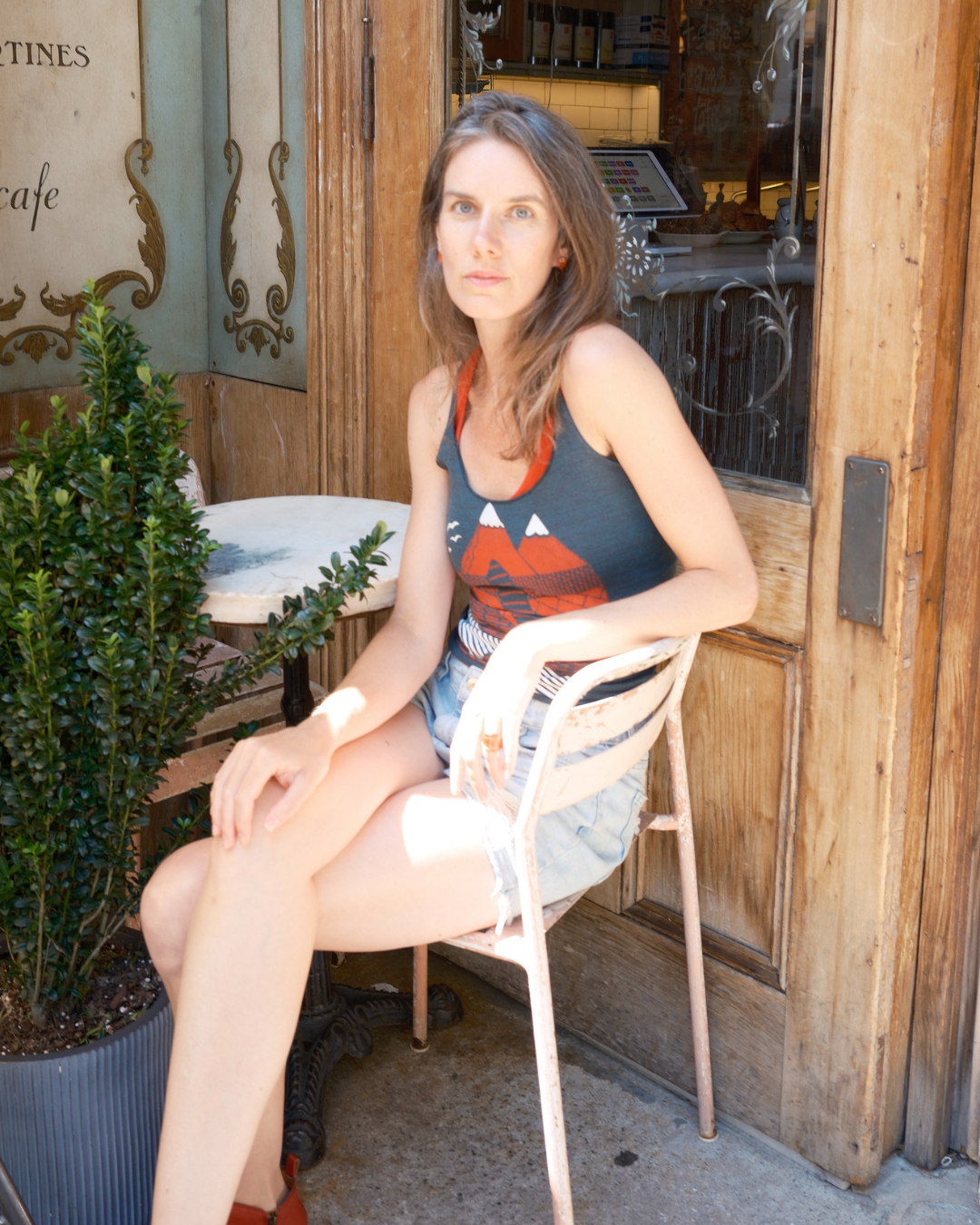
Photo: Leslie Jamison. Credit: Hengzhi Huang Yang.
Leslie Jamison is an essayist and novelist based in New York City, although she is originally from Los Angeles. She is the author of two novels (The Gin Closet; The Daughters), two memoirs (The Recovering; Splinters), two essay collections (The Empathy Exams; Make It Scream, Make It Burn), and is a contributing writer at The New Yorker. Jamison is a graduate of the Yale PhD program in English, the Iowa Writers’ Workshop, and Harvard College, and is now Associate Professor of Writing at Columbia University. Her newest novel The Daughters comes out in February 2027.
I first met Jamison years earlier as mutual admirers (or fearers) of our college literary magazine. The extraordinary sensitivity to the body I found in Jamison’s writing, whether oriented towards the world—medical actors, extreme runners, Morgellons patients—or subjects within herself, resonated with my own growing belief in mutual recognition as the foundation of empathy. Yet what does it mean to expand beyond a dyadic frame of reference (e.g., a doctor-patient interaction) to create an empathy that could work at scale? To step into all the world’s shoes at once?
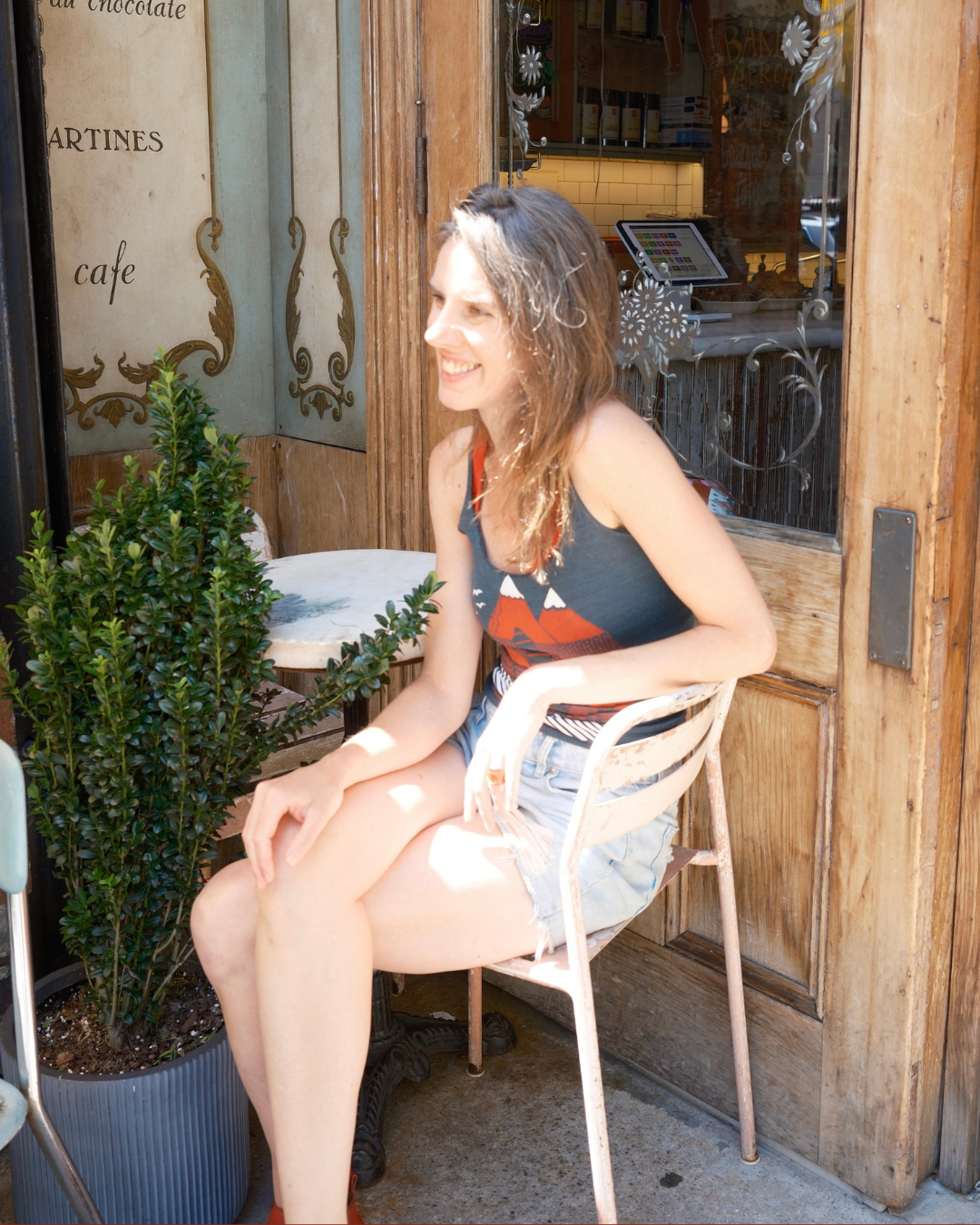
Jamison and I met at Bakeri Cafe in Greenpoint, near the sun-lit home she lives in with her family. We discussed the Eiffel Towers, self-systems, tattoos, and the other partial-selves that comprised the tall woman I was sitting across from. At one moment, Jamison shared with me the shelf of books that her students had written. What to make of all these volumes? All these frames of view? By the time Jamison had to leave to pick up her daughter, I could start to see a plural world taking shape.
Our conversation has been edited for clarity and length.
FRANK Y.C. LIU: We’ve corresponded about how poverty, disease, and other forms of suffering that require empathy at scale are told, especially in philanthropic writing. What draws you to that problem?
LESLIE JAMISON: During the first few years of my PhD, I got interested in the depiction of poverty in the philanthropic sphere—I remember close-reading fundraising campaigns from a women’s aid organization that would give you stories of women developing their livelihoods—it was probably a microfinancing venture—and how they had used the money. The literary snob in me looked at these pretty formulaic stories and thought, Okay, they’re packaging everything with a bow: you give X money, and somebody’s life improves in Y ways. But how can we do better? That’s how I got more broadly interested in literary depictions of poverty—an aspect of human experience I thought literature should be able to touch, but that, as a chronic condition that resisted epiphanic turning points and resolution, ran against so much of what I’d been taught to value in literary craft.
I was also looking at that narrative problem in order to try to imagine better, more complex forms of storytelling. How can you tell truthful stories about the experience of poverty that actually feature the human psyche in powerful ways, and suggest the possibility of some kind of transformation, without being totalizing or falsifying? I was influenced by James Agee’s Let Us Now Praise Famous Men and William Vollmann’s Poor People—both writers were consumed by poverty’s ubiquitous invisibility, and struggling with how to narrate an often plotless condition. Poverty can have a trajectory, of course—the great American romance of upward mobility, the Horatio Alger story, or its dark cousin, the descent narrative of Wharton or Dreiser. But Agee and Vollmann were getting at something more chronic: a poverty shaped by coincidence and circumstance, by not controlling the forces that shape your destiny—an ongoingness, an absence of interiority, that narrative is often understood as inherently allergic to.
FL: You’re the daughter of a public health professor and a global health economist. That must have affected your thinking.
LJ: The question of invisibility hits close to home, because I’ve internalized how my mother has spoken to me about public health as something that disappears when it works—if a measure is working, you can’t really measure what it’s done, since people just aren’t getting sick. It’s the best strategy but the worst story, a story about something that didn’t happen. But that’s yet another reason to pay attention to gaps and absences—to the human lives whose experiences don’t make it into the case count.
I teach a class at Columbia called Archive Fever, on how archival work shows up in creative writing. One of the big things we spend the semester on is what’s not in the archive. What do you do with that absence? Does animating it betray the absence, or perpetuate its violence by reinstating it? We read a lot of Saidiya Hartman’s work—she has an essay called “Venus in Two Acts,” where she revisits her own impulse to invent a fantasy of friendship between two girls on a ship in the Middle Passage, then dramatizes on the page the question: who was I consoling when I invented this intimacy? She wanted to resist the ways these girls had been turned into statistics, lost property, casualties, or absences.
There’s something beautiful about naming the fantasy and writing her encounter with the archive almost as a story—rather than offering the speculation itself, or cutting it out entirely once she’d critiqued it. Instead she preserves it and then critiques it, which is the most honest way to honor it: here’s what I tried to do to fill the absence, and here’s me second-guessing that decision, and I’m going to give you all of it.
FL: What’s your own relationship to self-critique?
LJ: If I were to chart my relationship to self-critique on the page—the trajectory of what was once a kind of terminal devotion to it, which I hope has given way to something more supple and complex—I’d say it started when I first began writing personal narrative. That really began for me at Iowa, where most of my workshops were fiction, but I took one nonfiction workshop.
I was so terrified of seeming like I was trying to make myself look like a good person, or a victim, that I leaned really hard in the opposite direction. I was like, Let me shovel out the least appealing, most self-condemning anecdotes I can find. I remember one guy in workshop saying, Is there such a thing as too much honesty? Because I really hate this narrator. On one level, when he said that, I felt like I’d done what I set out to do. On the other hand, I thought, What have I done? I also did this thing that my friend Greg helped me understand as a kind of ethical humble-brag: narrating something that wasn’t actually that bad—retreating a little from a friendship, say—but then coming down so hard on myself on the page that it almost seemed like I only offered the flaw in order to perform how hard I would come down on myself for it. To the extent that I do believe true self-indictment can be useful, it’s almost always part of a larger, more complex portrait.
Of course real indictment happens through specificity of what’s being narrated, rather than in the abstract condemnation layered on top of the anecdote. When you indict yourself in the abstract, it almost always ends up looking like you’re actually evading something while simultaneously wanting credit for not evading it. How can it hold not just self-indictment and some sort of compassion or forgiveness or generosity toward the self, but also genuine self-curiosity that hasn’t already decided on the moral of the story?
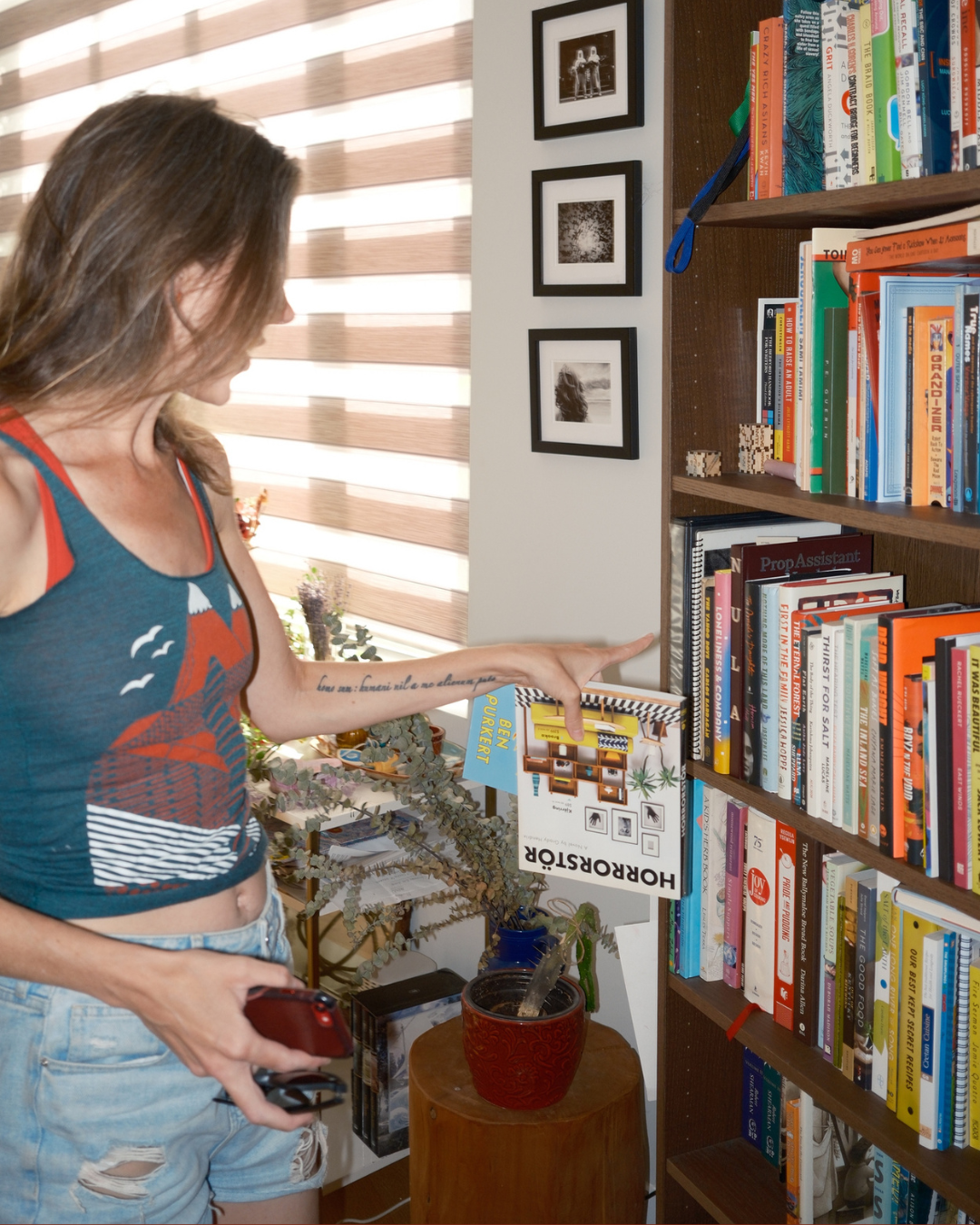
FL: I’m reminded of a passage in your memoir Splinters, where you discuss the wedding to C and later regret, yet you emphasize that the love of the moment was genuine: “Years later, I found myself bewildered by the woman who got married in Vegas—humbled by the residue of her choices, angry at her for all the harm she’d caused. So I handcuffed her with the anecdotal version of our Vegas wedding because I was afraid to let her hands go free, to let her protest, No! There was something beautiful that night, something you actually believed in.”
LJ: For me, one of the most fruitful ways to think about the relationship between the present-tense narrator and all the past-tense selves being written is to treat them as people with a layered relationship—layered in the ways of a romance or a friendship. Shuttling between these two selves, rather than staying locked on one or the other, is how I try to approach it—and that fluidity of shuttling between is also how I like to think about empathy. It’s like, here’s what I’m hearing or apprehending from you, but also, how can I recognize everything in me that shapes what I’m able to see—the limits of my vision, the biases I’ve been bringing? To stay fully focused on the self obviously won’t produce empathetic attention, but to stay fully focused on the other, without recognizing all the deformities and quirks of the perceiving self, is similarly limiting. You have to keep moving your attention back and forth.
With retrospective narration, you don’t have to either condone everything the past self has done or rail against all of it. There was a moment I loved in The Scar by Mary Cregan, which is about decades of suicidality and depression. Cregan renders a scene where she’s on a psych ward, left unattended for a few moments in the shower, and tries to cut herself with a piece of broken glass—I don’t know why she had a glass bottle, maybe it wasn’t a very good psych ward—but in that moment she steps out of the narrative to name all the things she feels toward her younger self. I’ve been angry at her, because she was basically trying to kill me. But I also want to protect her. I’m ashamed of her. I’m angry on her behalf, at whoever was supposed to be protecting her. Just naming all of those feelings felt so imminently true to me.
Of course, you can’t do that over and over, or it starts to feel burdensome and cluttered. But at key moments—where you notice the present self’s anger at the former self—I do think it can be useful to name and even narrativize the relationship.
FL: Who are the former selves you come back to?
LJ: The psychiatrist Harry Stack Sullivan has this idea of human personality as something he calls a “self-system,” made up of different parts and shaped by early caregivers: there’s good me, bad me, and not me. So smiling and being agreeable might become part of the good me, because they get a good response—people like us when we smile. And crying, raging, throwing tantrums might get conceptualized as part of the bad me. And then something so shameful that it becomes the not me. Like being, I don’t know, sexually involved with a dog for an afternoon and your parent catches you.
FL: Oh.
LJ: Something you can’t even conceive of as part of yourself. This is fiction by the way! I’ve always been interested in how we can reclaim the bad me and the not me as part of the self-system. But what I lost sight of in the early days was that if you only represent the worst part of the self, there’s nothing asking the reader to see it in a more redemptive, or even a more interesting, way.
With The Empathy Exams, what was so energizing about writing those essays was that they were a series of experiments in doing the thing I loved so much in fiction. Namely, thinking about the complexity of a given self—my own, or somebody else’s—the kind of grace I extend to characters in fiction—but also dramatizing how fully other selves could or couldn’t be seen. That’s always felt to me like one of the central attempts, and problems, of fiction: how fully can a character be rendered, and how do you also become aware of the limits of what you can see in that character?
And so I turned away from critique is the only form of rigor toward complexity is the form of rigor I’m more interested in. I really mean it, but I also hear a kind of internalized, collective judgment: that’s trite, that’s saccharine, that’s cliché, what does that even mean? And then I think, Yes, that’s exactly what I want to say. Even the final line of that book—it could only be the end, not beginning—was, “I want our hearts to be open.” And I thought, I can’t believe I just wrote that. But I mean it. I want our hearts to be open. So I preserved all that in the lines themselves.
FL: Well, The Empathy Exams begins with the epigraph “Homo sum: humani nil a me alienum puto.” “I am human: nothing human is alien to me.” It’s another beautiful formulation of admitting to being open to the world. Do the bad-yous and not-yous ever feel alien to yourself?
LJ: I think of self-relation, self-acceptance, even just self-engagement as a struggle rather than a given—more intriguing to me than the idea that I’d just naturally be at peace with all of it. Joan Didion said it’s a good idea to stay on speaking terms with all your former selves, and I like that, because “speaking terms” is still pretty capacious. You could be on antagonistic terms or amicable ones, but the point is to stay engaged somehow. For me, having a compassionate view of the former self means that every time I catch myself flattening a former version of me into whatever I need her to be—naive, callous, self-absorbed, humorless, whatever—I try to name that flattening and see past it.
The scholar Michael Warner writes about the conversion narrative as a beloved American form, a kind of impossible fantasy—a complete disavowal of the prior self. I’m much more interested in inconvenient continuity than conversion. Even when a self is quite different from its prior self, what remains the same? What can we still relate to, or learn from, or be surprised by, in a prior self?
In that vein of surprise and humility—trying not to just rest in the part of myself that judges my prior self for being a fool—I’ll say that my relationship to my tattoo, which is also the book’s epigraph, has been evolving since I got it. When I first encountered this line from Terence, my relationship to it was completely sincere. I was interested in the moral summons of not turning away from any prior self, or from anyone, and that the forms I feel most aversion toward are probably the ones I have some powerful attachment to. And then the poet Anthony Madrid asked me, Well, have you read The Self-Tormentor, the play by Terence that the line is from? And I said, no, definitely not; I just have a line from it inked onto my body.
FL: And I just quoted it to you without having read it either.
LJ: It’s an ironic line—it’s a gossip at court excusing his own gossiping, because, Oh, nothing human is alien to me.
And I thought, Huh, maybe I’m an idiot. I have this tattooed on my arm in total sincerity, and it’s actually kind of a joke. But then that started to interest me, because it connected to the way I was living into my relationship with the line—living into it more as struggle than dogma. The way I currently relate to it is less as an assertion of fact—I understand every human experience, I connect with every human experience, I can see every human experience—and more as I am interested in not turning away from any human experience, being open to what I might share even with the impulses, tendencies, and ways of being I might want to disavow. But I’m also interested in all the ways it’s impossible to actually have no human experience be alien to you. And that impossibility is—
FL: At the heart of empathy. To share the experience of the one and the many.
LJ: Yeah. In that way it feels like an accurate epigraph for The Empathy Exams, because the book of course isn’t making some grand, totalizing argument that empathy is great and we should all have empathy for other people.
I mean, what is empathy? We throw the word around as if it were ever possible to really understand what it’s like inside another human being. But that’s an impossibility, and we have to start from that as the baseline. So when we urge ourselves or other people toward this thing, we’re urging them toward an impossible asymptote, rather than an achievable state. That doesn’t mean there’s nothing useful in what we’re urging ourselves toward.
I feel the same way about the quote. To urge oneself toward a human experience rather than turning away from it doesn’t have to mean making a flat argument about human emotion. There was something about realizing that I didn’t know the first thing about where the quote came from that broke it open a little. It made the whole thing more humbling, a little funnier; it held a little more human experience. And I learned I was in good company, because Montaigne had it on the wooden ceiling of his study. Marx loved it. The clerk at the pharmacy loved it. Et cetera.

FL: It strikes me that’s the problem of empathy at scale—you can only take in one self, one moment, at a time. Perhaps another way to put that is we experience things in discrete chunks. You read one word at a time. There’s no such thing as looking at the whole picture at once.
LJ: When I was an undergrad at Harvard, I remember my professor Lynn Festa bringing in one of those tiny Eiffel Tower souvenirs on the first day of a class on eighteenth-century travel narratives. She asked, Why are we so obsessed with going to the Eiffel Tower and getting these little Eiffel Towers? Part of it is that you can take it home, of course. But the point she made that really opened something up for me was that when you hold it like this, you can look at the whole thing at once. When you’re actually standing beneath the Eiffel Tower, you can’t see it—when you get really close to something, you limit your gaze, because you can only see a part. It’s the same observation about how one apprehends a novel: at any given time you can only engage with a tiny bit of it, yet there’s a desire to see all those little bits of information at once.
I’m really interested in the way that, in temporal narrative, at any given point in your reading you don’t have access to something. When you’re reading the first hundred pages of Anna Karenina, you don’t have access to the end, and when you’re reading the ending, you no longer have access to the innocence of not knowing how it’s going to end—so it’s not that one vantage has total knowledge and the other doesn’t, you just have access to different pieces of it.
Nina Siegal, a wonderful novelist and journalist and my housemate years ago at Iowa, wrote a really tremendous work of nonfiction called The Diary Keepers about Dutch diaries during World War II—at the end of the war, Holland put out a huge call for the public to turn in their diaries, becoming a mass national archive of thousands of diaries.
FL: That’s incredible.
LJ: One of the things Nina talks about is that we’re used to granting weight to the retrospective gaze, since it knows what happened next. But these wartime diaries grant access to something impossible to reconstruct, which is people’s partial knowledge in the moment, before they knew what was coming. The national Dutch narrative can skew towards asserting that ordinary citizens didn’t know much about what was really happening in the concentration camps, but the diaries show a complex mixture of knowing and unknowing—bits of knowledge pushed aside because they were too horrible to comprehend.
That idea—that something is lost once you know how things turn out—is a useful corrective against the assumption that everything becomes available in retrospect. James Baldwin puts it well in The Fire Next Time, describing his decision to become a street preacher at fourteen as happening “out of a deep, adolescent cunning I do not pretend to understand.” That admission, that his adult narrator doesn’t fully know his prior self, is such a useful corrective to the idea that we just know more and more until we die. I’m very interested in the partiality of vision and knowledge, and in thinking about incompleteness as dynamic rather than as a liability.
FL: Has incompleteness ever been something to solve, not just notice?
LJ: In The Recovering, I wanted to write a book that drew on the form and structure of the recovery meeting, which I’d found so powerful and saving: a chorus of voices. It was unthinkable to me to tell the story of addiction and recovery as a singular story—
FL: But a book can never actually be a chorus. You can’t have ten people talking at the same time in a book.
LJ: Absolutely, the limits of my writing were something I was interested in owning rather than denying. And in fact the structures of writing ring true to the experience of sitting in a meeting: you’re listening to everybody else’s stories, but you haven’t lived any of them. You inhabit your own in a uniquely immersive way. It strikes me, as we’re talking, that my interest in narrating recovery shares something with that early interest in narrating the chronic—being interested in the chronicity of poverty as something fundamentally resistant to narrative. I wanted to make recovery as interesting as getting fucked up. In that way, it was almost a similar animating perversity to before: how do you tell these stories about things that make bad stories, going to meetings in church basements, but that are also, of course, important to tell.
FL: In The Gin Closet and The Daughters (coming out in February 2027), the plot moves across decades and even millennia. Does fiction let you stay inside a moment more fully than nonfiction can?
LJ: In The Daughters, I got to have the most reckless and explosive relationship to time that I’ve had in any of my books. It begins with the story of the Minotaur and his mother, so there’s a plotline set in ancient myth—a kind of feral world full of blood and stone and milk. Then there’s a plotline set in 1944—about a woman who becomes obsessed with the myth—that gets to live in mid-century America: meat rations, Peggy Guggenheim’s wartime art gallery where there’s a Jackson Pollock painting named for the mother of the Minotaur, belted shirtdresses, and suburban claustrophobia. And then there’s a plotline about a cult! Set in 1997. For that one, I got to write about Princess Diana’s death, Mother Teresa’s death, the Heaven’s Gate cult. All these things that were part of my fourteen-year-old consciousness but are now just the stuff of historical fiction.
One of the fundamental questions of the novel is how we take the stories of the past and reshape them to suit our purposes in the present. So I’m fundamentally interested in the way two different women engage with the myth of the Minotaur—what they need it to be and do, to give them a home to live in, to give them a way to understand their own regret or guilt or love. That question, How does a myth or story become something radically different for each person?, is a really beautiful, interesting one to me, and it was fun to play it out across these vast temporal distances.
FL: What draws you back to fiction?
LJ: I had a couple of attempted works of fiction, and even a couple of manuscripts that I finished and put in the proverbial drawer. Which, in my case, is a storage unit in New Haven I haven’t visited in a decade. So it’s not that I ever felt I’d totally turned away from fiction. But with The Daughters it was somehow important, or very energizing, to write it when I felt I was supposed to be writing something else! I have a word for this—I call it the “mistress” genre. Whatever isn’t your official project at a given moment has a transgressive charge and energy to it. Fiction got to be my mistress again.
Fiction offers me freedom and a kind of extrapolation as confession. Fiction lets me take certain aspects of my autobiography—forms of ambivalence, of wanting to tear down my life and free myself from it—and play those impulses out on a different scale, in a different theater, in a life that was utterly not my own. It let me tell the truth about a certain set of feelings not just by displacing them onto other lives, but by planting them as seeds and letting them grow into strange, wild blossoms.
Fiction can feel like a way of exploring a certain dark crevice in my own psyche that I couldn’t explore in memoir. It’s almost like my own life is the door at the front of a funhouse. I open that door and follow it into some other wild narrative I’ve never lived. My own living has just dropped me off at the doorstep. Then I cross the threshold into fiction and follow those darker, deeper, more ferocious places. It just feels like a different kind of truth-telling.
FL: Are you ever afraid or worried about your daughter one day reading these stories?
LJ: No. She’s intimately involved with it. Here’s a picture of her holding The Daughters. Within moments of my handing her the galley, she’d identified a typo! I was like, amazing. If she ever wants to read the book—I try not to assume she would!—I’d tell her the truth, which is not that any single character is me. There are many characters in the book, and probably each carries around inside her something I’ve felt, but none of those truths is a totalizing truth.
My daughter has such an amazing, sharp mind—she can recognize my crutches and verbal tics in a heartbeat. If she’s suspicious of anything in The Daughters, it’s not the depiction of motherhood but a certain ethos of compassion she’s learned to sniff out. When she read the back copy on the galley, about the mother of the Minotaur giving birth to “a creature the world calls monstrous,” she said, “Ugh. You’re always talking about how some people think other people are monsters, but they’re actually not.”
FL: Wow, she got it.
LJ: Totally calling me out on my brand. She’s probably my best reader. My most astute reader. She likes to give me a hard time for my default moral crutches, but then she’s actually the most big-hearted person I know.
FL: Of course generational gaps are always overly broad generalizations, but do you feel our cultural relationship with the personal essay has changed?
LJ: For me, personal narrative is one of the oldest narrative technologies we have: a thing happens to me, and I want to tell a story about it. I’m never going to be the person telling you the era of the personal essay is dead because the work of making meaning from what we’ve lived, and turning that meaning into art, will always feel valuable to me. But the politics of why personal narrative matters now, I think, has a lot to do with representation and visibility, which is what we’ve been talking about today. Personal narrative is a way to make visible lives we often forget, or lives that get left out of dominant cultural scripts and stories.
Visibility isn’t always a good thing, of course. The scholar Caleb Smith—who was one of my dissertation advisors at Yale, and who has also become a good friend in the years since—is much more of a skeptic than I am in certain ways, but I like the ways our skepticism and enthusiasm speak to each other. For example, he worked on a manuscript he found at the Beinecke Library called The Life and the Adventures of a Haunted Convict, by Austin Reed, the earliest extant memoir of incarceration by an African American author. Part of his argument is how it draws on a lot of different genres—a bit of the ballad form, a bit of the rogue’s-tour narrative form. There’s even parts plagiarized from other texts. But his whole point was that the author didn’t want to be fully visible. He was a fugitive, so he was telling his story while disappearing behind different sorts of narrative camouflage. That idea has really stayed with me—that it’s a mistake to assume everyone wants to be visible, or wants to use narrative as a tool of self-expression
And Caleb’s most recent book, Thoreau’s Axe, is about regimes of attention in nineteenth-century American literature—the way attention can be a coercive device, in schools, for instance. I asked him, On a human level, don’t you think there’s also something good about attention—about paying devotional attention to the things we love? He found that question interesting. People, forces, institutions, and technologies try to control our attention—so what would it mean to reclaim it?
FL: To direct attention on purpose.
LJ: For me, the possibilities of personal narrative also reside in its multiplicity—personal narrative often gets associated with solipsism, but if you really believe in it, you’re advocating for something closer to the opposite of solipsism. A reading culture in which we are constantly getting outside of ourselves by reading the stories of others. I teach a lecture at the MFA program at Columbia called “The Self” that has about sixty students in it every spring. It’s them—those students—that I believe in.
I think of personal narrative as an essentially multitudinous form. It’s not about “my story matters more than anybody else’s.” It’s that they all matter.
FL: I want to listen to all of them.
LJ: Which—to your point—is impossible. One can’t pay attention to all the stories of all the people at once. But one can encourage everybody who wants to write to tell their story.
FL: All perspectives are limited, and I think that’s all right.
LJ: Yes, the limits of a gaze are also what make it singular. Unique. Which is why I believe in reported work that can also confess the subjective gaze of the one doing the reporting. Looking at other people’s lives, telling the stories of other people’s lives: believing in the possibilities of the outward gaze, while still holding on to some of that critical awareness and energy. I can see how the fear of doing it wrong can be so overpowering that it makes you not want to do the thing at all.
FL: I’m reminded of “checklist item 31—voiced empathy for my situation/problem,” from the titular essay of The Empathy Exams where you’re a medical actor for a student doctor’s graded evaluation. Of course we all know that performance has its limits, but if it really does improve patient outcomes, perhaps that’s what matters.
LJ: I’ve always struggled with the ways it can feel more vulnerable, or uncool, to make the case for the possibilities of something, rather than critiquing it—because it feels like maybe I’m defending a thing that somebody with a more cutting, perceptive gaze will see the limitations of. It can feel like you’re risking foolishness by saying, “I believe in this,” or “I love this.” Over time I’ve come to accept that, temperamentally, I’m more of an enthusiast and a believer. That doesn’t mean the world would be better if it were made only of my kind. But I want to help create a culture where we’re not just talking about narrative as a form of violation or exploitation, but are also alive to narrative as a tool of illumination.