
SPRING/SUMMER 2026
Loch Ness
Maia Siegel
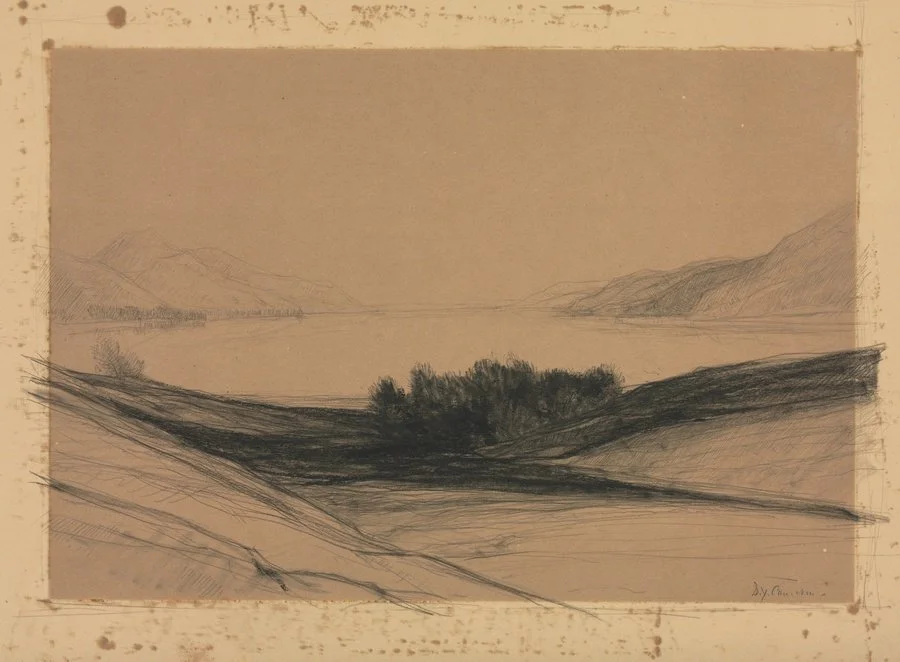
Art: David Young Cameron, Loch Ness, Scotland, c. 1885–1940. Public Domain.
I was looking for the monster, along with everyone else. The true monsters, I thought in the voice of my father, who generally disdained ugly people, are all around me: tourists bulging out of their casings and shells, eyes bugged open. In the windows of the sandwich cafes lining the lake, I could see that I was one of them—I was one of the slovenly tourists looking for a monster that I knew didn’t exist, priding myself on my good humor to look anyway. I had paid thousands of dollars to point at bubbles in the water, to take photographs of the boat’s shadow moving slowly forward. A tour guide would shuffle a group of us around, and I was often the only person who had shown up alone. Everyone else was retired and married. The tour guide would skip over me in the introductions, assuming I was somebody’s child. I never corrected him.
No one had liked my silence on this matter, especially the couples who were left to claim me. They shifted in their seats, joking with the tour guide up in front so that they didn’t have to look to the side, at my seat near the bus window. I had been excited to be ugly in Scotland, a place where most people were ugly. This, I thought, would give me time to focus on the real work. I wouldn’t have to think about the flaking skin on my scalp, the mats in my hair. Everything would be very serious.
Whenever you are alone, a task becomes very important to you. It did not take long for me to latch onto the monster, first as a joke, and then more as a quest. I had always wanted a pilgrimage. I had wanted to hike the Camino, but I grew worried about earning the diploma of completion, and earning the diploma meant crawling the last bit or doing it on horseback. I pictured myself dutifully crawling for miles and miles over dirt and then being kicked in the head by a trotting horse. So I wouldn’t even get the diploma in the end.
What I liked about the Loch Ness monster was that it wasn’t even scary. It was like fearing a guppy. It was like looking for an otter.
I stayed in a room in the house of a portly yoga teacher, whom I was scared of. I had booked it for a month, because there was a bulk deal that way. The room had been very cheap on Airbnb, which I realized when I arrived was because her house sat very far from the lake, with a single bus every hour to take you there. For many days I did not speak to her, as if this was her fault. Instead, I carefully and methodically looked for booby-traps in my room, double-sided mirrors, faulty locks. Sometimes she would seem to be swapped out with a slightly different woman, who was paler and taller, but I didn’t want to say anything about this, in case they were married or sisters or mother and daughter. She never mentioned the fact that there was another woman in the house, and I started to make up my own stories about the other woman. I told myself she was the yoga teacher’s developmentally disabled adult daughter, and whenever I heard rustling outside, in the garden, I would imagine her running in the back. This was somehow comforting.
My mother had had a similar situation with her sister. The sister had been sent away to a facility in New Mexico. My mother was a great beauty, comparatively. Her skin had always looked translucent, with long blue veins bumping near the surface. My mother’s sister had nothing going on underneath.
One of the few times I visited my mother’s sister, it rained, which felt like a harbinger of something horrible. It collected in the desert’s mounds, swirled like toothpaste spit. We brought my mother’s sister out to look at the puddles, the damp spots; she held my mother’s wrist like a guard rail, careful not to touch anywhere the rain had darkened. My mother had lent her sister her raincoat, which was expensive and waxed. When they walked ahead of me, I felt my eyes twist up, cross. At one point my mother paused, I thought, to tie her shoes. Instead, she reached her sister’s finger down to a puddle, forced her to touch. I don’t know why; we never talked about it afterwards. A small finger dipped into the dark. A howl came from her raincoat, the sound shaking and screeching and shoving off its wax coating. The sound crouched to the ground, its breathing muffled by the sand, and we had to get a staff member to pull the limp, crying woman back inside. My mother and I left immediately; we didn’t care about waiting out the rain.
The yoga teacher had a medical skeleton in the hall, which stood facing my room. Sometimes it would wear a jacket and sometimes it wouldn’t. I took this as a warning for me, as I thought it was aggressive to face the skeleton towards my room. I imagined her dressing it like a toddler, easing each skeletal arm in at a time.
There was a virus outbreak at my mother’s sister’s facility a few years back, and my mother’s sister died after fluid filled her lungs and she couldn’t cough it out. It had been a very expensive facility and we were all confused on how it happened. I wasn’t very sad because I hadn’t seen her in years—the facility was only accessible if you went up there on the highway, and my mother didn’t like driving on the highway.
At night, I would hear a great hacking cough from the yoga teacher’s side of the house, which could crescendo and then quiet on loops that lasted entire minutes. I would wonder if it came from her or from the pale woman. The yoga teacher never looked sick when I saw her for brief moments during the day, closing my room’s door before I barred it from the inside. I thought it must be the pale woman, and that was why she had to run outside at night, to get fresh air.
I met up with the tour group at the lake every morning, and then a bus would take us around for other angles if we didn’t go searching on the water, which required us to take the ferry. The ferry cost extra. I hadn’t realized until I arrived that the longest lake tours were three-day excursions, so I kept rotating tour companies, pretending each time that I was new to the whole endeavor. I tried to avoid going to the sandwich places near the lake so that they wouldn’t treat me like a regular when my current tour group walked in, binoculars swinging from our necks. We all treated our binoculars as a joke, a silly way to lean into the bit. But we all wanted to see something, and when the tour guide pointed to a bubbling, our necks snapped to follow his finger. I kept asking the married couples to take photos of me with the bubbling lake spots, but they would always take them from awkward angles, and while I was blinking. I started to suspect that they did this on purpose, because they hated me.
I went to a horror movie alone on one of the days it rained hard in Scotland. It was always raining hard in Scotland, and then it would suddenly lift into a limp mist hanging near the train station’s Starbucks sign. The theater was empty except for me and two young men. Two blokes and a bird, I thought of saying into the dark theater, and maybe they would laugh. I remained silent and pursed my lips. The movie attendant closed the door of the theater on us and I was sure I was going to be raped. The men sat in my row, one seat away, so it looked like we had walked in together. It was almost comforting, after I was sure they weren’t moving towards me; we were a trio.
The movie came on and it was very quiet. There was no backing music, maybe to cut production costs. Most of the movie was from the perspective of the monster, who was always walking around aimlessly, trying to find the next person to kill. Victims were much easier to find than monsters. After the movie finished, the two young men turned to me and said, “Weird one to see by yourself, yeah?” Then they shuffled out, leaving me in the dark.
The next day, out by the lake with the tour group, I decided to attach myself to the Finnish couple in my bus row, a bald man in round glasses and his wife in a green coat. She walked incredibly carefully, as if there were grenades in her path. I offered to take their pictures next to the lake, and to make sure I got them with their eyes open. The wife stepped back, right into the railing near the ferry. I heard the little clink of her back against the metal. She grimaced and the bald man collected her, shuffled her back into the bus. She pressed her binoculars against the bus’s glass window, towards the lake. He went back out to look for the monster, and I watched her watch him look at the lake. Neither seemed to see anything of interest; they just kept scanning the horizon.
I climbed into the bus, taking a seat next to the wife. Her green coat was propped up and holding its shape on the chair beside her, like an invisible person.
“Did you see anything out there?” I asked the wife. She shook her head.
“I did,” I said. “I saw something big.”
“Really?” she asked, not meeting my eyes, rubbing the small of her neck. “I saw a tail,” I said, committing. “It was long and black.”
Everyone else filed back on the bus in a single-file line. The woman didn’t tell her husband what I’d seen. The green jacket held its shape on the bus seat until he sat, replacing it. I had outed myself as a secret believer; I wanted to see the monster.
Back at the yoga teacher’s house, the night coughing stopped. The skeleton facing my room was bare; someone was wearing its jacket out. I imagined the pale woman throwing it on while running down the street, past the bus stop, past the lake, past the cool monster’s head, smooth and dark, lapping the water.
I wanted to see her, the pale woman. The sister, the maybe-daughter. I imagined her with a tail, peeking out from under her long coat.
The next morning, the skeleton was still naked, the house empty. The yoga teacher’s room stood open and dark across the hallway. I walked in, straight towards her closet, where a row of floral Arket blouses hung limp. The room was crowded with purple cracked crystals, wooden Buddhas, vials of essential oils. The jacket’s waxy olive arms were not there.
I turned around, leaving the closet door wide open. I walked out into the street, which was shining with wet, narrowing over the hills. I started towards the lake, the only destination I knew in Scotland. There were miles of brown cement between us, fast-food chicken stands and shrubs.
I walked past the movie theater, which was empty this time of day. The marquee still listed the horror movie from weeks ago. I thought of my companions, the two boys, our silence. When I pictured them turning back to me, sitting alone in the dark theater, it was from their perspective: the movie screen white with credits, my face lit up with the names of actors, cameramen, stunt doubles. The other velvet chairs folded and dark. We had not been a trio, I knew; they had been a duo, and I was on the other side of the memory. But I could remember it from their side, as if I had left with them. If I did this, it felt like I had been gone a very long time.
I kept walking, past souvenir shops and pubs, churches and tour buses. The cement cracked and narrowed.
A woman was walking on the other side of the street, her rain jacket long over her back, blonde hair pressed close to her skull in a bun. I crossed to follow behind her. She was taller than me, and the crown of her head was so pale it was almost green. She coughed some greening gunk out the side of her mouth. It landed on the street, next to chip wrappers and disposable dental flossers. Her hips swayed as she walked, which I started to do, too. We swayed in concert. I felt a movie enclose me in its frame, its backing track missing, my stomps forming the rhythm of the monster. There were victims all around me, women running in the dark, disappearing in lakes, drowning in the muck. I felt my flash of white credits; I was part of the cast.
The muck rose up around me. The woman in front of me started walking faster. My feet moved to match. I felt my eyes cross in a way that felt warm. The woman’s hair fell out of its bun, its scraps hanging limp at her neck. Her rain jacket moved to the side, and in the dark I could see, I could see. A flicker underneath the wax, a thrum. I didn't need binoculars. Here she was. Now.