
FALL/WINTER 2026
Na Zhong Renews Family Narratives with Imagination
interviewed by Jianan Qian
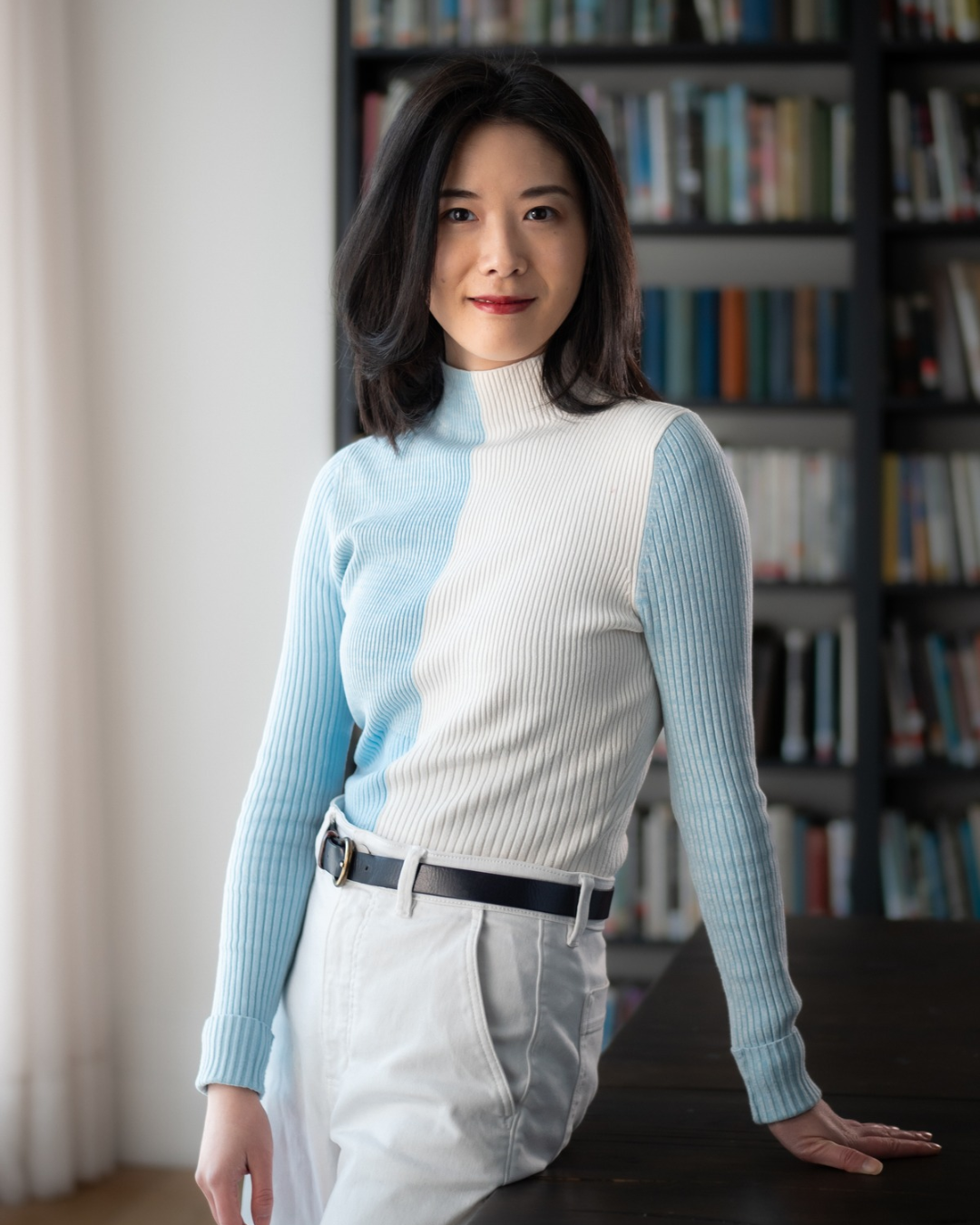
Photo: Na Zhong.
Hailing from Chengdu, China, Na Zhong is a fiction writer and literary translator based in New York City. A MacDowell Fellow and a Center for Fiction Susan Kamil Emerging Writer Fellow, she is the author of the novella Three and the novel Travelers Must Be Content. She also writes a column for China Books Review and is the co-founder of Accent Society. In her native Chinese, she has translated Sally Rooney’s first three novels—Conversations with Friends, Normal People, and Beautiful World, Where Are You—co-hosted the literary podcast 跳岛FM, and published numerous works of fiction and nonfiction in China’s leading journals.
Nearly ten years ago, I first met Na in New York City. We had both recently moved to the U.S. from China to pursue MFA degrees. She was enrolled in a creative nonfiction program at the New School, while I was in a fiction program in the Midwest. We talked about our struggles to make our adopted language sound natural, the expectations we faced when submitting stories about China to our workshops, and our uncertainty about who our readership was and to what extent we should accommodate it. In the years that followed, these persistent challenges prompted Na to do more. She continued to write and translate, but she also started the bilingual creative community for people navigating similar challenges.
In her new novella, Three, I find many choices original and wonderfully curious. All the characters are identified by single letters (N, F, X, for example). The cities are referred to in similarly coded terms, such as SH. Major social events are also alluded to without being explicitly identified.
Is this coded language a way to resist the pressure that writers from abroad often face to represent their countries of origin realistically? Is it a way to distance the narrator from the story’s more autofictional elements? Or is it a way to engage with the tradition of fairy-tale archetypes? Perhaps all these possibilities were on Na’s mind from the beginning.
We spoke in person and later over Zoom. Our conversation has been edited for clarity and flow.
Jianan Qian: It’s so good to talk to you, and congratulations on Three!
Na Zhong: Thank you so much. Yeah, it means a lot that you enjoyed it.
JQ: I really do! I have so many curiosities! I’ll start with the very special title, Three. At first, I wondered whether it might have something to do with 三口之家, or a family of three, a particular family structure in the context of China’s one-child policy. Then, as I continued to read the novella, the number seemed to take on symbolic meaning as well. How did you arrive at a title and what does the number mean to you?
NZ: When I first started working on this project, I named it Family Fragments after Natalia Ginsburg’s Family Lexicon. With this particular project, I wrote a synopsis: there are three people; they form a family, and eventually they fall apart and enter the world separately as fragments of what they used to be. I think “fragments” means a lot as a concept to this novella.
But when I submitted the manuscript to my editor, she thought the title was a little too abstract. It’d be difficult to evoke an image in readers’ minds when they came across this title. She suggested that we brainstorm a few other candidates. And I proposed Three; after some back and forth, we decided to go with it.
Growing up, “three” has always been my lucky number. Now that I come to think about it, I picked it as my lucky number because it represented me and my parents. So, it definitely has something to do with the family structure. And because I’m so emotionally attached to the family structure, “three” begins to take on a symbolic meaning.
JQ: It’s a catchy title. I really like it too.
NZ: But it turns out, you know, there are quite a few books titled Three.
JQ: I didn’t know!
NZ: The other day, I went to McNally, and there was a novel titled Three by Ann Quin. Roberto Bolano also has a book Tres, which is Three in Spanish. Ryuichi Sakamoto has an album called Three. So many people have actually taken the title before, so it can be a little hard to find my book…
JQ: No, I don’t think so. Bookstores should have a shelf dedicated to all those numerical titles. You will have great neighbors.
NZ: That’s a nice idea.
JQ: I mentioned symbolic meaning because I felt you wrote this novella in a wonderfully coded language. For example, you give all the characters single-letter names. This seems drastically different from the advice many writers have received from their MFA programs, where they are taught to always make characters distinctive and psychologically complex—starting with their names. What drew you to this way of naming the characters and what possibilities did it open up for you?
NZ: First of all, the sort of advice that instructors usually give in workshops simply doesn’t apply to Chinese writers. Take my name in English, Na. When people say Na here, it’s such a simple word. They have no idea that it’s connected to a Chinese character that might have multiple meanings. Whenever I write about Chinese characters and give them traditional Chinese names in Pinyin, I’m acutely aware that half the meaning of their names will be lost on readers anyway. As for what remains, I can make some phonetic suggestions. For example, I might give a particularly harsh character a name that sounds especially aggressive. But that’s about all I can do. I don’t want to introduce every character by explaining what their name actually means in Chinese characters. I don’t think that’s an efficient way to introduce a character.
When I was writing this novella, I really wanted to get rid of all my obligations—the obligations I feel as a Chinese writer to explain myself to English-speaking readers. It was also a very intuitive decision. I had no idea I would call the woman “the woman” until I wrote the first sentence of the second chapter.
Names are very suggestive. They can be very revealing. Sometimes, just by looking at a name, we can tell a character’s race, gender, age, and perhaps even profession. But I wanted my characters to be as mysterious as possible. I wanted to introduce them in a way that left no preconceptions whatsoever, so they have the ability to resist easy interpretations. It was both an intuitive move, one that gave me permission to approach the characters and dig as deeply as possible, and, in retrospect, a way of rebelling against the expectations that arise when English-speaking readers encounter a Chinese story.
JQ: Now that you mentioned it, Chinese names are simplified in English. In Three, the woman never gets a name, not even a letter. Why is that?
NZ: Well, I think that by withholding information, people are claiming power. And the reason that the woman remains nameless is that she is actually the most powerful person in this fictional universe. She doesn’t need to be named. She’s the matriarch. How can you name a matriarch? No one has the power to name the matriarch.
JQ: Right.
NZ: I feel a certain pleasure in not giving her a name because she doesn’t need a name. It’s also a simple way to distinguish her from the rest of the characters.
JQ: That’s a smart move. As a reader, I did feel that even when the daughter, N, tells her part of the story—what is supposed to be an episode in her life without the woman—the woman is still there.
NZ: Exactly.
JQ: You also mentioned the expectations English-speaking readers have of a Chinese book. I find that your book makes no effort to explain China to readers who know very little about it. Many of the references are deliberately coded, yet readers like myself, who grew up in China, are able to decode them.
NZ: Really?
JQ: I think so. Some of these references are to major social events, such as the 2008 Wenchuan earthquake, while others point to specific geographical locations. Did you see your decision not to explain these references—or to leave them double-coded—as a deliberate way of resisting the pressure placed on writers from other countries? Or were you simply conscious of what you didn’t want to explain or represent?
NZ: I’ve treated about half the material in this novella in my MFA thesis, a coming-of-age story I eventually decided not to publish, because it wasn’t very good. I’d gone through every step of trying to explain myself in that novel, and it didn’t work for me. As a reader, I kept getting bored because I was explaining things I already knew. I’m not very patient, and I don’t want to repeat myself or explain things I’m already familiar with. Also, when I was writing that novel, my brain was functioning mostly like a translator’s. I was constantly thinking about how to translate Chinese experiences into English: How do I translate a particular food or dish? Should I preserve the sound of a street name, or explain it? How do I contextualize a particular event within a broader social and historical framework? In the end, I didn’t want to do that anymore. It was exhausting to constantly think about how to clarify things.
To be honest, in a way, I feel that we shouldn’t be burdened with the obligation to explain things simply because English-speaking readers know too little about China. In other parts of the world, we grew up reading translated literature. Whenever we didn’t understand anything, we either read the footnotes, looked it up in a dictionary, or searched online. No one complained about it. When the gap between readers from different cultural contexts is so wide, I think it’s almost unrealistic to expect a single writer to fill in every blank.
JQ: When the editors came on board later, they realized that the lack of explanation had actually become one of the novella’s strengths, right?
NZ: Yes, because in a way, I’m not burdened with explaining, and readers are not burdened with learning.
Everything works organically within the universe of the story. I actually learned this in my first workshop in my MFA program. Back then, I was writing an essay about my mother’s childhood. It began with something like, After the revolution is over, the landlord runs away, leaving this beautiful house behind…
Some of my peers in the workshop said, We need to know what kind of revolution this is, why it happened, who the landlord is, what kind of house it is, and where it’s located. My instructor said, Well, I don’t need to know. If a landowner feels the need to run for his life, then things have gone wrong, and that’s enough background information for the story to work. I’ve always carried that lesson with me.
JQ: Without explanations, the focus of the story has become much sharper. It’s not easy to do, though. As writers from the rest of the world, we might always wonder how English-speaking readers might receive our stories. The effort to adjust to that imaginary expectation itself may become a source of stress. If there is an intended audience, who do you imagine when you write?
NZ: When I reached the midpoint of this novella, I actually stopped writing. At the time, I was querying my first novel—the one I wrote after the coming-of-age novel—which was eventually acquired by Coffee House Press. But before that offer came, we’d faced many, many rejections, and I’d become really frustrated. I felt that the novel was written for an English-speaking audience, so I began to lose faith in my ability to understand my intended readers. I thought, if that novel was so difficult to sell, who would read this one?
This novella was different. I wrote it purely for myself, with no readers in mind. It was a selfish project, in a sense: a way to memorialize a chapter of my life and achieve some emotional catharsis. So when Joyland eventually accepted it, I was pleasantly surprised. I realized that sometimes you have to forget about your intended readers in order to reach them. Perhaps readers will find your book when you stop trying to imagine who they are and where they might be.
JQ: This is all very inspiring. Sometimes we imagine the others; we might add more assumptions or misunderstandings along the way. Back to the novella. I do think parts of Three read to me almost like fables or folktales but without the kind of moral that we often associate with those genres. And I was especially struck by the section in which N stays with her boyfriend’s family for the feast. What attracted you to the fairytale tradition? What can that mode of storytelling do that a conventionally realistic narrative might not?
NZ: When I revisited the material, I realized I wasn’t telling a new story. These kinds of things have happened millions of times throughout literary history and human history. The novella is about class, coming of age, and marriage—evergreen themes that many writers have explored before.
More importantly, these are standard elements of the fairy tales we grew up reading, like “Snow White” and “Cinderella.” That’s when it occurred to me that perhaps I could build a connection between ancient folktales and contemporary stories. Of course, there’s a lot of tension and many differences between them. Still, we keep seeing ourselves in folktales, and that’s what draws us back to them again and again. I think that’s the power of archetypes. With this novella, I really wanted to take advantage of archetypes and patterns because I’ve been obsessed with genres for some time. I’m always looking for ways to transcend linguistic and cultural barriers, and I think genre fiction offers a great deal to exophonic writers like us.
Archetypal characters have the advantage of being universal. We grew up reading the Brothers Grimm’s fairy tales, just as children around the world have. Those stories are immediately accessible, but there’s also something inherently mysterious about them. I think that mystery comes from the experience of being human: being born into this world and exposed to all the darkness, fears, anxieties, and uncertainties of existence.
In that sense, the novella feels quite existential to me. It’s also about time and the inevitability of being changed by it, of good things being spoiled by time. And fairy tales, as one of the oldest forms of storytelling, help evoke this sense of time in the story. They work almost like an ambiance. I really wanted to create that effect because time is such an important element in the novella. In a sense, one of the novella’s aims is to fight against the power of time.
JQ: By drawing on fairy tales, you turn a feast where two families meet for the first time to discuss a marriage into something beyond what I’ve witnessed in my own life. I can sense the darker elements lurking and brewing beneath the surface of the scene, and how fragile N is when confronted with class differences. That, in turn, gives me a new perspective on fairy tales—you know? In fairy tales, you often have these feasts involving an innocent girl. There’s usually a darker turn before the happy ending, which then seems to gloss over the harsher realities of what happens in between.
NZ: Yeah. I don’t know if you’ve read the original, untampered-with Brothers Grimm fairy tales. I haven’t read them myself, but I heard that they’re much darker than the versions we grew up reading.
I feel that fairy tales, in a way, have always served as a vehicle for expressing all the inexpressible pain and fear people are inevitably exposed to simply by existing in this world.
JQ: You also mentioned time being an important element in the story. China is very hard to depict as a place. It has changed dramatically in recent decades. But in Three, I have such a clear sense of the places, the movement, and also different epochs despite the fact that no specific place or time markers are used! How did you do that?
NZ: I discovered many of the approaches I used in this novella while writing the second chapter, which was actually the first chapter I wrote. Initially, I was simply retelling the woman’s story, but at some point, I felt that the current narrator needed to step in and offer a flash-forward to create a contrast. The narrator is so omnipresent and omniscient that she’s almost like the lord of time. She knows everything that has happened to this family in the past, what’s happening in the present, and what will happen in the future. So from time to time, she inserts a comment about what happens later, creating a contrast with the event she has just recounted. I found immense pleasure in doing that—manipulating time.
Whenever I think about family life, I realize that it never unfolds chronologically. Different layers of time are always compressed together, until it’s almost impossible to distinguish them from one another. I find that really interesting when it comes to how we form memories of our family narratives, you know? So many things get repeated within a family. Similar events happen again and again, and because they’ve happened so many times, they begin to overlap in our memories. Eventually, they merge into a single memory, existing on the same level even though the events themselves happened at different points in our lives. I wanted to capture that quality.
It’s almost like introducing a fourth dimension, collapsing all the timelines until they merge into a single point. That point has an incredibly high density and, in a sense, feels more powerful.
JQ: I also find the tension in the story unusually intense and intimate. At times, I felt as though I were given an almost autobiographical access to their stories. And I know you received your MFA in creative nonfiction. You also mentioned you’d treated this material in your MFA years. I wonder to what extent your training in nonfiction also influenced the way you approach fiction, particularly intimacy, its relationship to memory, and the handling of lived experience.
NZ: During my nonfiction program, I started a memoir project because everybody was writing memoirs, but I always felt embarrassed about it. I was in my twenties back then. What experience did I have to write a memoir? Eventually, by the time I was working on my thesis, the memoir had already become an autobiographical novel.
But I think the intimacy you mentioned probably comes from my longstanding inability to resist autofiction. Sometimes I feel like it’s my guilty pleasure. I love reading it. I’ve enjoyed Ben Lerner, Rachel Cusk, Sheila Heti, and Annie Ernaux. There’s something about autofiction that feels very real and true.
I’ve always wondered what the difference is between autobiographical fiction and autofiction. Sometimes I feel the main difference lies in how close the author remains to the material while shaping the narrative. The author might be the person who lived the experience, or might not be, but there’s a desire to play with that distinction, to blur the line between reality and fiction. I have a real soft spot for writers who take that approach. Of course, there’s a part of me that loves the gossip and wants to know: Did this really happen? But there’s also something deeper at work, too, a dissatisfaction in me with some of the contemporary fiction we see today. A lot of it feels too far removed from the reality we live in.
In Ben Lerner’s work, however, autofiction allows him to explore Wikipedia, digital devices, and the ways technology shapes our memories and our representations of events. I feel that autofiction sometimes has a greater capacity to capture reality, even if only fragmentarily. Some contemporary fiction does this very well, of course, but other works simply fail to reflect the world we live in.
JQ: Now I am the gossipy one. I heard your mother was also working on her memoir around the same time, right?
NZ: No, it was after I sold the novella.
JQ: Was she inspired by your work?
NZ: I sort of poked her into doing this. Over the past few decades, she’d made three attempts to write novels, and all of them had failed. She’d been retired for a couple of years and was trying to learn how to write, so she wrote a couple of short stories that weren’t very good. I was honest with her. I told her they weren’t working because they weren’t drawn from her own experience. For a first-time writer, one of the best ways to learn is to start with your own life and see what you can make of it.
The thing is, she’d spent nearly two decades teaching Chinese, first in high school and then in middle school, and had sort of internalized八股文 (the traditional rigidly structured essay form, like a three-paragraph taught in American high schools). I told her that to break those habits, she needed to write in the Sichuan dialect. And to write a story in the Sichuan dialect, it had to come from her own life.
JQ: Very good advice.
NZ: I hope so. You know, she’s been one of the millions of micro investors in the stock market for about two decades, and I think there might be a story there. She’s met so many interesting characters over the years. So I basically pitched her this idea: How about writing about your experience as a micro investor and how you’ve managed to improve our family’s life through your efforts? It could be an interesting story about a Chinese woman trying to outwit 庄家 or the market makers. It could also be a memoir of our nuclear family.
She gladly took up the challenge. Eventually, she managed to deliver the manuscript within six months. I was her first reader and editor, and I did all the line editing. I also acted as her agent, pitching the manuscript to multiple publishers and receiving a couple of offers.
So now, yeah, she’s on her way to becoming a proper writer. I’m really glad for her because, finally, she’s getting to fulfill her dream. In the past, many of the novels she wrote were handwritten in little notebooks she bound herself. Eventually, the manuscripts would always end up lost in the nooks and crannies of our apartment. I felt really sorry for her because she was so consumed with taking care of us. Now, in a way, helping her become the novelist she’s always wanted to be is my way of paying her back.
JQ: Congrats to your mom. Wow, two autofiction writers in the same household! Has your mom read your work, too?
NZ: Not yet. I’m translating it into Chinese, and before it gets published, I'll probably share the manuscript with her.
JQ: I see. Because autofiction writers treat some materials as being from real life, do you ever have any concerns about having her or other relatives read your version of storytelling?
NZ: I mean, I can’t stop my family from reading it, so I try not to think about that. Plus, although I treat it as autofiction, a lot of the events are fictionalized to protect my family and so on.
I’d be curious to see how she reacts, because I think parents and children often have very different perspectives on what happens within a family. I think that partly comes from the power imbalance between them. When children are growing up, they’re definitely the weaker ones, while their parents hold the power. And it can be difficult for those in power to recognize what they’ve inflicted on those with less power. At the same time, it can be difficult for those who are weaker to appreciate what the more powerful have done and sacrificed for them.
So it’s really a practice in empathy. I think this happens to a lot of Chinese children. When they become adults, they approach their parents and say, Hey, this happened in the past, and you really hurt me. Do you remember that? And the parents always say, I never…
JQ: I never did it.
NZ: Yeah! I never did it. You must have made that up. And I don’t think the parents are necessarily lying. It’s just that parents’ lives are so different from their children’s. An incident might have been so brief or insignificant in a parent’s life that it never left a dent in their memory. So I think my take will be very different from my mother’s. I’ve read her manuscript, and I know there’s far less darkness in her story.
I get it, though. As a parent, she brought a life into the world, and that child has since grown up and started a family of her own. My mother has achieved a lot and helped ensure that her family has a good life. That’s something to be proud of. But for parents and children to get on the same page about their shared past, it’s so hard to negotiate. I don’t think it’s ever really possible.
JQ: I hope she will enjoy reading Three and enjoy talking to you about it. And hopefully you will inspire each other to write more autofiction afterward.
NZ: She’s already writing a second book about her childhood. I’d be very interested to read it. She’ll probably begin to understand what it felt like for me to write my novella, because in her next book, she’s writing about her parents and how they treated her as a little girl. I think that could be a valuable experience for her—to realize that, as children, we tend to blame our parents.
JQ: There’s a tender moment in Three when N is going through a difficult transition in high school and is tempted to blame her parents. When I read it, I was struck by how much that line accomplished. The moment felt real, but there was also a subtle critique of that impulse.
NZ: Thank you.
JQ: In addition to writing in English, you are also a wonderful writer in Chinese, a wonderful translator between Chinese and English. Well, how do the two languages get along in your mind?
NZ: It’s very hard. I’m always frustrated by the fact that a single book of mine will probably never be able to capture what it feels like to live in multiple languages. You know, I also speak Japanese, I’m teaching myself French, and if you count dialects as languages, I speak Sichuan dialect with my parents. So I feel like we all live in multiple languages.
But because of the medium itself—a book is a book, and most of the time, it’s intended for readers of a single language—there are so many things we can’t convey in a book written in just one language. Of course, some writers sprinkle a little Chinese or other languages into their English texts here and there, but to me, that doesn’t feel authentic enough.
I feel like I’m always living in the chaos of languages. I wouldn’t say I think only in English or only in Chinese. I feel like the two languages are holding hands in my brain, helping me think along two tracks. Sometimes they complement each other; sometimes they clash or become entangled. But that’s just the way it is.
JQ: You mentioned on the recent China Books Review podcast that your fascination with English began with the accidental discovery of a biography of Virginia Woolf. Now, a bit more than ten years after you started to explore the literary tradition of the English language, does the language still fascinate you in the same way? Or how has your relationship with English evolved over the years?
NZ: You know, recently, I’ve started translating from Chinese into English again, and it’s fascinating because the last time I translated something from Chinese into English was in 2020. That was six years ago, and I remember how difficult it felt back then.
This time, it feels so much easier. Of course, my vocabulary is expanding, and I’m also more familiar with how English-language writers write. For example, I know how to use punctuation marks. I understand their nuances and the subtle differences they can make to a sentence. All these things have accumulated into a real sense of ease when translating from Chinese into English.
I think that’s also one of the privileges of being an English translator: you tend to feel you have more liberty. When I translate from English into Chinese, I tend to be more faithful to the original in terms of structure. I do feel that English has become a better friend to me.
JQ: I really enjoy the prose of Three. It’s vibrant and beautiful.
NZ: Thank you!
JQ: Well, my last few questions concern knitting. You knit in your spare time, and you also wrote a beautiful essay in Chinese about knitting, referencing Penelope’s weaving in The Odyssey. In the essay, you explored the connections between knitting, writing, patience, patterns, elegance, and so much more. How has knitting influenced your writing practice in unexpected ways?
NZ: I always compare knitting a sweater to writing a novel. In a novel, you need to introduce new characters at different points, and that can be hard. This has happened to me multiple times: I finish a chapter without knowing how to continue, only to go back to the previous chapter and realize that I’ve somehow wrapped up one thread without introducing a new one.
Once I started knitting, this became more apparent to me, more tangible. When you knit, you need to introduce a new yarn a few rows before you finish with the old one to make sure the connection is as sturdy as the rest of the sweater. You alternate between the old and new yarn over those rows. That’s a useful lesson for novelists, too. When you introduce a new character, you need to do it gradually, allowing them to develop a kind of chemistry with their surroundings and giving readers time to warm up to them. For me, it usually takes two or three scenes for a new character to establish their presence and make it clear to me that they’re here to stay.
Another thing I’ve learned from knitting is unraveling, or frogging, which means undoing a knitted project, sometimes all the way back to the beginning, because you’re not satisfied with the result. It can be crushing. You might spend forty hours knitting a sweater, and you won’t know what it will ultimately look like until you finish it. Sometimes, the finished product doesn’t suit you at all. And because you’ve already spent so much money on the yarn, you want to recycle it. That’s when you have to make up your mind to frog a sweater you’ve spent months making.
I think it’s very similar to scrapping a draft and starting from scratch. It’s equally crushing and frustrating, but as both a knitter and a writer, you know it’s sometimes necessary. I think both practices require patience and discipline.
JQ: I really love this comparison, especially about learning to be patient with the fabric. To conclude, could you tell us a little about the novel coming out with Coffee House Press and the writing project you’re currently knitting together?
NZ: The novel that will be published by Coffee House Press is a historical novel set in 1950s Manhattan Chinatown. It’s inspired by Eileen Chang, though it doesn’t strictly follow her life. It’s about an immigrant playwright who flees China for New York City, hoping to launch her career as an English-language writer, only to find that a character in her play-in-progress suddenly takes on flesh and blood and becomes a real person. He’s undocumented, and now the playwright has to take care of this character who’s a troublemaker and who’s constantly thinking about reinventing himself.
So, yeah, I’d say it’s a novel about reinvention and discovering what’s happening within a community. I think it perfectly captures the first six years I’ve spent in New York, and I do hope it’s an entertaining read, because I had a lot of fun writing it.
JQ: It sounds like a lot of fun already.
NZ: I’m currently writing a novel about true crime. It’s inspired by two murders that took place over the past two years. One is the Bay Area software engineer who killed his wife; the other is Luigi Mangione shooting the United Healthcare CEO. I’ve sort of merged the two cases together, and the novel revolves around four main characters who become obsessed with the murder and the murderer. As their obsession deepens, they find their lives increasingly intertwined with one another and with the murderer, to the point that there’s no going back.
With this novel, I really want to explore how vulnerable immigrants are to crime and the dangers of the new world. I also want to explore how technology has, in many ways, enabled the commercialization and commodification of crime. It’s called “Fans of True Crime” because it’s named after a fictional true-crime website where videos of people committing crimes are shared privately behind a paywall. It’s a little similar to what happened earlier this year with the Chinese Telegram group chat among Chinese immigrants in Germany.
I want to explore the risks and downsides of technology and how it magnifies many of the problems we already have. Ultimately, the novel is also about our strange fascination with crime. Why are we so obsessed with it? And what does that say about us?
JQ: That sounds fascinating. And yeah, I’m sure that the novel will be very popular. And I hope you’ll make a lot of money from it!
NZ: Oh, I don’t know. I used the opening chapters to submit to multiple grants, and so far I’ve got 100% rejection, so I don’t think people are interested in it.
JQ: Maybe it’s because they think the novel itself will be a big hit, so there’s no need to fund the project now. You know?
NZ: We’ll see.