
SPRING/SUMMER 2026
Nanci Griffith and the Sound of Sense
Tom Powell
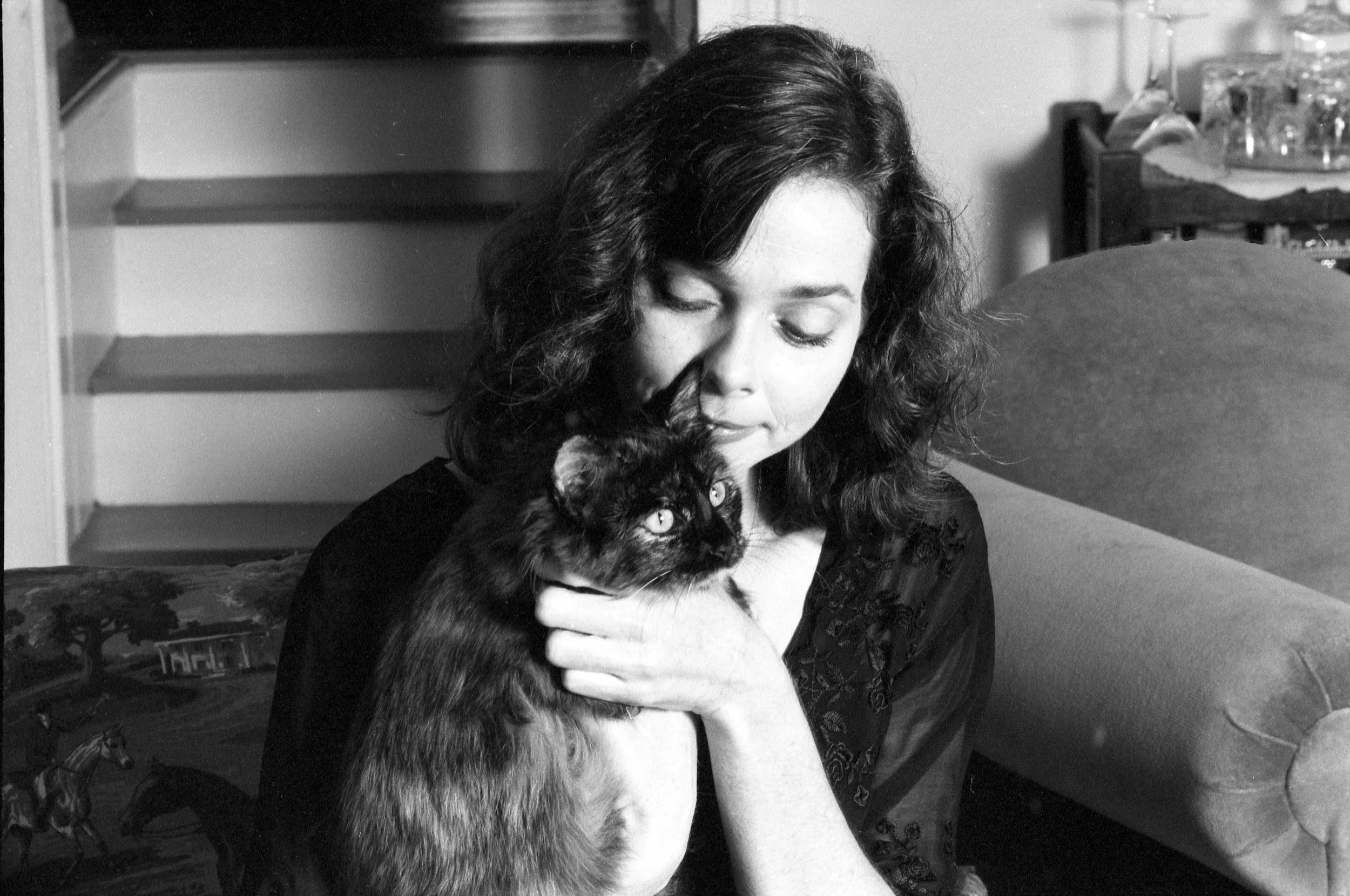
Photo: Nanci Griffith. Getty Images.
Perhaps this is controversial, perhaps pedestrian. I hardly know but must say this: the singer and songwriter Nanci Caroline Griffith, who left us on August 13, 2021, was a poet capable of the most haunting and apt imagery. It is tempting to say that Griffith was a reluctant Imagist: as a singer and songwriter she was known for spare, emotional narrative, ranging from “Listen to the Radio,” an impossibly brief tale of a woman in Mississippi leaving her partner to pursue her music, to “There’s a Light Beyond These Woods (Mary Margaret),” recounting a childhood friendship that grows into adulthood, and the epic “Love at the Five and Dime,” narrating the catch-in-the-throat beautiful lifetime love story of a dime store clerk and an at-first-young -and-ambitious musician. But peppered into her terse narratives, like currants in an honest loaf of brown bread, are unforgettable images. Take “Listen to the Radio.” As the narrator drives away from her life she tells us that “I am leaving Mississippi in the evening rain / These Delta towns wear satin gowns in a high beamed frame.” And in the same song notice too her genius at deceptively simple and quick characterization: “I left a handsome two steppin’ good ole boy in Tennessee / Now, he's sittin' on the sofa, lookin' for his supper, wonderin' what's become of me.” To anyone who knows the South, or the Rocky Mountain states, or pretty much anywhere rural in this country, you instantly know—and yousee—everything you need to know about who she is leaving. The same song yet again. Griffith’s narrator could simply tell us she is driving to New Orleans, but instead she says that “There's a moon across the border in the Louisiana sky / I smell the Pontchartrain,” and we can taste her passage—and her concrete, palpable, and unstated hope: “I've got a double-o-eighteen Martin guitar in the backseat of the car.” What Nanci Griffith does not say, she shows.
Shall we conclude—too quickly—that Nanci Griffith is, in effect, an Imagist poet? Were we to ask the Imagist Amy Lowell, I suspect she would say that the tools Griffith uses to such stunning effect are “the essentials of all great poetry, indeed of all great literature.” Surely this much is true. And in many ways Lowell’s 1915 Imagist manifesto all but presages Griffith’s approach to song:
To use the language of common speech, but to employ always the exact word, not the nearly-exact, nor the merely decorative word. To create new rhythms—as the expression of new moods—and not to copy old rhythms… To present an image… poetry should render particulars exactly and not deal in vague generalities, however magnificent and sonorous… To produce poetry that is hard and clear, never blurred nor indefinite… concentration is of the very essence of poetry.
And it is true that Griffith stands in opposition to the wordy, overblown, the portentous, or as Lowell put it, “the cosmic poet, who seems to us to shirk the real difficulties of art.” But Griffith’s metrical constraints—anathema to the classic Imagist—give her a power that could be diffused in free verse. An Imagist? Yes and no.
*
Born in Seguin, the county seat of Guadalupe County, Texas, Nanci Griffith grew up in the Austin suburbs and graduated from the University of Texas with a degree in education. She taught kindergarten and first grade for a brief time before turning to music full time. Her love of literature is manifest. Famously, her album covers feature the artist posing with various books, offering clues to where she has come from and where she is going: “Other Voices | Other Rooms” shows Griffith holding a copy of Truman Capote’s coming-of-age novel, Other Voices, Other Rooms; “Poet in My Window” includes a copy of Thomas Wolfe’s Look Homeward, Angel; “Once in a Very Blue Moon” shows her reading Eudora Welty’s Delta Wedding; the front cover of “Last of the True Believers” shows Griffith with a copy of Donald Spoto’s The Kindness of Strangers: The Life of Tennessee Williams while the back cover shows her holding Larry McMurtry’s Lonesome Dove; her album “Clock Without Hands” is named after Carson McCullers’ novel of the same name; and so on. She read Cormac McCarthy. With the music of Loretta Lynn and of Townes van Zandt, Southern—and Southwestern—literature were the air she breathed, though rather wonderfully at one point her favorite writer was the poet Charles Bukowski.
Griffith’s life was fraught with challenge and at times heartbreak. Her parents divorced in 1960, when she was only seven. For five years in junior high and through high school she dated a young man, John, who was killed in a motorcycle accident following their high school prom. Though her father was a key source for her introduction to folk and country music, over time they grew estranged, culminating in her writing the searing “Bad Seed.” Her health problems were relentless: in 1996 she was diagnosed with breast cancer, in 1998 with thyroid cancer, and she developed Dupuytren’s contracture, leading to her losing mobility in her fingers, a devastating event for any guitarist, much less one with Griffith’s gifted fingerpicking style. It is a sad and often-repeated commonplace that Griffith long fought a terrible depression and was given to alcohol to dull the pains she suffered, “drinking, popping every kind of pill, doing anything that would bring me down off that wall.”
*
To wrap this essay in academic dress, Griffith understood Robert Frost’s “sound of sense.” Take a moment to recall what Frost said about “the sound of sense.” Having spent time in England between 1912 and 1915 talking with poets ranging from Edward Thomas to Ezra Pound, and after devouring Arthur Quiller-Couch’s Oxford Book of Victorian Verse, Frost found his own way, vernacular and conversational: “Whenever I write a line it is because the line has already spoken clearly by a voice within my mind, an audible voice. There has been a great hue and cry raised over… as I have sometimes called it, the sound of sense… ”. Frost despairs of the young poet who “is prone to echo all the pleasing sounds he has heard in his scattered reading… He has not listened for the voice within his mind, speaking the lines and giving them the value of sound.” Famously, Frost proposes a different, colloquial approach: “It has been a long time since I used any word not common in everyday speech… In this, perhaps, I have unconsciously tried to do just what Chaucer did when the language was young and untried and verile.” Where Pound, imprisoned in a sweltering steel mesh cage in Pisa, exhorted the poet to “Learn of the green world what can be thy place / In scaled invention or true artistry, / Pull down thy vanity,” Frost says that “I have sought only those words I had met up with as a boy in New Hampshire, working on farms during the summer vacations. I listened to the men with whom I worked… When I started to carry their conversation over into poetry, I could hear their voices, and the sound posture differentiated between one and the other. It was the sense of sound I have been talking about.”
Consider Yeats as well, who memorably said “I can remember the very day when I thought it—If somebody could make a style which would not be an English style and yet would be musical and full of colour, many others would catch fire from him… I set to work to find a style and things to write about that the ballad writers might be the better.” And again: “I deliberately reshaped my style, deliberately sought out an impression as of cold light and tumbling clouds.” To reshape this style in a way that others might catch fire and “ballad writers be the better,” Yeats like Frost turned to common speech, away from the language of the English poets of the last century, making precisely Frost’s point at the expense of poor Shelley:
Shelley had but mythology, and a mythology which had been passing for long through literary minds without any new inflow from living tradition loses all the incalculable instinctive and convincing quality of the popular traditions. No conscious invention can take the place of tradition, for he who would write a folk tale, and thereby bring a new life into literature, must have the fatigue of the spade in his hands and the stupor of the fields in his heart.
Yeats in time said that his contribution to Modernism was naturalness of language and the use of “passionate, normal speech.” As F. R. Leavis put it, Yeats’ language is “in touch with the spoken living language and the speaking voice.”
And here we find Nanci Griffith. Consider “The Wing and the Wheel”:
The wing and the wheel, they carry things away / Whether it's me that does the leavin' or the love that flies away / The moon outside my window looks so lonely tonight / Oh, there's a chunk out of its middle, big enough for an old fool to hide // Where are all the dreamers that I used to know? / We used to linger beneath street lamps in the halos and the smoke / The wing and the wheel, came to carry them away / Now they all live out in the suburbs where their dreams / Are in their children at play
A poem about loss, from geographic to emotional to the loss of dreams with age, all told in the simplest of spoken language. Find a three-syllable word? You won’t. “The wing and the wheel, they carry things away,” the recurrent circular imagery—wheel, moon, halo—and the transfer of a life’s dreams to one’s children feels like Yeats; “there’s a chunk out of its middle, big enough for an old fool to hide” like Frost. The subtleties compound themselves with each hearing: a person can be carried away, but so can love itself. And it could be spoken as easily as it is sung. As she herself said, “Being a good songwriter means paying attention and sticking your hand out the window to catch the song on the way to someone else’s house.” This is the sound of sense.
Griffith’s power of metaphor is the power of spoken language, periphrastic, simple, but carrying the weight of worlds. “I Wish It Would Rain”: “Love in a memory / Sparkled like diamonds / When the diamonds fall they burn like tears.” “If Wishes Were Changes”: “So long to the blue days of wishing / If wishes were changes / There'd be no goodbyes.” “More Than a Whisper”: “They say that I misread your lines 'cause I've been lonely all my life / And here I'm reachin' for some silver and leavin' my heart out in the fire.” “You Made This Love a Teardrop”: “Is that a broken heart in the corner of your eye?” “You Can’t Go Home Again”: “I'm waiting for the moon to rise / He'll kiss my tears away and set my heart in line.” “On Grafton Street”: “You're a Saturday night / Far from the madding crowd.” Griffith’s deceptive simplicity has not escaped the notice of her peers. Lyle Lovett observed that “Nanci’s songs seemed like they were about something real with genuine writing that made you want to listen again and again… Her songs worked on the surface, but they also gave you a deeper understanding and revealed something over time in an even deeper way. What a wonderful thing.” And Kathy Mattea, who immortalized Griffith’s “Love at the Five and Dime,” astutely marvels at Griffith’s “economy of language.”
Nowhere do Griffith’s economy of language and natural voice work more powerfully than in her lightning-fast but tone-perfect characterizations. Screenwriters are told that you must establish character within five minutes of introducing the character. Nanci Griffith could do it—recall our handsome two-steppin good ol’ boy—in two lines. “Love at the Five and Dime” gives us “Rita was sixteen years, hazel eyes and chestnut hair / She made the Woolworth counter shine.” Eight syllables tells us that Rita was hardworking, dutiful, down to earth, attentive to detail, not likely on her way to college or the middle class, and so much more. Or try “Ford Econoline”: “She's the salt of the earth / Straight from the bosom of the Mormon church / With a voice like wine / Cruising along in that Ford Econoline.” And in “Drive In Movies and Dashboard Lights” Griffith memorably creates a richly detailed character who is instantly recognizable but completely original: “Sister had a crystal voice / She played a Silvertone from Montgomery Ward / Baez songs in Monroe hair / She sure could turn the boys' heads to stare / Swim wear saunter, tan and haunt them / Was all she learned in school.” And in “There’s a Light Beyond These Woods (Mary Margaret),” Griffith captures in three short lines the dreams of two high school friends who dream of an artist’s daring and bohemian life: “Let's go to New York City, Margaret / We’ll hide out in the subways / And drink the poets’ wine.” As Amy Speace put it, “Her songs… are novels in three minutes.”
And then there is the deeply underappreciated novel itself, Two of a Kind Heart, that Griffith wrote in the late 1970s and early 1980s at the same time she was beginning her career as a singer and songwriter. Published posthumously in September 2023 by her friend and producer Jim Rooney, Two of a Kind Heart repays the reader willing to seek it out. The depth of characterization and setting is exactly what we would expect from this songwriter. Describing two neighbors—an older white woman who had lost her husband and an older African-American man who had lost his wife—sitting on the woman’s porch in the hot Austin summer of 1962, she says:
They sat in silence now, Thomas and Leota, not missing the sound of conversation and neither feeling uncomfortable with the loss for words. They were both accustomed to the quiet, both content with their solitude and neither in need of anything more than their cold, wet iced tea and the shade of Leota’s sycamore tree. They had both loved and lost, both held and been held by the treasures of passion, and both would bathe in the loss of harmony for the rest of their lives.
The power of poetic imaging pervades this lovely novel as well: “Richmond had the roundest head he’d ever seen. It wasn’t sort of egg-shaped like everyone else’s, it was just round, just a bit on the piggish side of round. Richmond didn’t really have a neck; his big ole round head just practically sat right on his shoulders, which didn’t amount to much either.” In contrast, the young Leota is described as having “ash blond hair, which she kept in braids wrapped around her head, and eyes the color of fresh pine needles,” and she “could eat like a horse and still remain as frail as a whippoorwill.” And as so often with Griffith, you are constantly surprised to find your heart catching in your throat: “When Leota opened her eyes, Edgar was gone. His hand was so still and the chill of it made her recall his icy touch back in October, when they stood on the porch in the cold of the first blue norther of the season.”
Yet for all the powerful imagery and characterization of lives in an evolving mid-century Texas, Griffith’s novel—not unlike Frost’s and Yeats’ poetry—has a deceptive weight that crosses into the philosophical. Even those who foolishly find nothing beyond Southern charm in Eudora Welty’s gentle prose will be hard-pressed to deceive themselves about the metaphysical heft of Griffith’s writing. Witness her description of one of the grandchildren intentionally breaking Leota’s foot with a croquet ball:
When it became apparent that Leota would win the game on her next turn, Ethel fell silent and her small, dark eyes squinted to a glare; her short, bubble-cut, bleached-blonde hair seemed to stand on its end. A thin-lipped smile seemed to come on Ethel’s face as she stepped up to take her turn. Leota looked up just in time to see the intention in the young girl’s eyes and the swing of the mallet to the ball, which was aimed directly at her feet. That ball smacked Leota’s ankle so hard that it had lifted her completely off the ground and when she’d landed squarely on her thin behind, she lost consciousness completely.
And then the coda:
Yes, indeed, this was one heck of a summer. When all was brought to the surface, when every coat of paint on every wall of understanding was burned away by the heat of the sun, leaving only the bare wood to defend the hearts of the innocent—for the innocence itself was not long for this world.
To make the obvious point, the tension of evil and innocence in a family’s summer croquet match, delivered deftly by Nanci Griffith in Two of a Kind Heart, is more than worthy of Flannery O’Connor.
If we think about how Griffith became a past master of Frost’s sound of sense, it is inescapable that her poetry’s power derives at least partly from her writing in song. Consider Frost again: “The greatest freedom poetry can attain is having form, a frame, to work in. Free verse is batting a ball into space and wondering why it doesn’t return to the batter. Poetry written in form is like batting a ball against the side of a wall and feeling it return to the bat. A picture frame with its four simple lines is necessary to the showing of a picture. Try it and see. The frame thus becomes a part, even, of the picture.” For Griffith, the constraints of songwriting—short more or less metrical lines, simple language for a broad audience, and a conversational style drawing the listener in—gave her the frame to create a poetry of sense, a use of language that—Yeats again—makes “ballad writers be the better.” And here we may begin to see how difficult it is to say confidently that Griffith is an Imagist poet, despite the powerful and precise simplicity of her verse.
Perhaps not surprisingly, Griffith could and often would withhold herself. Jim Rooney observed that “John [Prine] had lots of respect for her as a writer and artist. He would have liked to be her friend, but that wasn’t in the cards. That was the way with [most] people. You couldn’t be her friend. Nanci just wasn’t there. Whatever it was was so deep inside it destroyed her and was related to the loneliness. I don’t know what caused it, but she couldn’t shake it. Took her over eventually. Very sad.” She also became increasingly prickly, at times with an indignant and very real sense of having been ill-treated. In 1998 Griffith wrote an open letter to Texas music critics that was a masterpiece of aggrieved vitriol, saying in part that
There has always been a certain amount of pathos within artists who leave their sacred bountiful homes of birth for the benefit of preserving their own belief in their art—especially in cases such as my own where my native soil that I have so championed around this globe has done its best to choke whatever dignity I carried within me.
Noting that like herself, Katherine Anne Porter “too had the wisdom to get the hell out of there and you hated her because she wrote of you as you are, not as you so self-indulgently perceive yourselves. That mirror must be incredibly difficult to accept,” Griffith concluded by saying “I carry with me always the pride and the knowledge that great things have come from my native soil—very few ever return there. Texas is, after all, the only place on earth that actually eats its young.” It is worth noting that the reaction of some critics to Griffith’s jeremiad arguably confirmed the points she—perhaps intemperately—made.
That being said, Griffith was legendarily generous, making room for, and tirelessly promoting, other artists. If she sang another writer’s song in concert, she made a point of telling the audience who wrote the song, and she jumpstarted many a career. Lyle Lovett: “Maybe I could have started playing credible original music venues if Nanci didn’t introduce me to the folks at Anderson Fair, but it didn’t happen that way. Everything started happening for me because Nanci Griffith introduced me to them.” Perhaps most striking, singer-songwriter Mary Gauthier, then new to Nashville, tells this story:
The first year I lived in Nashville I was invited to a party… that became a song circle with Guy Clark, Lyle Lovett, John Hiatt, Joe Ely, Steve Earle, and Nanci Griffith... I was on the edge of my seat, desperately wanting to go from being in the audience to swapping songs with that group of legends. I knew I was in deep waters, the new kid in town, but oh, how I longed to sit in that circle… As the music was winding down, Nanci looked over and asked, ‘Mary, would you play us a song?’… I handed Nanci her guitar back when I was done. She shook her head and said, ‘Keep it.’ I froze, holding her engraved, signature sunburst Taylor 512 cutaway guitar in midair, question marks in both my eyes. ‘It’s yours,’ she said.
Maybe paradoxically, and despite all the challenges she faced, Griffith was by all accounts great company. Emily Saliers of the Indigo Girls said that “Nanci was really fun to hang out with. She always made me laugh and want to pay attention to her.” Singer / songwriter Gretchen Peters said “Nanci was superfun as a person, very sweet, funny, really quick witted, and not full of herself”; a chorus can easily be found echoing this impression of a warm, funny, open-hearted person. As Holly Gleason rightly (and beautifully) said, “She was exotic as peacocks on the front lawn, as familiar as homemade bread or a well-washed linen shirt with a slightly frayed collar.” A paradox indeed.
Finally, any time spent with Nanci Griffith’s music leaves you beset with an abiding sense of dislocation and an obsession with, well, leaving. “Not My Way Home”: “You know, this love has left us / Don't count the years, it took a long time to kill / I know you will find a place for memories / And you'll be out there runnin', I will be here to be still.” Or her “You Can’t Go Home Again”:
So much silence to my hometown streets
Gonna put my cheek to the window and watch it sleep
Where the shadows fall from sycamore trees
Fight off this north wind and I'll be headin' back east
Let the Colorado River roll on the sea
I will be crossing it in changes
This ole town never did really care
That much for me
I don't know why I always come here
In my dreams
It's the hardest to hold but it's the easiest to find
If you'll slip for the dollar I'll fall in the wine
But you cannot save your past for today
It will leave you cold on an outbound train
Griffith’s use of “outbound train,” of course, evokes her often-covered song “Outbound Plane” (co-written with Tom Russell): “I don't want to be standing here with this ticket for this outbound plane / 'Cause I've been here before, and somehow, it doesn't feel the same / Talk is cheap, so we could talk all night long / We may never figure out just where our love went wrong / And I don’t wanna be standin' here / And I don’t wanna be talkin’ here / And I don’t really care who's to blame / ‘Cause if love won’t fly on its own free will, it’s gonna catch that outbound plane.” In a perceptive and affectionate portrait after Griffith’s death—to call it an obituary undervalues the power of the piece—Holly Gleason notes that in Griffith’s lyrics “Love was sometimes perfect and attained; occasionally flawed and wild. But as often, it was failed and someone—usually the woman—was leaving, frustrated, sad, but never beaten by what had transpired.”
One reviewer has noted that “Griffith very rarely felt at home, either in Texas or in the music industry.” Indeed, based on what we know of her life and her lyrics, it is possible that Nanci Griffith did not all that often feel at home anywhere. Consider “Grafton Street” (written with Fred Koller), describing her time in Ireland, where she was by all accounts welcomed, loved, and even revered:
On Grafton Street at Christmas time
The elbows push you 'round
This is not my place of memories
I'm a stranger in this town
And the faces seem familiar
And I know those songs they're playin'
But I close my eyes and find myself
Five thousand miles away
We might do well to compare Griffith’s dislocation in “Grafton Street” with the dislocation evoked by Yeats in “The Lake Isle of Innisfree,” which Yeats wrote in 1888 while in London and which he described as “my first lyric with anything in its rhythm of my own music”:
I will arise and go now, and go to Innisfree,
And a small cabin build there, of clay and wattles made;
Nine bean-rows will I have there, a hive for the honey-bee,
And live alone in the bee-loud glade.
And I shall have some peace there, for peace comes dropping slow,
Dropping from the veils of the morning to where the cricket sings;
There midnight’s all a glimmer, and noon a purple glow,
And evening full of the linnet’s wings.
I will arise and go now, for always night and day
I hear lake water lapping with low sounds by the shore;
While I stand on the roadway, or on the pavements grey,
I hear it in the deep heart’s core.
If you close your eyes and clear your mind of what you know, Yeats’ last quatrain could easily—easily—be a verse from a yet undiscovered song by Nanci Griffith. Perhaps I will be pardoned for the hopelessly romantic thought that somewhere they sing together.
Note: I would be remiss not to give credit to Brian T. Atkinson for his superbly informative collection of reminiscences by Nanci Griffith’s friends and fellow artists, Love at the Five and Dime: The Songwriting Legacy of Nanci Griffith and to Holly Gleason for her wonderful appreciation of her friend in “Nanci Griffith Catches Some Sweet Blackbird's Wings,” Lone Star Music, as well as to various commentators, including Adam Sweeting, “Nanci Griffith’s Irish hit, cancer history and ‘really dysfunctional’ family,” Irish Times; David Heffernan, “Nanci Griffith: From a Distance,” The Blackpool Sentinel; Stuart Henderson, “Trouble in the Field: A Conversation with Nanci Griffith,” PopMatters; The Extreme Geographer, “My Tribute to Nanci Griffith (And the Stories Behind Her Songs)” ; and Rachel Syme, “Nanci Griffith’s Lone Star State of Mind,” The New Yorker.