
FALL/WINTER 2025
Pavese’s Other Faces
. . . so from that broken splint, words and
blood came forth together.
Dante, Inferno, XIII, 43-44
Adam Krasnoff
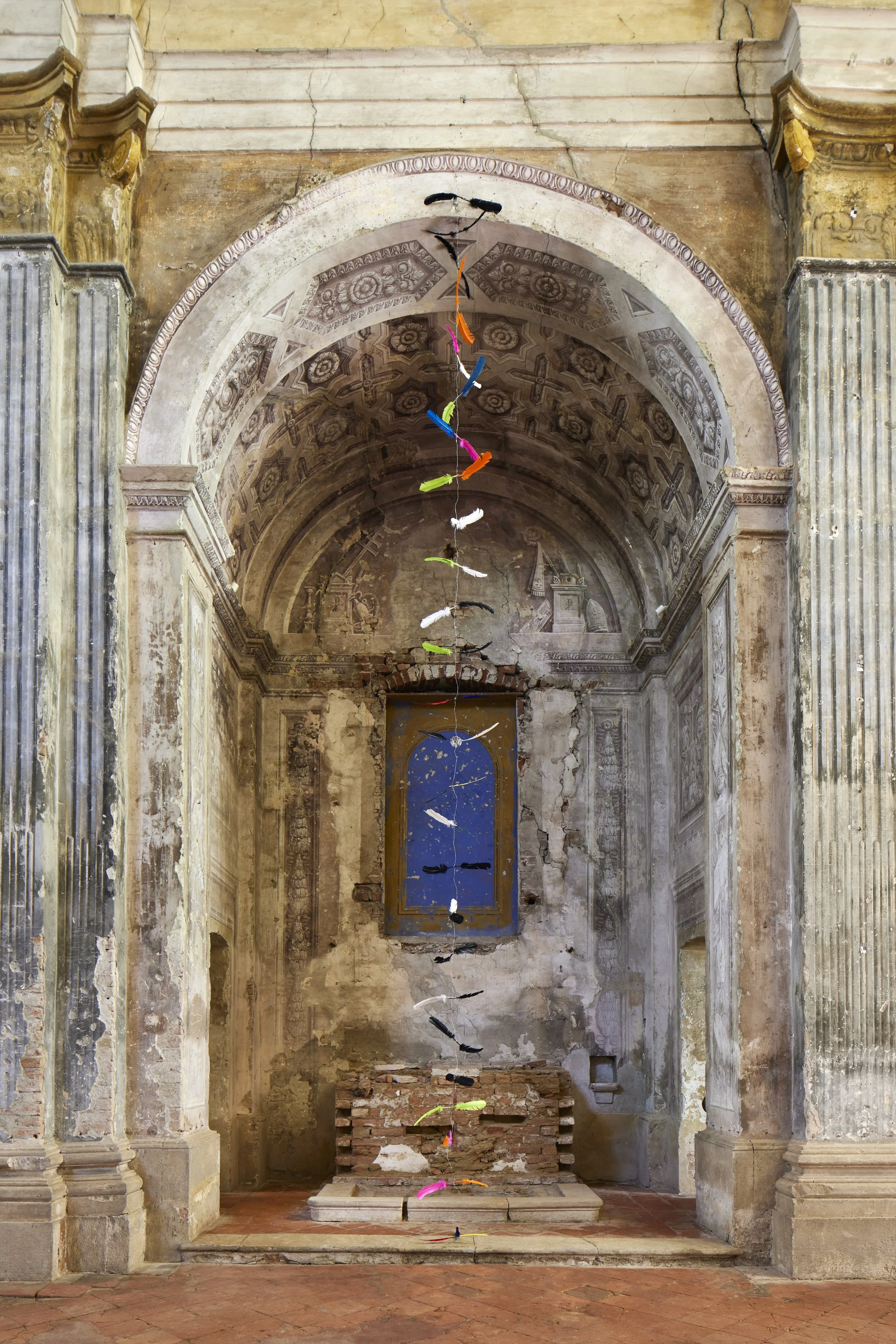
Arthur Simms. Linea, 2023. Courtesy the artist, Karma and Martos Gallery. Photo credit: Form Group.
In 2001, more than a half-century after he committed suicide, the remains of the Italian poet and novelist Cesare Pavese were transferred to the cemetery of Santo Stefano Belbo, the village in which he was born. His gravestone stands only a short walk from his birthplace, a modest country home facing the rugged Salto hill, with its scattered vineyards and footpaths. Pavese’s belated return parallels that of the unnamed narrator in his final novel, The Moon and the Bonfires, who returns to Santo Stefano Belbo after years spent in America to find the town, its people and its landscapes, irreparably changed by war and time. At the beginning of the novel, Pavese’s narrator observes, “I’m almost sure I wasn’t born here. I don’t know where I was born. There isn’t a house or a piece of land or any bones in this part of the world about which I could say, ‘This is what I was before I was born.’” Those three haunting sentences, a radical statement of self-effacement, were written in the final years of Pavese’s life. It had been over three decades since he left his hometown for Turin. Though he remained in the city for much of his life, his family returned to the Langhe, the northern countryside of his boyhood, in the summertime. This landscape, with its hilltop villages and deep valleys, its granaries, vineyards, and dairies, was embedded deeply in the young Pavese. In a diary entry dated October 11, 1935, he wrote: “Could all my images be nothing more than an ingenious elaboration of a fundamental image: as my native land, so am I?”
How did the insistent identification of the young Pavese give way to the ambivalence of the seasoned novelist? Perhaps the question overstates the opposition between these two attitudes: the man who claims not to know where he was born on one hand, and he who cannot extricate himself from his birthplace on the other. The former vehemently denies what the latter has fought so hard to accept. The first-person narrator of The Moon and the Bonfires commits, on the novel’s first page, an act of impossible refusal. He cannot not recognize his village, with its familiar, mocking sights, its vestiges of history. “I thought that this place, where I hadn’t been born, was the whole world,” Pavese writes. “Now that I’ve really seen the world and know that it’s made up of many villages and towns, I’m not sure that I was so wrong as a boy.” Upon his return, Pavese’s narrator goes to see the hazels on the Galminella hill, where he used to walk as a boy. Memory leads the way. But atop the hill he finds the stand of hazel has disappeared. Unconscious recognition gives way to the unease of change, images at once themselves and not themselves. The forest remains, but the trees no longer stand.
*
As my native land, so am I. When Pavese made that Whitmanian declaration in his diaries, he thought of himself first and foremost as a poet. The following year, in 1936, he would publish his first book, Lavorare stanca, a collection of poems translated into English by William Arrowsmith as Hard Labor. Long out of print as a single volume, Pavese’s early work returns this year in a reissued edition from New York Review Books. Much as it was in Pavese’s lifetime, Hard Labor’s reputation has been eclipsed by that of his novels, many of which returned to print decades ago. Though he has staked out something of a canonical place as a novelist — Susan Sontag calls him “one of the few essential novelists of the mid-twentieth century” — his poetry has come to be viewed as little other than a key with which to unlock the later prose works, or worse still as an afterthought. Yet when Pavese’s poems first appeared in English, their impact was undeniable. Saul Bellow, upon reading Hard Labor, declared that “this is how writers in our ever-worsening world should write”; Harold Bloom and Kenneth Rexroth both celebrated Arrowsmith’s translations as a landmark from which Anglophone readers might well learn something about “the war of American poets against their own tradition.” With the benefit of even greater distance, Pavese’s “still, sad music of humanity” in Hard Labor seems a reference point for a range of American poets, including James Wright, W.S. Merwin, and Galway Kinnell.
The relative neglect of Hard Labor would have left Pavese embittered but unsurprised. In 1941, when asked by a reporter to provide a brief summary of his life, he reported: “I was born at Santo Stefano Belbo, and I live in Torino. I’m a bachelor . . . In 1936 I published Lavorare stanca, a book of poetry which went unnoticed.” Like so many first books, Hard Labor documents a writer’s proverbial and literal search for his home terrain. For Pavese this was an uneasy process which occasioned serious reconsideration of his place in the world. What—or, perhaps more crucially, where—was this place? In the countryside of his childhood or the city of his maturity? In the past or the present; in memory or in experience? The construction of Hard Labor might well be understood as the elaboration of Pavese’s early struggles to make sense of the relationship between himself and his native land, a relationship which, if the poems are any evidence, was anything but a simple parallel.
In Hard Labor, Pavese sought both to reach back toward his ancestors and to break away from them, to surround himself in their language and their atmosphere, not in order to draw closer to them, but in the hope that he might understand where his severance from them began. In his diaries, we can observe Pavese wrestling with early drafts of the poems, with the landscape of Piedmont at the center of this struggle. To return to that entry from October 1935:
… is it not simply that between Piedmont and myself there runs a current of sympathetic impulses, some conscious, some unconscious, which I shape and dramatize as best I can: in image-stories? A relationship that begins with an affinity between one's blood and the climate, the very air, of home, and ends in that wearisome spiritual drift that disturbs me and other Piedmontese?
The poems develop along similar lines—first with an affinity between the speaker and his landscape, and from there into far murkier territory, that combination of rootlessness, doubt, and self-imposed distance characteristic of those who have left home behind, and are forced continually to look back on it. In a sense, it is the growing indistinction of memory that creates the condition Pavese calls “wearisome spiritual drift.” But in constructing poems about his ancestors, what was Pavese looking back on, exactly? To reach them, the poet would first have to turn away.
Like the narrator of The Moon and the Bonfires, Pavese looked far from Piedmont in order to interpret his allegiance to it. He located the affinity between self and land in both classic and contemporary American literature.1 Perhaps the most crucial American influence on Hard Labor was Edgar Lee Masters’s Spoon River Anthology, which Pavese translated, a 1915 collection of free verse poems written from the postmortem perspectives of the citizens of the fictional Midwestern town of Spoon River. In Lee Masters’s brief poems, written in the plainest American language, Pavese encountered something like the alien reflection of his own pastoral upbringing. In the graveyard of Spoon River—great equalizer—Chase Henry, “the town drunkard,” lies beside the venerable Judge Somers, “who made the greatest speech / The court-house ever heard”; not far off are the likes of “Indignation” Jones, with matted hair and beard, whose only pleasure was a trip “to the grocery store for a little corn meal / And a nickel’s worth of bacon.” Here were the earthy inhabitants of Santo Stefano Belbo, the farmers and day laborers, the drunks and whores, the mothers and fathers, the supplicating priests and absentminded carabinieri, each furnished with names like “Fletcher McGee” or “Butch Weldy,” each narrating an idiosyncratic slice of American life. The effect of Lee Masters on Pavese was uncanny, both familiar and profoundly defamiliarizing. His terseness, the brittle, spare quality of the poems, offered an example of just what the formalities of Italian verse lacked. Meanwhile, the colloquialisms of American speech presented him with a refracted model of the Piedmontese dialect of his childhood. As Pavese writes in his first postscript to Hard Labor, “The Poet’s Craft,” he had begun to think of “all literary language as fossilized, a dead body, in which life could not quicken or the blood flow.” Here was an alternative.
Just as Pavese rejected the “fossilized” language of his own native poetry—the Canti of Leopardi, for example—he also wanted to break away from its constraints of form and structure. Lee Masters would thus provide Pavese not only with a manner of speech but with the bones of a form which Pavese called “image-stories.” The idea of a poetic work unified by its formal construction seems to have caused the young poet no little anxiety, as if any sense of fixed structure involved a capitulation to older, more burlesque forms. It might well be pointed out that Pavese is hardly an informal poet; in fact, he admits that “such [formal] concepts, perhaps quite a number of them, can be found in my collection; all I deny is that I put them there.” What he sought, instead, was a poetics in which “the imaginative and conceptual bond is provided by the subject matter . . . since the consciousness of a single subject unifies the different aspects of an experience.” The Spoon River Anthology might be the example par excellence of this kind of poetry. Its first-person narratives, reconstructions of experience from beyond the grave, answer for Pavese’s rather programmatic notion that “Every poem is meant to be a story.” These image-stories, told in a series of frank, intimate voices, reveal a vision of “the world as a place where every man evolves, out of his own experience, his own condemnation or justification,” as Pavese writes of Lee Masters’s work.
Hard Labor represents the evolution, from Pavese’s early experiences, of his own condemnation or justification. (“What will be the new atmosphere of my poetry?” Pavese asks in a diary entry written in the midst of the book’s composition. “. . . This atmosphere, this revaluation, ought to be such as to justify me in history.”) Indeed the dialectic between those states of mind, the condemnation or justification of oneself, call to mind the distinction between the narrator of The Moon and the Bonfires (“I don’t know where I was born”) and the youthful Pavese of October 1935 (“as my native land, so am I”). This conflict, which Pavese would transform into an occasion for poetry, might also be described as the encounter of mind and body, the spiritual and the material. Pavese’s poems combine the rootlessness of the metaphysical—loneliness, abstract longings, the search for love—with a steady attention to the earthiness of the real. To describe his inner world, Pavese looked to the sights and sounds of his native land; to describe his native land, he looked within himself. The poet was well aware of this conflict. In his diaries, Pavese asks the following question: “Do I express spiritual things by speaking of material things, and vice versa?”
The first poem in the collection, “South Seas,” seems an answer to this question. In it, we are introduced for the first time to the typical Pavesean speaker, a lonely man hyperaware of his loneliness, given to silence and solemn reflection. This inwardness, rather than distinguishing him, links him to a sense of community. It is, in fact, an inheritance, passed down from one ancestor to another:
... Silence is a family trait.
Some ancestor of ours must have been a solitary man—
a great man surrounded by halfwits, or a poor, crazy fool—
to teach his descendants such silence.
The poem unfolds as a linear narrative in which the speaker and his older cousin walk together on a hill above Santo Stefano Belbo, reflecting on the outer and inner changes which have shaped them and their place of origin. The speaker, a clear analogue for the poet, has left Piedmont for Turin; his cousin, who left the town when he was just a boy, is both an erstwhile model for the existence of a life beyond one’s home and firm proof that even years spent away do little to dispel one’s character. Pavese’s interlocutor speaks in “a dialect like the rocks / of this hill, so rugged and hard that twenty years / of foreign idioms and sailing foreign seas / haven’t made a dent.” The metaphorical likeness between stone and speech, which recurs throughout the book, is one of many ways Pavese unites his countrymen with the land on which they walk. For Pavese, the working of the land, the long days spent in field or forest, harvesting or foraging, yielded men and women who not only began to resemble wood, rock, or earth, but took on something of their essence. In this sense, the labor of his ancestors was both inward- and outward-facing—it transformed the laborers themselves as much as it did their surroundings, bonding together blood and soil with “more elusive rivals: thoughts, desires, dreams.” Abstract forces are represented by material means; the spirit, if Pavese’s view of his ancestors is to be believed, might well have been contained in an image as simple as a plowed field or a picked vine.
For Pavese, however, this substitution, the material taking the place of the abstract, meant something quite different. As the poet reaches outward, finding the means to describe his own conditions of mind in his surroundings, he is often struck not by the landscape’s oneness with himself, but by its irreducible difference. In “The Night,” Pavese recalls gazing in awe from his bedroom window at the hills of Piedmont. He is “stunned to find them massed together, / vague, transparent, still.” Faced with their indistinction, he feels no spark of recognition. That land is, for him, certainly not meaningless—reverence is by necessity freighted with meaning—but what, precisely, does it represent? Not a livelihood, as do the carefully tilled fields Pavese sometimes uses as metaphorical stand-ins for his ancestors. No, those slopes, covered with “daylight things,” plants and vines, are “defined and dead”; life, on the other hand, is somewhere and something else, immaterial, “a thing of wind and sky / and leaves and nothing.” The night of Pavese’s poem refers to a system of apperception; he describes, in effect, the filter through which he, the awestruck son, sees the land where he was born. From those “hard hills,” Pavese would have to create something different. Imagination would have to take the place of hard labor; spirit would have to succeed materiality. The latent danger of this mode of life, of embedding oneself in abstraction, is its likely proliferation of visions and phantoms—elusive rivals indeed. In this vein, the speaker of “Encounter” conjures for himself a ghostly, irreal Other: “I encountered her one evening: a brighter presence / in the unsteady starlight, in the summer haze.” This female partner is described in negative terms: Pavese’s speaker “[does] not know if she is beautiful”; he “never managed to hold her fast”; he “cannot understand her.” Yet for the poem’s speaker, this woman’s “presence [is] / defined, unchangeable, like a memory.” Contradictory, in other words, a presence couched within an absence. It is little wonder that Pavese places this woman amid the dreamy atmosphere of a summer morning, a suitable parallel for the haze of memory, immediately conjurable yet so illusory. In the final lines of the poem, Pavese admits, perhaps a little sheepishly, to the unreality of his subject: “I created her from the ground of everything / I love most.” The Piedmont of Pavese’s poetry, fertile ground for false apparitions and vague remembrances, might bring to mind a line of another of his American masters, Gertrude Stein: “There is no there there.”
“Encounter” also announces the centrality of sex, or sexual difference, to Pavese’s vision. If Hard Labor is in part a coming-to-terms with place, it is also an account of a private sentimental education, a coming into one’s own body and into the physicality of love. As in the case of Pavese’s relationship with his native land, his relationship to eros is characterized by the opposition of materiality and immateriality. Sexuality takes dual forms in these poems. In “Encounter,” we find the idealized, unrealizable, and ultimately fabular vision of sex, an unrestrained yearning toward nothing in particular. More often than not, this is the inner vision of Pavese’s speakers, mired in loneliness and aggressive isolation. This negative, or immaterial, relation to sex has two faces: the sublime, as exemplified by the imaginary partner of “Encounter,” and the embittered, as in the haunting “Love Affairs,” which describes the death of a boy who fell from a window while “spying on cats making love.” The boy, punished for his erotic curiosity, is made to learn a harsh lesson about the proximity of sex and death. As he dies, Pavese writes, “The bitches,” who would sniff at his corpse come morning, “were still howling.” In both cases, the end result is the denial of pleasure.
But there is another, gentler Pavese hidden in the book too, a man at once of genuine tenderness and passionate lust. More intriguing by far than the young poet musing about l’amour fou—the very sort of prevarication Pavese so thoroughly rejected in Leopardi and the other Italian romantics—is Pavese the keen, excitable observer of other bodies, the poet of material love. In “Women in Love,” a poem which more than earns its Lawrencian title in terms of sensuality, we find “girls . . . scared of the seaweed which hides / beneath the water and sticks to their legs and shoulders— / wherever the body is bare.” Then there are the Turinese women of “Sultry Lands”: “They have liveliness and grace. Even when they're naked, they talk / as vivaciously as ever.” And in the overwhelming “The Country Whore,” we find these wonderfully unfolding lines, linking earth with the embodiment of sex: “Fragrance of barn and light / mixed with the smell of sweat that’s always / in her hair, and the animals nuzzling it.” As Pavese writes at the end of the poem, these images are pungent and sharp; they “caress like a touch.” One smells the heat of passion in this poem and feels its beating pulse, no mean feat for a man who once scorned, in his diaries, so-called “lovers of sensation.”
Hard Labor’s vision of sex and love reaches its emotional peak in “Fatherhood,” a poem in which a young woman dances while thinking of her father, “who once had her in his blood, who fathered her / one night in bed, stark naked, with pleasure and joy.” In a crowded tavern, she is surrounded by the eyes of men, both young and old, who stare at her and imagine undressing her, undressing themselves. The poem takes a simple and retrograde premise, the putative release of a daughter by her father to a life of sex, and infuses it with warmth, humor, and grace. Of the old men in the bar, Pavese writes: “All of them, old and feeble, are the remnant of a body / that enjoyed other bodies”; of the young men: “Someday [they] / will be fathers too. Women, for them all, is one woman.” The poem is less about parenthood itself than it is about the physical joy of sex, about the ecstasy and love from which a child is produced. Unlike the ghostly Other of “Encounter,” the dancer in “Fatherhood” seems to be a representation of a real, if archetypal, woman. It may be that in looking outward rather than inward, Pavese came closest to describing the environment of his upbringing in its fully embodied form. But it is also worth asking whether this embodiment itself is a kind of myth-making, whether the woman who, according to the poem’s final lines, will dance in this tavern eternally, is finally so different from that described in “Encounter.” Both of their presences, after all, are “defined, unchangeable, like a memory.”
That his own memories were defined and unchangeable was a source of continual frustration for Pavese. He often returned to Hard Labor in his diaries. In one especially self-aggrandizing entry, he writes to himself in the second person: “Turning over the pages of Lavorare stanca again, you feel quite depressed . . . Was it worthwhile to spend six years2 of your life composing it, from twenty-four to thirty? In your place I should be ashamed.” That bitterness seems nothing more than the older man castigating the younger for what he could not have yet known. In another anxious entry, written in a fit of despair: “I again become the man who has not yet written Lavorare stanca . . . shaken by childish but agonizing fits of terror, as I did in my twenties.” But that fear is not apparent in the book. In its frankness, its willingness to strip himself and his world bare, it seems more like an act of bravery and of love. If the book caused Pavese any undue discomfort, it was likely because he saw so much of himself in it, though there must have been consolation in this recognition, too. “A man is never completely alone in the world,” Pavese writes in his diaries. “At the worst, he has the company of a boy, a youth, and by and by a grown man—the one he used to be.”
This is, surely, false company, made enjoyable only by the persistent deification of past over present. This idea is actualized in the poem “Myth,” in which Pavese describes the transition from youth to manhood as a process of desacralization, the transformation of a “young god” into a “man.” With an air of fatalism, Pavese warns his reader, addressed in the second person, that they will one day awaken to find that “the summer is dead,” “the mountain no longer touches the sky,” and “the clouds / are no longer massed like ripe fruit.” Those images, deadened in the present, will live on only in the mind. Sensation will give way to cognition: “The body of a man / is bent in anxious thought where once a young god breathed.” The poem’s central contradiction is that it describes immortality in mortal terms; the youth is made a god by virtue of the ephemerality of his youth. His limitlessness is retrospective. Strangest of all, the definition of the land itself, its color and its light, its sights and sounds, seem to recede with him, to disappear and, by disappearing, to become eternalized. The poem’s title could refer to the whole imagistic landscape of Hard Labor, which, receding from Pavese as he grew older, became crystallized into a series of changeless myths.
*
Non scrivere piu—“I won’t write anymore.” With that simple declaration, Pavese closed his diaries. Nine days later, he committed suicide by an overdose of sleeping pills in a hotel room in Turin. Suicide, of course, perpetuates its own myths. The act takes on its own life once completed, independent of that it bears away. Pavese would have been well aware of this. In fact, he considered its consequences on numerous occasions: “Consider this point carefully,” he writes in a diary entry of 1936, “nowadays, suicide is just a way of disappearing. It is carried out timidly, quietly, and falls flat. It is no longer an action, only a submission.” A mute gesture, in other words, incomprehensible and uninterpretable—the last available currency, perhaps, for men like his isolated protagonists, stubbornly entrenched in silence and separation. The bitterness in his words is difficult to miss. But in effect, Pavese’s death was anything but mute; it was destined to become, however perversely, an invitation for interpretation. His suicide, like that of many writers whose work comes to metonymize the life of their nation, was an act, conscious or unconscious, of self-mythologization. For Pavese, myth underpinned the entire structure of daily life. It was in the voices and rituals of his ancestors, as had become clear in the writing of Hard Labor. And it was in the continual struggle to outdo himself:
Myth teaches that we are always fighting against a part of ourselves, the part we have outstripped, Zeus against Typhon, Apollo against the Python. Conversely, what we are fighting is still part of ourselves, our former selves. Above all, we fight in order not to be something, to free ourselves.
Pavese would advance this theory of myth, in which the drama of gods and mortals comes to represent the continual struggle against oneself, in a work which both stands outside his oeuvre and explains it: Dialoghi con Leucò, or The Leucothea Dialogues, now available in a new English translation by Minna Zallman Proctor, out this fall from Archipelago Books.3 It was on the inside cover of the Dialogues that Pavese inscribed his characteristically self-effacing suicide note (“I ask forgiveness and forgive you all. OK? Keep the gossip brief”). Proctor rightly points out in her introduction that few critics have placed the Dialogues at the center of Pavese’s oeuvre, but there are a few notable exceptions, among them Arrowsmith, who called the work Pavese’s masterpiece, and the critic Leslie Fiedler, a relentless early champion of Pavese in America, for whom it is “is surely his most beautiful, his most achieved effort.” Honorifics aside, Arrowsmith’s and Fiedler’s assessments are significant insofar as they both identify the Dialogues not as a marginal curiosity, but as the backbone of his entire worldview. This becomes even clearer when one reads Pavese’s diaries, in which references to mythology abound. In a letter from 1942, Pavese writes, “I need myths, fantastic and universal, to fully and unforgettably express this experience that is my place in the world.”
A series, or perhaps better yet a cycle, of philosophical dialogues between figures of Greek myth, the Dialogues appear at a glance to contain very little of their maker. Whereas Pavese relied heavily on his own experiences when constructing his novels and poems, his dialogues trade in abstraction and obfuscation. Though they draw on ubiquitous narratives—the myths of Oedipus, Orpheus, and Achilles, among others—his dialogues tend to deepen, rather than elucidate, the mysteries of their sources. To attempt to read any straightforward allegorical meaning across Pavese’s extensions, revisions, and elisions of these myths would be foolish, and it would be even more absurd to tease from these abstruse texts anything so concrete as a logical framework with which to explain away his suicide. Yet the interpretation of the dialogues has largely been concerned with the text’s connection to his death nonetheless. It may be that in the ill-advised retrospective project of making Pavese’s works legible in terms of his biography, it has become difficult to address The Leucothea Dialogues as anything but an exception that proves a rule—a means, however abstract, to an end.
Proctor, in her introduction, draws an even more intimate connection between the book and Pavese’s suicide, quoting a letter written just days before his death: “If you want to know who I am now, reread ‘Beast’ from my dialogues.” “Beast” is one of the few dialogues in the book between a known and unknown figure: Endymion, the strikingly beautiful shepherd whom Zeus placed in an eternal sleep, and a man simply attributed as a stranger. (The other extant examples in the book are a dialogue between two hunters, two shepherds, and an encounter between Oedipus and “a mendicant.”) Endymion, like Ixion was with Hera, was punished by the gods for taking a lustful interest in Artemis, and thereby transgressing the boundary between mortal and immortal, earth and sky, finite and infinite. As he is in many of the dialogues, Pavese is interested in Endymion’s story insofar as it comes to represent the intractable distance and difference between gods and mankind. The youthful shepherd takes to the slopes of Mount Latmus each night in search of the goddess, for whom he is willing to wait in perpetual wakefulness. But in refusing sleep, Endymion is condemned forever to the province of dreams; “it is known,” writes Pavese, “that a person who can’t sleep wants to sleep and goes down in history as the eternal dreamer.”
Endymion’s sin is not the desire to transcend himself, per se, but his belief that transcendence might be possible at all. “When I go up Mount Latmus,” he explains, “I stop being mortal.” Then, as if to placate his skeptical, affectless interlocutor: “Don’t look at my eyes, they don’t count.” Though he wishes, in love, to become like “flesh in her dog’s mouth,” their encounters are always mediated through the unerring gaze of the goddess, who is content to observe Endymion from afar and approach him only on her own terms, and almost always without contact; after all, “no one has ever touched her knee.” In this way, Endymion is consigned to a waking life akin to sleep, to an endlessly deferred love, atemporal, which both takes place in an eternal present (“As long as the mountain is there, I will not sleep in peace”) and is continuously cast ahead, into a future he will never reach. As their dialogue continues, Endymion’s prevarications begin more and more to resemble a desperate search for counsel, and the stranger’s responses more and more like divine wisdom. “Everyone has their own sleep, Endymion,” he remarks, “Your sleep is a plethora of voices, cries . . . Sleep with courage, you have nothing else worthwhile.” Is this the voice of Zeus, who finishes by telling Endymion that he “must never again wake up”? Understood in this sense, the dialogue is an annotation to the story of Endymion, structured to explicate his punishment. But it is also a revision of that narrative, in which the shepherd is urged, on his own terms, to choose sleep; that is, to choose oblivion.
For Pavese, the relationship between mortals and immortals might be understood as a representation of the radical distance between the self and the world. His mortal characters live in a world governed by invisible, indomitable forces; the difference between their reality and ours is the continuous revelation of those forces by the gods themselves, who in their fitful apparition and disapparition construct an intricate series of fictions—myths—by which we might interpret our surroundings. Though the gap between the gods and their mortal subjects often seems uneclipsable, the dialogues reach their emotional and conceptual peaks when that distance seems most porous, as when Endymion makes his nightly pilgrimage to Latmus. (At one point, the stranger remarks that the “immortals also feel the lure of the hearth,” the implacable desire, perhaps, for the warmth of home; whereas Endymion and the stranger “have a little divinity of [their] own, too.”) In his diaries, Pavese writes: “In the Dialoghetti, the mortals sigh for divine attributes, and the gods for human qualities. The multiplicity of gods does not affect the issue. The work is a conversation between divinity and humanity.”
“Blind,” the early dialogue between Oedipus and Tiresias, is perhaps the book’s strangest evocation of the relationship between gods and mortals. It functions as a prologue to the Oedipal myth; “the sorrows of Oedipus began shortly after this conversation,” Pavese writes, “which is to say, his eyes were opened and then, in dread, he obliterated them.” But opened to what, exactly? In Pavese’s telling, Tiresias, the blind prophet, claims foreknowledge of the world before the entrance of the gods. For Tiresias, the gods were not responsible for creation but assignation; their major contribution was to bring to bear on the world systems of categorization and representation. If they can be said to have authored anything, it is language, not the material world itself. “The world was here before they were,” explains Tiresias. “It already existed, filling space, bleeding, and delighting . . . But now, it’s all by virtue of the gods, and so everything is made of words, illusions, threats.” Tiresias’s vision is of a world in which language instantiated the Fall, in which the so-called purity of things-in-themselves was ruptured by the process of naming. “Like the gods,” he warns Oedipus, “you explain things by naming them. You don’t know yet that there is rock under the dirt, or that the bluest sky is the emptiest.”
Like many other figures in the book, Pavese’s Tiresias speaks in a series of gnomic, oracular pronouncements. Tiresias’s strange idiom should call to mind the Delphic Oracle, a central figure in the Oedipal myth, and another figure who stood at the threshold between divinity and humanity. Here, his argument might be understood as a cautionary tale about the limits of narrative. By handing down a cycle of explanatory stories to us, the gods dressed reality in a cloak of figuration. While the Oedipuses of the world busy themselves with interpreting how any given action might figure in a larger network of cause and effect, they forgo in turn the essence underlying or subtending that network. The irony in the prophet’s logic is that he himself deals in interpretation; others, like Oedipus, flock to him with their own stories, eager to understand their implications, only to receive by way of reply another story. Allegory begets allegory. In a rare moment of reflexivity, Pavese seems to speak directly to his reader as Tiresias asks Oedipus: “What is it about this story that makes you think it means something?” Is it not the desperate search for meaning that creates the conditions for its continual denial? Reading their exchange, I found it hard not to be reminded of the final sentence of Kafka’s fragment “The Trees”: “But see, even that is only appearance.”
Oedipus and Tiresias’s dialogue opens up a larger question about The Leucothea Dialogues: is it a narrative work at all? The dialogue, a far older literary form than the novel, is often (as in the case of Plato’s Symposium) employed for exegetic means. Where the Platonic dialogue is meant, by a process of gradual interposition, to reduce its speakers’ ideas to their core, Pavese’s dialogues accumulate conflicting images and histories until their original meanings are dissolved. This has, in part, to do with Pavese’s firm rejection of the fabular qualities of myth. Rather than an illustrative system, Pavese sees myth as “a hothouse of symbols,” a set of references expressible only through their inherent narrativity. To explain away their mystery, to transform “myth into ‘logos’ . . . [to] strive towards form, towards a fable, a self-sufficient organization,” is for Pavese the antithesis of art. At the heart of The Leucothea Dialogues is a desire to dispel the immediacy and recognizability of myths, not by transforming or destroying them, but by underlining their most universal characteristics until they become, once again, rich and strange. “We know,” he writes, “that the best and quickest path to surprise is to stare fearlessly and steadily at the same object. Then—there is that perfect moment when, miracle of miracles, that same object will seem like something we’ve never seen before.”
The experience of reading these dialogues is much like being told a set of stories one assumed one had already forgotten, only to be reimmersed in their alien but undeniably familiar contours. New ironies emerge, as when Oedipus, having just been urged against his over-reliance on them, says to Tiresias “I pray to the gods that [going blind] doesn’t happen to me.” Or when the arrogant Patroclus, on the eve of his death, tells Achilles, “I’ll be untouchable. Like a game.” Then there are those figures who, as Pavese ventriloquizes them, seem renewed with knowing wisdom. So it is with Orpheus, embittered and lost in the underworld, who tells Baccha: “Every time you invoke a god, you meet death. You go down into Hades to break something, to violate destiny. You don’t defeat darkness, and you lose the light.” Does this constitute revisionism? Does the power of Orpheus’s myth not come from his ignorance of his fate? Pavese argues, in a diary entry, that without its lesson (against temptation, in Orpheus’s case), the myth’s social function, so to speak, disappears:
The Dialoghetti preserve the elements, the gestures, the attributes, the knots of myth, but they abolish its cultural reality, which springs from a long tale of graftings, copying, derivations etc. (which makes them understandable). The social background (which made them acceptable to the ancient) is also abolished. What remains is the problem, and this your fantasy is solving.
By erasing certain dimensions of their historical legibility, Pavese brings to the fore the “knots” of myth, surely the qualities most appealing to the poet or novelist, who deals in successions of images or actions linked not necessarily by logical sequence but by larger structures of feeling.
In a futile search for Pavese’s psychology—by behaving, that is, like the sort of reader Pavese would have detested himself—I found myself continually drawn to “The Fires,” the dialogue between two shepherds, a father and son. This dialogue depicts the construction of a bonfire in deference to Zeus, that the shepherds might enjoy a year without trouble, a year of abundant rain and growth. This practice is the descendant of a far more violent one, involving the ritual sacrifice of a child on the bonfire. The prospect terrifies the son and edifies his father; it makes the former want to spurn his ancestors and the latter embrace them. On this particular night, there are “more bonfires than stars.” As the father goes about lighting their fire, his son peppers him with questions. “Are those stars or bonfires?” “Does it really rain everywhere when it rains?” “Did they really used to burn people alive?” “What about the gods?” As he asks more and more questions, the son grows more frightened and more indignant. His father chastises him for his resistance to the myth: does he not know the horrific consequences of drought? “Everything dies,” the father explains. Rain must be conjured up, one way or another. Like the yearly burning of the bonfire, this dialogue has a cyclical quality. The son’s resistance to the ritual, which his father sees as a natural fact of life, will one day give way, we sense, to a hardened acceptance.
Perhaps we can do no better than to accept myths as they are handed down to us, in spite of or because of their alterity, their networks of contradiction and refutation. Like the questioning son before his father, our insistence on causality and purpose is gradually effaced as time goes on—that is, as we are ourselves narrativized. Then we might understand what Pavese meant when he wrote that he needed myths to understand his place in the world. That place was far from secure. He needed the assurance of myths, perhaps, but also their assertion of pain. There was, for Pavese, no escapism in a return to mythology. That ancient well allowed him to step outside himself, to see himself from above or from a certain critical distance, at which remove the distinctions between pain and pleasure, exhilaration and suffering, were dissolved. Of his suicide, Natalia Ginzburg wrote: “Like those who love life and don’t know how to detach themselves from it, he looked beyond death and imagined death to the point where it was no longer death he imagined but life.”
In the thirteenth canto of Dante’s Inferno, Virgil and Dante enter a dense, gnarled wood. They are surrounded by cries of suffering which seem to have no source. Virgil advises Dante to break off a piece of one of the branches; when he does so, it cries out, bleeds, and begins to speak. Gradually, Dante is given to understand that this barren forest belongs to those who have done violence to themselves. But in the act of suicide, they have not managed to divide soul from body. Their bodies have been replaced with these trunks; their souls are encased, with their words, in bark. Dante compares the sound of the words escaping from the branch to a bundle of wood set alight. As one end is consumed in flames, the other begins to hiss and spit, to crackle as it is placed, perhaps, atop a bonfire constructed to bring on the rain. On November 30th, 1937, Pavese writes: “Death will necessarily come, from ordinary causes. It is inevitable, and one's whole life is a preparation for it, an event as natural as the fall of rain.”
1 At the age of twenty-one, Pavese had written a lengthy thesis on Whitman, whose ecstatic articulations of the harmony between place and body would prove influential in effect if not in style. Besides Whitman, Pavese also turned to Herman Melville, Gertrude Stein, and John Dos Passos, all of whom he translated.
2 The number seems to change according to the account; sometimes three, sometimes four, here six.
3 This new edition follows closely on the heels of the 2023 reissue of the only previous English version of the Dialogues, by Arrowsmith and the classicist D.S. Carne-Ross.