
FALL/WINTER 2025
Reilly Davidson Wants Lived Experience in Art
interviewed by Hengzhi Huang Yang
Reilly Davidson is a New York–based writer, curator, and gallerist. Her writing has appeared in KALEIDOSCOPE, Conceptual Fine Arts, and The Brooklyn Rail, and she has organized exhibitions across U.S. and international venues, including Martos Gallery, C L E A R I N G, Shoot the Lobster, and Dawid Radziszewski Gallery. I spoke with her this fall—as a writer and editor in love with art, to a bibliophile curator.
HENGZHI HUANG YANG: You have this kind of unique duality that I noticed in your practice. On one hand, you are getting a lot of traction for your thoughtful exhibition curations at Martos Gallery and Shoot the Lobster. On the other hand, you are known as a writer and critic, having written articles in the past for Artforum, Brooklyn Rail, and KALEIDOSCOPE, among others. Your analog texts and press releases are often essay-esque; they are longer and walk through philosophical ideas. Formally, how do you understand your writing and curation as two separate projects? Or do you view them as one? How is the thinking behind your writing process and curation process different or similar in that way?
REILLY DAVIDSON: I actually don’t identify as a critic at all. Generally, my approach to writing is getting in there as much as possible and aligning myself more with an art historical framework. This is different from reviewing, because I change my mind all the time about art, and having “a stamp of preference” is not really my speed. I really admire people who can, within a week or so, lock down their ideas and create a formal argument for or against the show. It’s hard for me to quite define my own writing practice. I suppose on one end it’s a craft, but it often becomes intertwined with my own research and curatorial practice.
HHY: So what you’re describing is using both writing and curation as a sort of meaning-making out of and recording, historicizing even, the experience of yourself and the artists around you, as opposed to merely judgment or evaluation. “Getting to the bottom of something” is an act of discovery and attention.
RD: Yes exactly. And to add to that, I’m more apt to evaluate privately; with friends and at shows; like pointing to a specific thing that is there in the work, and wondering, Hmmmm, I don’t really know what the artist is doing here. Evaluating publicly is just not my corner and not my job; I work directly with artists, and prefer to do so over a long stretch of time, if possible. The privilege of being a curator is to get to watch artists do their thing in conjunction with an idea that you're building or thinking about, the whole thing becomes reciprocal. Because we are in each other’s lives, we're engaged in each other's practices in a tangible way.
For instance, one of my close friends is also an artist I’ve frequently collaborated with—Olivia van Kuiken. Her show was just on view at Matthew Brown, Bastard Rhyme, I wrote the accompanying text. Liv's also in the show that I organized for “Curated By” in Vienna. We talk most days, from the studio and from the “writer’s room,” or whatever. She’ll send me pictures of an unresolved painting and a question about the form or color, and I might ask for her thoughts about an artist or idea. Oftentimes, I’ll send her a few reference images that might help inform her work, and she’ll get me back with a book I need to read. It’s a very special relationship.
HHY: I really like this idea of framing your practice as a dialogue, an embodied lived experience, or experiences. Tell me more about your motivations and reasons behind this method.
RD: I would never want to overwhelm an artist with my own idealistic spin on their work. I like being along for the ride, but I suppose I’m largely in the passenger’s seat trying to figure out the map. Like I mentioned with Liv, there are certainly points of intervention but I like to think they’re more suggestive than prescriptive. I’m opposed to “censorship” and also to flooding an artist with my own impulses. Even if I disagree, or if I'm not totally sure about what’s going on, I want to search and figure out whether or not this is going to work.
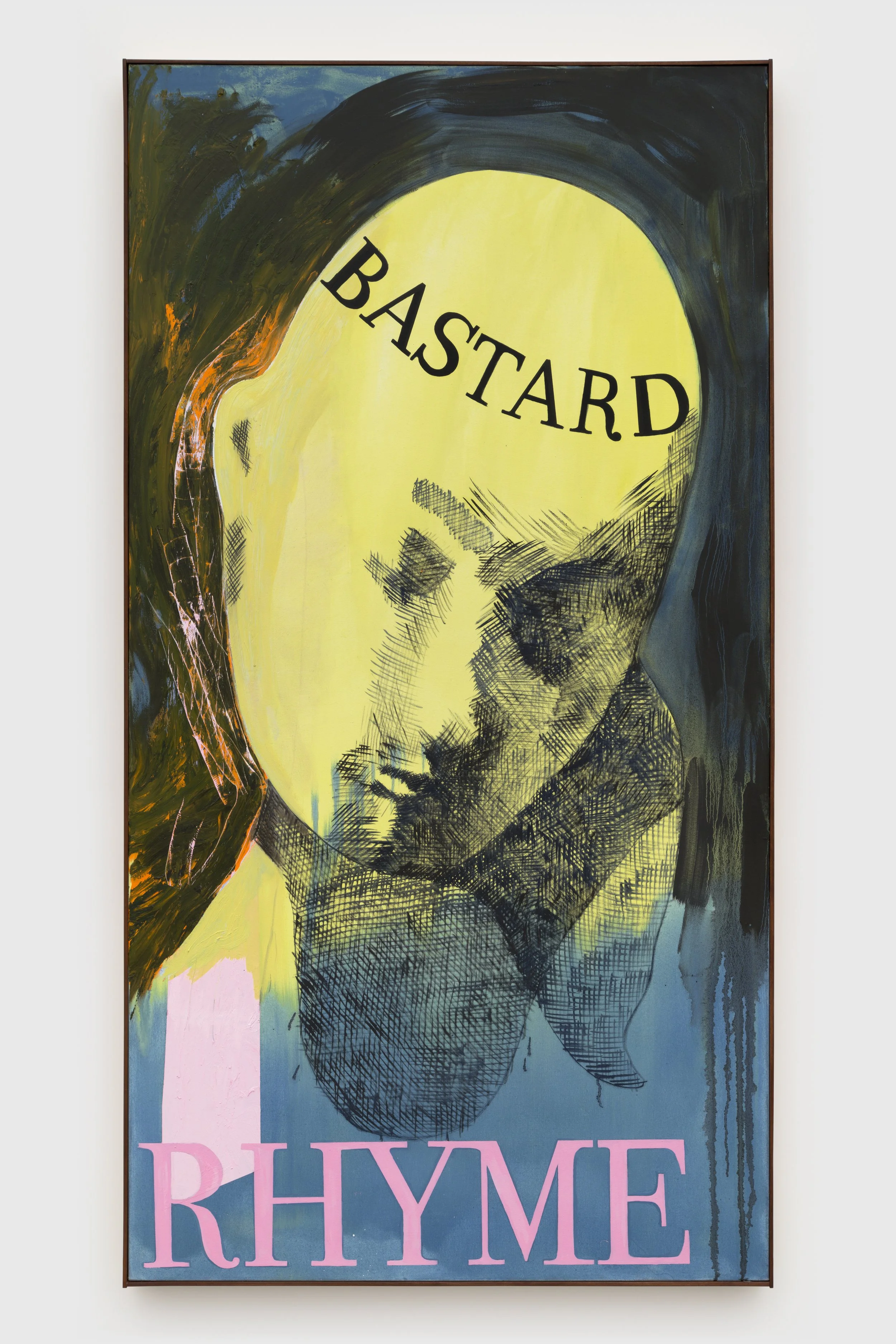
Olivia van Kuiken, Bastard Rhyme, 2025. Courtesy of the artist, Matthew Brown, and Châteu Shatto, Los Angeles
It is always conversational, always a coming-together of ideas—Alright, I like this artist and I like that artist, so what are the connections there? Or I like these artists. I'm reading this book right now. Oh my friend, she just watched this film, or read this book and something is compelling. Does it apply here? If not, I'll save this for a later date. The process becomes about juggling between ideas that I, or someone else, has, and learning from them. When the idea comes before the artist list, this still rings true. It’s just got a tinge of pretext. The dialogues still have to happen, always.
HHY: I want to go to this point you just made about getting inspirations not only from different people but also from different genres and forms of art. Novels, poems, films, music, etc. You mentioned not having studied Art History in college. I see this unorthodox mix of cross-influences everywhere in your work. For example, you situated the inquiry of “finding,” for an exhibition with C L E A R I N G, in the context of a lesser-known essay from Friedrich Wolfram Heubach; and you also once prefaced and titled another exhibition with a collection of Flaubert's satirical work, The Dictionary of Accepted Ideas. How did these come about?
RD: To put it most aptly, I am always searching. It’s very special to be a part of other people’s careers and their personal worlds. From everybody I’ve worked with—and it’s always a learning process—I take something away; whether it is a conceptual position, an author or director recommendation, the knowledge of some artifact that I didn’t know about, etc. Initial discussions with an artist start with: What are you thinking? What are some of the ideas here? But also, What are you looking at? What are the movies you're watching? Is there a book or a text or an ideological position you feel drawn to? While working with Henry Curchod on our show at C L E A R I N G, we talked a lot about one of his favorite books—A Confederacy of Dunces by John Kennedy Toole—that’s how the title for that show, Oh Fortuna! came about.
HHY: It’s very cool that these contexts all naturally converge together.
RD: At this point I have a pretty sizable library, but I used to frequent secondhand bookshops and pick things up that looked interesting or resonated. And these became starting points. Input and output need to be balanced. If anything, one should probably privilege the research, it’s a lifeblood. Burnout happens when you’ve used it all up and don’t do the work to replenish.
HHY: You mentioned that you mostly work with contemporary artists and artists who are alive, and you often reference temporal contexts and put your show in cultural frameworks and hermeneutics that are legacy and historical. I find it fascinating that if we follow your understanding of your work as an art historian, writing younger, emerging artists into art history—there is this constant meeting of the old and the new.
RD: There are so many nodes from history that repeat themselves, and ideas are totally recurring. I’m not necessarily invested in nostalgia or navel-gazing, but it can be very rewarding to dig into the archives and at least acknowledge the pretext of what I am trying to do and what artists are doing now. In a similar vein, my friend Rex always tells me to “look back but don’t stare” and I think he’s onto something…
HHY: Who makes up that pretext for you? What are some of your inspirations? What are the conditions you work within?
RD: A lot shifted for me after reading Marcia Tucker's autobiography. The New Museum is in a completely different place today, obviously, but I’m interested in the way she moved at the time and created an entirely new model.
Realistically, I work freelance. I do project by project, essay by essay. I didn't get my master's; I didn't get my PhD. I'm not really on track for an institutional position at the moment, because you need those things for it. However, one can get “over-educated” and retreat from a certain zone of naive curiosity; like you board this train with specific parameters, and once it leaves the station, you can’t really venture beyond its limitations. Working in the way that I do, I’m able to have just a bit more latitude to explore and operate with this relative naivete that the exhibitions benefit from. If you don’t learn certain rules or conventions, you’re freer to riff.
That’s not to say I’m not invested in learning… I totally am… It’s just without guardrails for now.
HHY: I was just reading Marcia Tucker’s autobiography and her collected writings. She is the best.
RD: Yeah. Outside of Marcia Tucker…I’m looking at my bookshelf right now…I like a lot of artists who also write. Luc Tuymans, for one, I love his texts. He’s also such a great curator: i.e., the James Ensor show at the Royal Academy of Arts. I have that catalogue on my shelf, and right next to it is the one for The Forbidden Empire, which he organized with Yu Hui.
HHY: Totally. I think it was done in two consecutive locations at the BOZAR EXPO and the Palace Museum in Beijing—that’s fun.
RD: —yeah, comparing Chinese and Flemish artists. It’s from 2007, so you can’t find much more information about it elsewhere, but these books are an amazing source of material. I’ve also been thinking a lot about Lucy McKenzie’s show [Prime Suspect] at the Brandhorst Museum in Munich. I have that book, too.
Film figures pretty centrally as well. I love Chantal Akerman, and Maria Lassnig is one of my favorite painters, though her videos are also pretty top. I love, love Scorsese because he reminds me of my dad, but also how he builds these totalizing experiences, his visual-sonic worlds are just so mega… Then there’s a whole rabbit hole to go down. I spent a lot of time at Electronic Arts Intermix when I was in college. Everything in that database is part of this north star for me—Trevor Shimizu, Sophie Calle, Paul McCarthy, Alex Bag, Bernadette Corporation, and so on.
I don’t just look at people in my field. In fact, I don't really feel like I've had a “mentor” or, similarly, somebody that's been like a particular guide for me, but I have had really fantastic collaborations and support along the way. I'm not without that, by any means; I’ve really had no guide, or anyone who's “taken me under their wing.” That’s not a complaint, by any means; it’s just not how things have shaken out for me.
HHY: In terms of connecting with people. You run a nicely curated and beloved Instagram. There is a lot of discourse on the role of social media and the internet in shaping our relationship, preferences, and taste with regard to contemporary art. What can we say about finding a community for art and a supporting network, alternatively, then both on and off the internet?
RD: In the simplest terms, it’s just a democratization of a certain form of access. The internet is relatively open to influence, whether that influence is true or false, bad faith or good. On the other hand… I grew up in Seattle, where I had my own brushes with art, spending my formative years in museums, but it was all pretty limited in scope. Without being in a city like New York, it’s pretty difficult to participate in a real way. I also feel pretty strongly about a firsthand experience with the thing you’re committing to, so seeing work in person is crucial. Online continues to be this extension of the real, an archive of things I’ve seen, and perhaps there’s a bit of a thread in terms of taste or proclivities… At the end of the day, I’m just playing around there.
HHY: Yeah. There is something beautiful about curating and especially your style of curating, where art stops being “ideas” and mere spectacles floating on the backdrop of history, but integral to the sensible ways you read, you see shows and see the world.
RD: In certain forms, art teaches you how to look at the world. It’s also a respite from “bare aliveness.” There is this possibility of democratization going on when more people get to experience art—and participate in it by bringing their own idiosyncrasies. But on the other hand, it can be so self-enclosed, caged up in theory. I don’t mind work that requires further engagement with a text or philosophy of thought. It doesn’t have to mean anything, as long as there’s a hook—the work, for me, has to have some sort of draw, otherwise what’s the point? I’m interested in all of it.
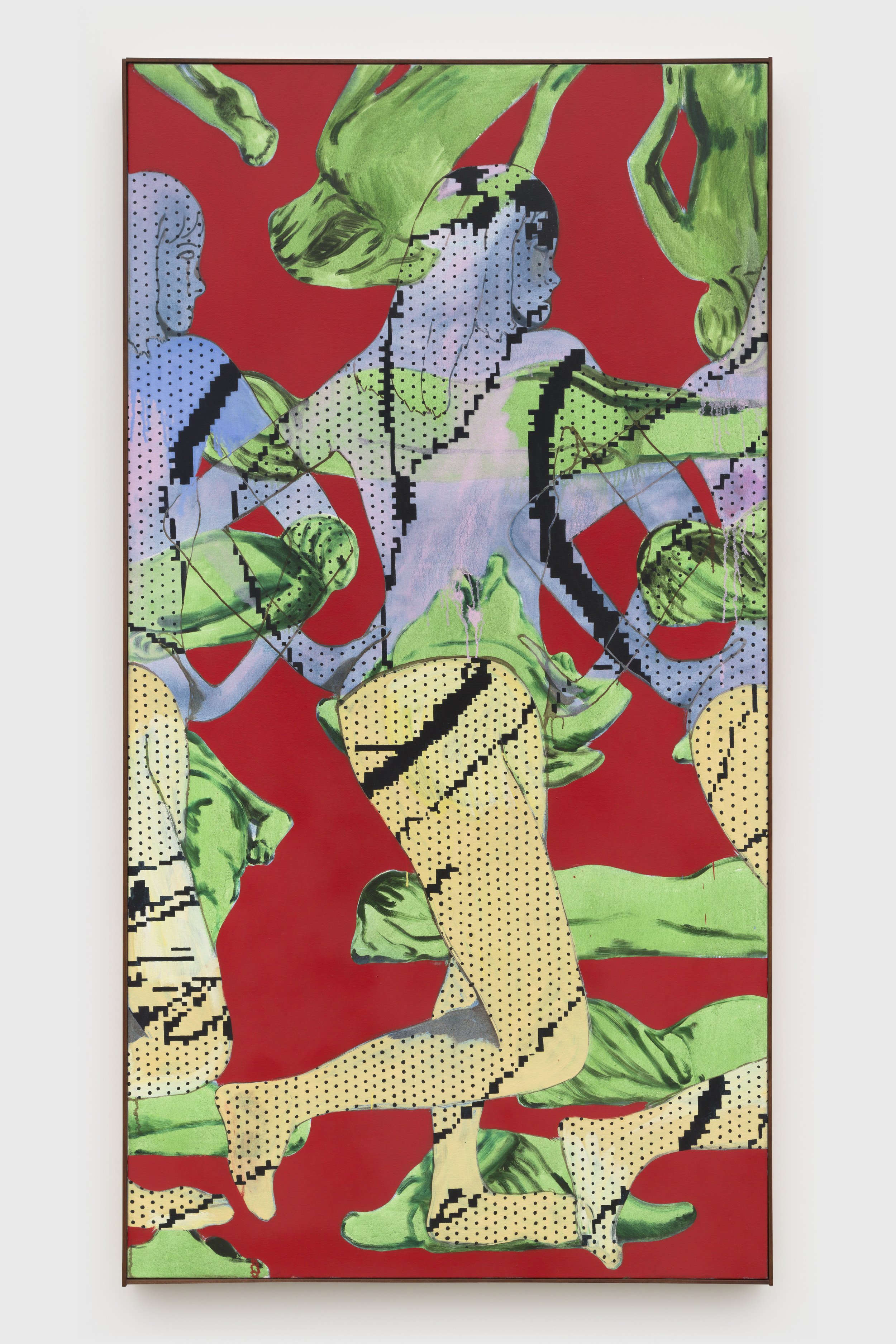
Olivia van Kuiken. Untitled, 2025