
SPRING/SUMMER 2026
Rose Friedman and The Civic Standard:
How a Small Town Cultural Project Works to Transform Society
interviewed by Makenna Goodman
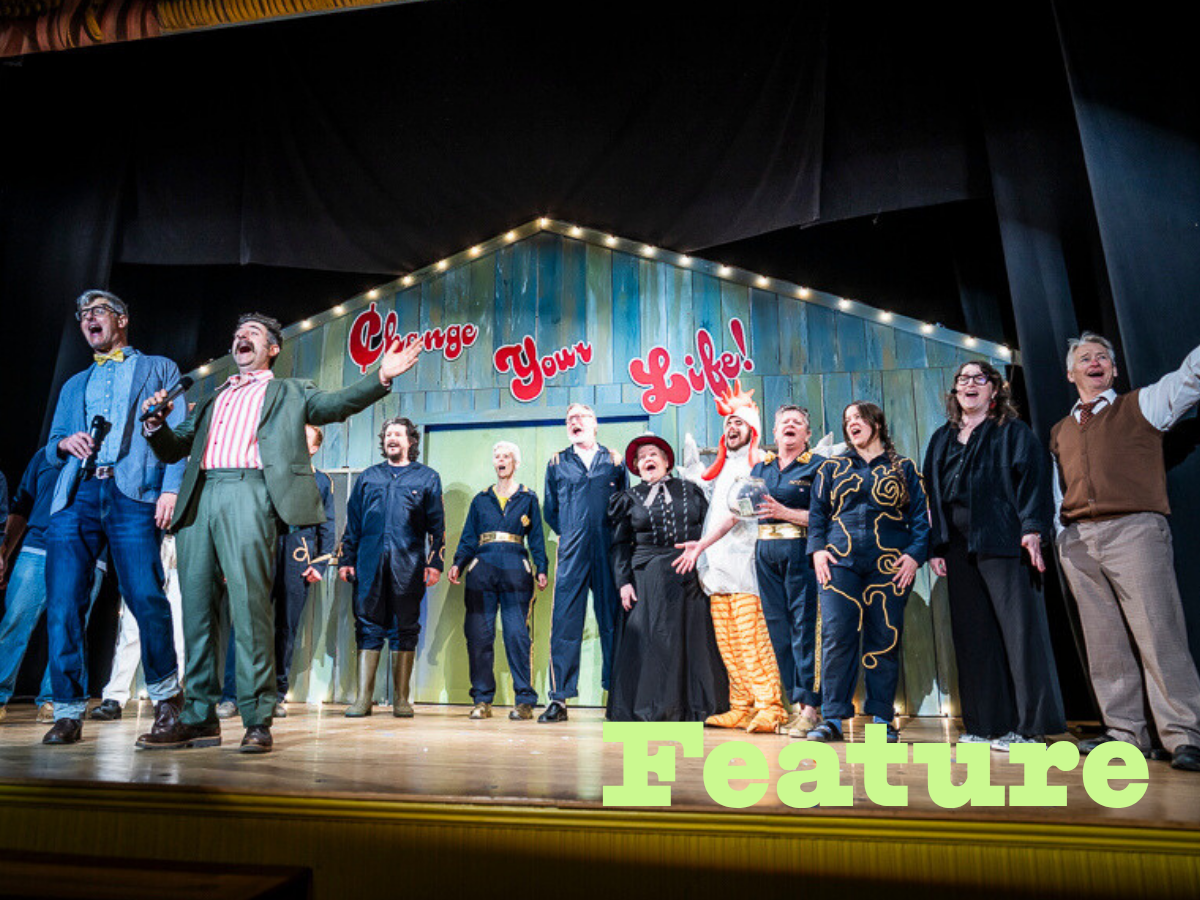
Photo: Terry J. Allen
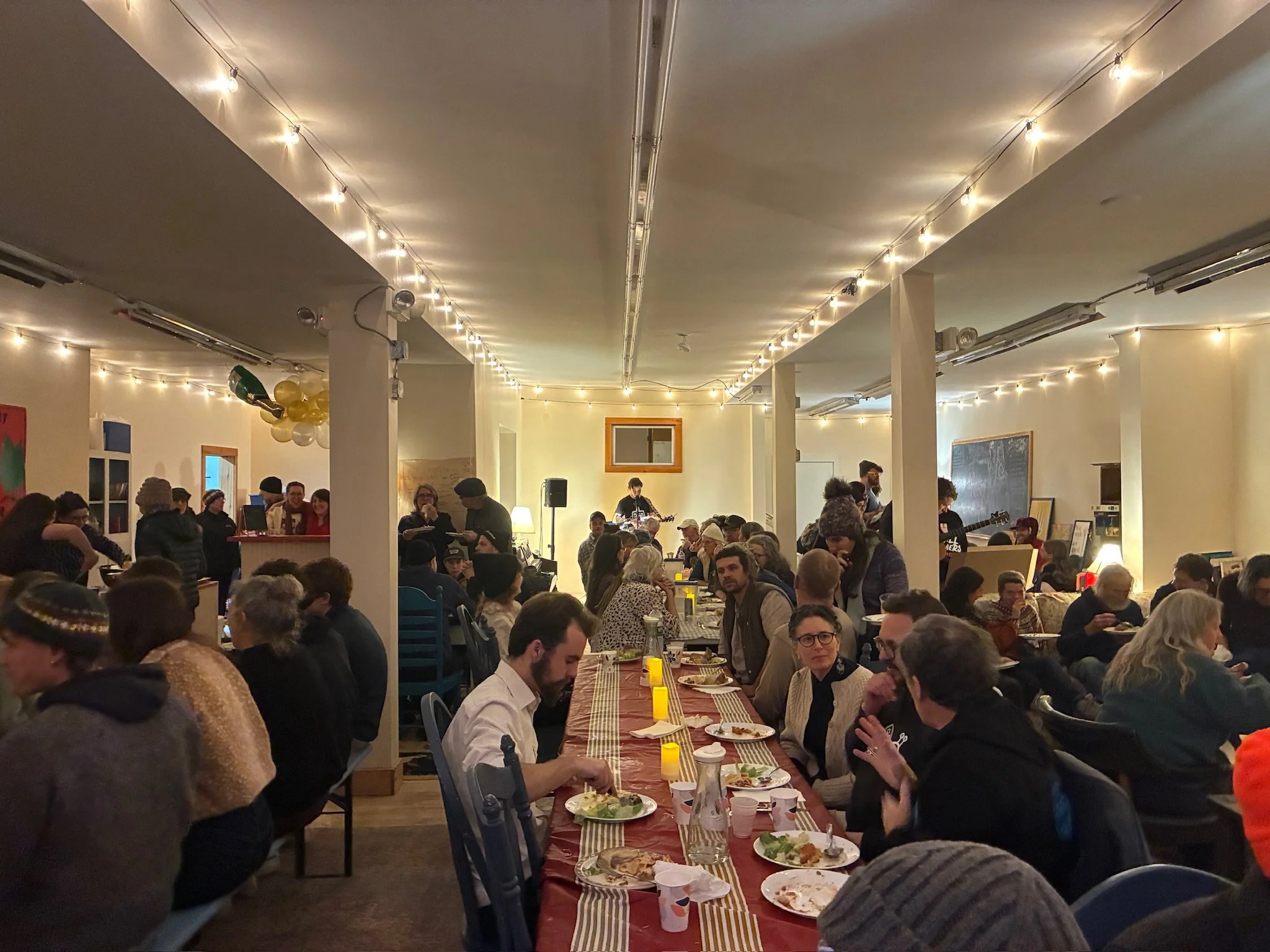
Rose Friedman is what Toni Cade Bambara would have called a “cultural worker,” deeply committed to the intersection between art making and social justice. She’s a director, community organizer (although the word “organize” irks her), and performer who co-founded and now directs The Civic Standard, which is both an organization and an idea. The Civic, as it is more commonly known, offers a weekly townwide dinner party, public living room, and collaborative art project in the small town of Hardwick, Vermont, located in the Northeast Kingdom—closer to Canada than New York City—whose mission is to listen to the townspeople in order to reflect the narrative of the town back on itself. Imagine a town center that is also an avant-garde art house, where people from every corner of the political and class spectrum gather to eat supper with one agreement only: they all live there. And, as long as you show up and have a sense of humor, you can be in the show. (Hardwick’s Town Manager plays a frequent parody of himself, as does the bar manager of the American Legion. And I’ll never forget when award-winning author M.T. Anderson hilariously performed the role of town crier, modeled after the local listserv, Front Porch Forum.) Rose also directs original vaudeville-style puppet theater shows that she writes with her husband, touring shows around the state (and often with at least one of her kids as part of the act). She studied at the Moscow Art Theater and New School University, and worked with the iconic, anti-capitalist Vermont puppet theater, Bread and Puppet Theater, for over a decade. The Civic Standard was founded as an extension of her need to be an active part of her community and an artist at the same time. She is, obviously, a force.
MAKENNA GOODMAN: Let’s start with hearing about the origin story of The Civic Standard. When and where did it begin?
ROSE FRIEDMAN: The Civic Standard grew out of years of experimentation and cultural work in our town. We put Saturday morning live kids' shows into an empty storefront on Main Street during mud season for a few years. We served free soup on the porch of the Grange Hall during COVID. We built a kid-powered carnival for the local parade, and provided a homemade midway. We built trust, we paid attention, we entertained, we joined boards and committees and looked for ways to help. When we announced the start of the Civic, we wrote, “This is a new name for something we have been doing for many years”. For me, creating the organization was the next step in a lifetime of theater making and trying very hard to braid art and community organizing and social services together but always running up against the pressure to specialize and to make sense.
The Civic as a name and an official organization began through conversation with friends. My feeling at the time was that all of the experimental event-making, theater productions, free soup, carnivals and bingo nights we had been doing over about two decades in rural Vermont needed a roof—both in terms of a name and a physical structure. I had a theory that if we had a door that people could walk through, where we could sit and do the planning and thinking and building work of all these projects—but visibly and publicly—that everyone would then understand how all these parts of life are actually naturally connected. And then we could demonstrate on a daily and consistent basis that we wanted everyone to help and participate. Having a place would mean we could move from pop-up projects to one continuous conversation with our community. I wanted to explain—I’m still trying to explain—that mutual helpfulness and civic engagement and making art are not mutually exclusive—but are, in fact, in conversation all the time, and I aim to put that conversation into physical form.
MG: Did you have a space for the organization from the beginning?
RF: Actually, no. In 2022, after getting my nerve up by talking to like-minded friends and basically daring ourselves to make something happen, we started trolling up and down Main Street, peering into abandoned houses, and asking local real estate agents for ideas. Earlier in the year, the local paper had vacated their headquarters, shifting from print to online publication only, and walking away from the office that had housed this local paper for over 100 years. We heard through the grapevine that it was going to be sold, and that they hoped to keep the paper afloat. So we reached out to the owner/editor and asked to see the building. It was all wrong. Too small for shows, too crooked for a commercial kitchen, not accessible, in need of a paint job. In need of many things. He said he’d sell it to us for $120,000. We said, “Thank you, but we have no money”.
About three months later, the pipes had burst in the basement, and the paper continued to struggle. We had looked at many more places, talked to many more people. We approached the owner again, with a different ask. We took him for coffee at the diner and proposed a kind of formal squatting agreement. “Let us set up headquarters in the building and we will spruce it up, make it cozy and cute, keep the pipes from bursting again. We could cover the cost of the utilities but wouldn’t be able to afford the rent.” Shockingly, he said, "Sure, why not? Let’s try it.” After about a year and a half of this arrangement, he donated the building to the organization.
That was almost exactly two years ago. Perched as we are just above the Lamoille River, the Civic is one of the last remaining structures on that side of Main Street. After town-wide flooding events in the short time we have been in residence, and having learned a lot about the needs and history of the little newspaper building, we decided to make a move rather than become preservationists. So we moved to a former grocery store directly across the street. The door on Main Street is now so much more than we first imagined it—as it opens onto a large and accessible gathering space, with a cafe upstairs and a studio workspace on the third floor. The same principles are still operating every day and in everything we do, but after four years, we have moved beyond a rough little experiment in cultural organizing and into something more sturdy and permanent. As permanent as any cultural entity can be, given our time and place.
MG: Would you say you’re creating theater with local residents that dovetails with your central mission of community organizing, or is this part of a larger artistic project?
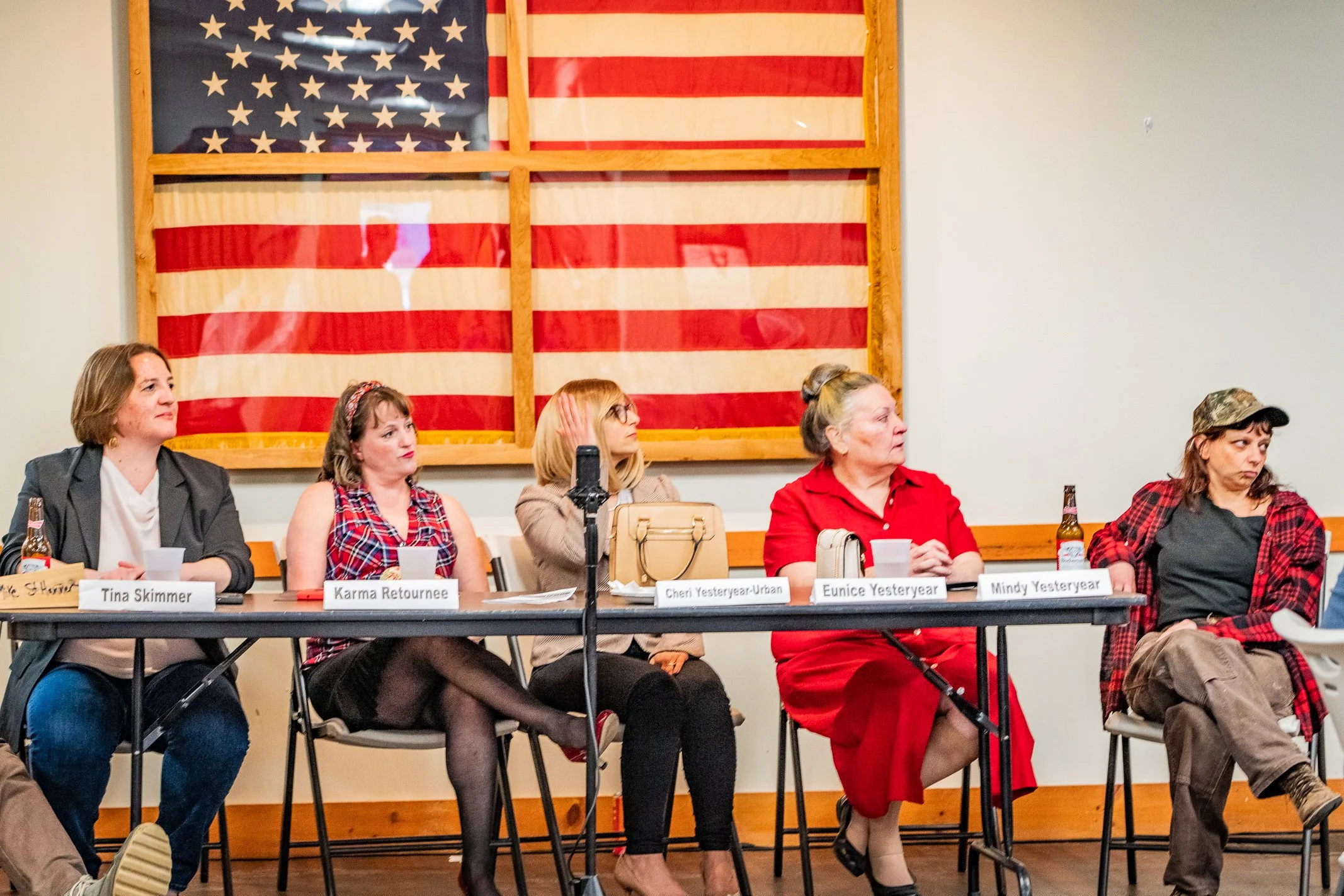
RF: There is always a larger artistic project at work, and there is always experimentation and discovery, and there is always an element of the performative or theatrical, even when it doesn’t look like theater. So, when we invite people into, say, a Mother’s Day high tea, in the park right next to Main Street with 18 wheelers and everyday traffic lumbering by, we go all out. Vintage aprons, a flowered arch entryway, homemade scones, and printed menus. Everything by donation. We try to make any event and every event feel like some cinematic fantasy version of itself. But then we also try to make them all free. There’s a ridiculous tension in that, but the homemade, low-budget grandiosity communicates a certain authenticity. Everyone is in on the joke. No tricks; just ridiculous amounts of work that nobody exactly asked for. We believe deeply in nonsense, as in the not-making-sense in the face of efficiency and profit. It is deeply illogical to make an original show with 25 performers and then put it on for one weekend in the Legion hall, where the capacity of the room is less than 4 times the number of people in the show. That just isn’t good business. And yet, it is correct. Because it feels right, and our job is to let everybody in on that feeling.
MG: So, would you call it community theater?
RF: I’d say we are creating theater with and for the community. So, we are leaning hard into what is in the air. What people see and talk about, and what is felt but not necessarily spoken aloud. That’s where the ideas should start. Of course, it doesn’t always feel so clear as that while it’s happening. It’s weirder. But often one conversation or overheard complaint will tip me towards an idea. I like to think about the things that the community takes for granted and then imagine my way into how we can all, together, suddenly notice this thing or feeling that has always been there. It’s like falling in love.
Sometimes community members have agreed to play themselves, or versions of themselves, in our shows. I am interested in the way we perform our roles in life and how to bring some of those performances onto the actual stage. I think class is a fascinating performance. There’s class in the sense that some of us have houses we own and some of us can’t afford to make this month’s rent, and then there’s also the way in which class is cultural. I’m fairly obsessed with how people in our small town dress the part— how the vehicles we drive and the boots we wear communicate something way beyond merely what the owner can afford. It’s cultural identity, it’s signaling, it is its own kind of performance. And that performance that’s all around us is not something that’s usually explicitly talked about. So when we bring it onto an actual stage, it’s like we’re holding up a mirror to the community. Sometimes it’s a little bit of a fun house mirror, but still one in which they can recognize themselves and laugh and, we hope, see the absurdity and the beauty in what we all are.
I am also a bit obsessed with theater that is not called theater. What happens when you put a proscenium arch in front of a high school basketball game? Or a public meeting about a new fire station? I have leaned into this concept when we organize bingo games or spend weeks building handmade carnival midway. There are a lot of stages and audiences even in a place that supposedly doesn’t value performing arts. I think a lot about how humans seem to instinctively understand what the rules of performance are—much the way a bird knows how to fly. We were taught how it works, but we also just have a natural proclivity and need to do it.
MG: Can you talk a bit about your inspiration, or who the Civic is in conversation with?
RF: For me personally, specific inspirational sources include Joan Littlewood, who made spectacular epic theater by and for and about working class people, Peter Schumann and his anti-specialization artistry and commitment to economic autonomy, the Black Panthers and their programs to address basic needs in the neighborhoods where they were also working towards huge social change, Hallie Flanagan and basically the entire history of theater under the WPA. All artists and organizers who have tried to challenge capitalism both in the content and form of their work; who have made art as an open protest against oppression and the endless monetization of the human spirit; and who simultaneously have tried to actually live their vision of an inclusive and just world. Theory in practice.
The Civic Standard grew out of the study of these organizations and institutions, as well as by looking really deeply at what organization or institution is needed in our time and place. We looked at the small rural schools, local churches, Grange halls, fraternal organizations, committees and clubs that have kept this place and its people alive and functional for generations. We wondered, why are so many of these structures fading away? Why don’t people volunteer as much as in previous generations? Why are we so lonely and how can we help and know each other?
The Civic is rooted in a very specific place, and that specificity is the eternal flame of all our work. We do not aim to address the entire world, or to make something that can be easily replicated in every place. So, we are in conversation with our town, Hardwick—its people, history, circumstances, regional context, and our shared moment in time. Sometimes our programs are gesturing towards the past—a movie theater that closed on Main Street half a century ago, the dance hall deep in the woods that no longer exists, the bachelor community filling the bars during the granite boom. We find a lot of inspiration in studying old and forgotten ways of gathering people, as well as the things that still sustain the particular culture of this place—the oral storytelling traditions, bingo games, church suppers, and neighborhood systems of taking care of each other. But we are also talking to the very present and living community that is right in front of us. Our theater work is shaped by the actual people, problems, ideas, and unspoken feelings swirling around town. Our direct aid addresses the very basic challenges we encounter by knowing real people in a real place, whether that is flood relief or just giving someone a ride. So, we are in conversation with ghosts and also with our neighbors.
MG: Can you speak to a couple of examples of how you’ve seen this transformation in action?
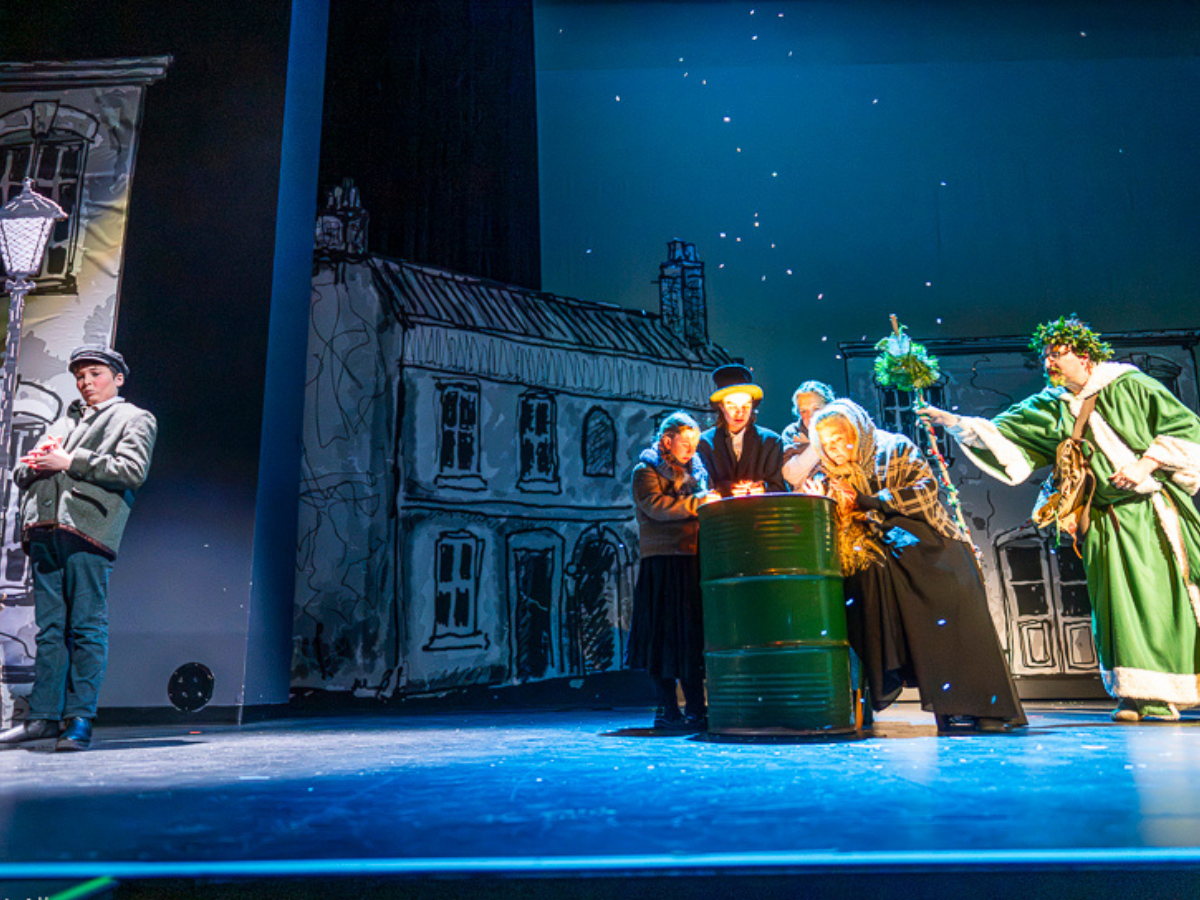
RF: Sure. Here’s one: a friend who had never been involved in theater told me that when we were working on our most recent production, he lost all sense of time and any feeling of reality. He loved being in this strange underworld and struggled to explain to his friends how intensely necessary and deeply joyful it had felt to spend an untold number of unpaid hours telling stories in a dark room. Also, in one of our shows last year, we made snow fall from the ceiling by cutting up a piece of paper into confetti and crawling into the catwalk to sprinkle them down. It was snowing outside the theater. Somehow that moment was heartbreaking to many of the audience, and communicated a whole lot about the sensation and the impossibility of being stuck in the cold.
These are tiny transformations that are fleeting and hard to describe. And they are laborious and fussy and deeply unnecessary—in the sense of physical survival or benefit to the stock market. But they are necessary if we want our actual human condition to change, for society to evolve, or for greater understanding of and empathy towards each other. Of course, if we want art to transform anything, people have to actually have access to it. And I don’t just mean discount tickets or touring regional shows to small cities. I mean the access of seeing, of making, of understanding, of affording. There are all these levels, and they all have to open the heck up.
MG: I love the image of the snow falling on stage while also falling outside. This was in your adaptation of A Christmas Carol, right? Can you talk a little bit about the shows you’ve done so far, and what you’re working on now?
RF: Yes, that scene was from an adaptation of A Christmas Carol, the most conventional “play” we have put on so far. Except that we pushed the boundaries of a reasonable number of cast members—using all 45 people who showed up to audition. That play started with the seed of an idea. In the enormous arts center the next town over, I imagined the audience assembling for a jolly holiday show and entering the lobby where a long table laden with—I mean, just groaning under the weight of—an enormous feast of figs and cheeses and cakes and jellies would be waiting. Slowly, the realization sets in that all along the giant plate-glass windows lining the lobby are at least a dozen children standing in the snow, underdressed, shivering, noses pressed to the glass, drooling over the feast they cannot touch. So, that was my starting point for making that show. The other Civic Theater Projects include, “Developed to Death,” a murder mystery dinner theater performance set in a public zoning meeting; “Garage of Doom,” a haunted abandoned automotive shop where a mysterious object opened a portal to an alternative version of our town; “Change Your Life,” a live pretend historic game show with real cash prizes; and “The Wedding Tale,” a fictional wedding which included ceremony, dinner, speeches and dancing, exploring local class tensions between “lakers” and locals.
We have just started work on a new show that I can only at this point describe as attempting to braid together the puzzles of an escape room with the frightening exaltation of an exorcism through an invented ritual intended to meet our grasping need to understand our place in the world and in history. Should be very straightforward.
MG: Very straightforward. Ha! Do you think there is something specifically Vermont about The Civic Standard?
RF: The impulse at the core of starting the Civic and the thing that guides most of our program invention and decision-making processes seems hugely human to me, not tied to a specific culture or geographic location. That impulse is a sort of childlike and innocent question about how we can help each other. Like, I see that person is suffering, and I am planning a party for the neighborhood. Can’t the person suffering be included? Is there something I can do to alleviate their suffering so that they would even want to attend and would have the capacity for something as unnecessary as fun?
At the same time, the culture we are building off of and honoring is small-town rural Vermont culture. We are not trying to improve on it or teach anyone something “better”. We are just trying to keep the threads of gatherings and mutual aid that have been here for generations alive for the next era of humanity here. Sometimes that means making it new, or making it at least seem to be new. Doing the old things in a new way. Sometimes, though, we need new ways of being together that have never existed before because the times we are living in are new. I often say that someone attending bingo in utter seriousness, with lucky statuary in tow, and someone attending their first bingo game somewhat ironically, and posting it for a laugh on Instagram—they are equal attendees. Like, I don’t really care why you are there, because those two people are at the same event, in person, doing the same thing, for at least a moment.
MG: What even is a “civic standard”? Like, how do you define it?
RF: That name was chosen for its mystery and flexibility. We liked that it sounded like the name for a newspaper, or a boat. We liked that it could be referred to as “the Civic,” which conjured up images for me of the beautiful old theaters scattered across the small cities in the Midwest, remnants of the WPA program under FDR. But I also understood that it sounds like we are promoting an official standard for everyone to live up to, or to hold as a community. So, if I imagine The civic standard for us to all hold, it’s probably that every action we choose as individuals takes into consideration the common or civic good of the whole. And, of course, the more things we do under that banner, the more we are defining what we mean by that civic standard. Personally, I chose to belong to a place and find out, experimentally, what would happen if I loved it fiercely and put its well-being into the heart of my art and life. I’m subtly suggesting that everyone else could do the same.
MG: This is one of those interview cliches, but I really love young people, so I’m going to ask it anyway. If you could say one thing to a young artist inspired by your work, what would it be?
RF: The peculiarities and limitations and liabilities of your experience, your taste, and your intellect are the toolkit for you to make your own brilliant work. I think the desire to help people and the desire to make art can co-exist within one brain in equal measure, and any two seemingly divergent desires might mutually benefit and strengthen each other. We are complicated, and so is the world.