
SPRING/SUMMER 2026
San Julián
Chase Melton
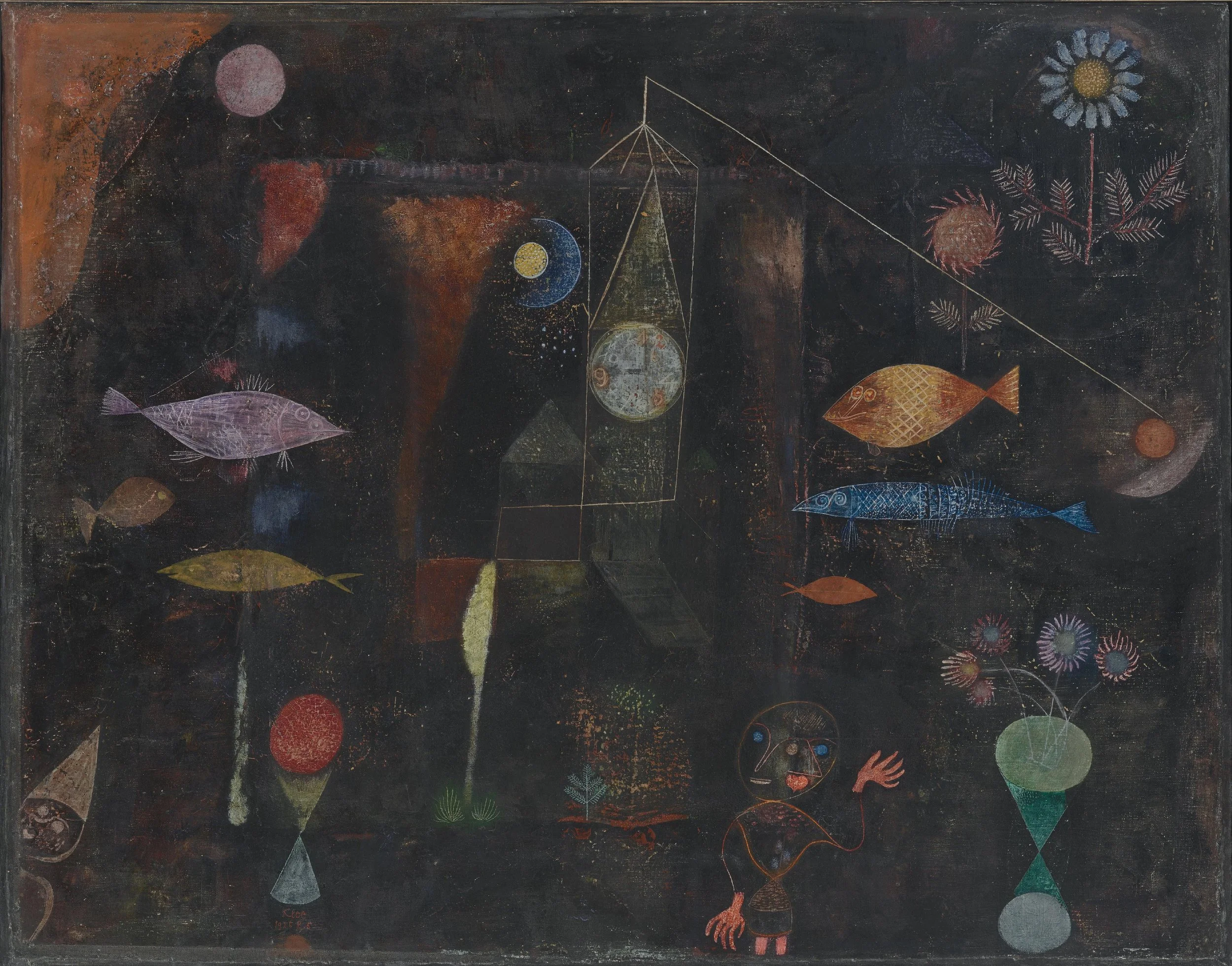
Art: Paul Klee, Fish Magic, 1925. Public Domain.
They were driving through the swamp to the taquería. Andrew stared out at the clusters of cypress trees kneeling in the black water that was always imperceptibly flowing. It was late afternoon and the sky was bright and gray. Twenty miles ahead of them the smoke plume of a scrub fire stood like a column against the horizon. He thought maybe he could feel the fragility of civilization, just a hundred years of industry and two inches of sheet metal separating him from a life out there, exposed to the elements, to the silent, undiscerning massiveness of nature.
It was Andrew’s first full day back. For the time being, he was living in his father’s condo in his hometown, a medium-sized city on the placid white shores of the Gulf of Mexico, known for its golf courses. Three days prior, David, his ex-boyfriend of nine months, had left him, and at that time he’d been between gigs and had no money and nowhere else to go. David had left him because Andrew had lied to him, a senseless, useless lie for which there was no explanation. On his roof at dusk, staring out at the identical towers of Stuytown, David had spoken firmly, pragmatically, explaining how they couldn’t go on living together, at least not right now; he was too shocked, too confused. Andrew had understood. Ever since the lie had begun he’d foreseen this ending. The only question had been how long he could bear it.
Andrew and his father parked in the gravel lot beside the taquería, a standalone stucco edifice, its outer walls a lime green. Entering the restaurant, they were met with a blast of cool conditioned air. Patrons crowded by the salsa bar, others laughed loudly at their seats. A tinny cumbia emanated from the kitchen. Maria, the owner, recognized both of them immediately. Disregarding the lunch rush, she turned and embraced Andrew, remarking to his father how much he’d grown. Andrew inquired about Maria’s son, Ignasi, a high school cross-country teammate of his. A tourist couple was trying to enter just behind them, lingering on the threshold, letting the cool air out. Maria saw the couple, had seen them from the beginning and condemned them to wait.
Maria said Ignasi was in Orlando learning metalworking. “He says he wants to help build roller coasters. I tell him, OK, get really good at it first.”
The woman in the doorway peeked out from behind Andrew and his father, holding up one finger, her mouth in the shape of an O. Maria ignored her. “He’s staying with his dad right now, to save money.”
“Me too,” Andrew said, returning her gentle smile. He thought that at any moment Maria might start crying. She’d had a reputation on their high school cross country team for bursting into tears at races, overwhelmed by her son’s struggle on the course.
“Okay, sit down, sit down,” Maria said, gesturing toward a table beneath a window. On her way to the kitchen, she glanced at the couple, still standing in the doorway, staring at her. “Come in!” She barked. “Close my door!”
Much had changed since the last time Andrew had been there. The old, grubby Spanish tile had been pried up and replaced with wood-patterned linoleum. A new purple neon sign was mounted on a wall of fake foliage, spelling the name of the establishment’s patron saint in a loud cursive font.
Also new: the saloon door through which Maria now disappeared to retrieve chips and salsa. Beyond that was the kitchen; further still, the side door, where a courier hauled in the larger cuts of meat too unwieldy and unsightly to come in through the main entrance. Andrew remembered waiting by that door often with his teammates, in the middle of their afternoon run. Ignasi would knock, and, if they were lucky, Maria would appear with a bottle or two of tamarind soda for them to share. They’d split it evenly, passing the bottle in a circle, each policing the length of the other’s sip, the bittersweet flavor like sucking a sugary tea bag. The boys’ gratitude, their feeling of replenishment, delayed their lewd comments about Maria’s curves, and her Mexicanness, until they’d put at least half a mile between them and the restaurant. And these jokes were told quietly, hidden in flurries of breathy laughter, so that Ignasi could pretend not to have heard them.
“You don’t talk to Ignasi anymore?” his father said. “You two used to hang out all the time.”
Andrew shrugged. “I guess everyone sort of scattered after graduation.”
“Maybe you should visit him. I remember you two were very close.”
“We were. But it wasn’t like that.”
Andrew had come out to his father the morning before he’d left for college. He’d worried for months about his reaction, and had ultimately decided not to subject himself to it. But his father took it well enough; boarding his flight to Boston, Andrew had received a text message from him, strangely worded: We will do this together.
Do what? But the message had assuaged some of Andrew’s worries, and—perhaps what he’d needed most of all—made him laugh. That was six years ago. Now they were together, one-on-one, for the first time since he’d graduated college. Time had muddled things; Andrew could only guess at what had changed over that interval. They’d communicated regularly, calling maybe once every two weeks, but the talk never went deep. Now he wondered how frank he could be with his father, whether that was something he should already have a hunch about.
“It’s good to have you back,” his father said, and he told the truth though he was skeptical of the nature of his son’s visit. There was nothing for Andrew here. What reason did he have to come home, other than to ask for money?
“Are you just passing through?”
“No,” Andrew said. “I think I’ll stay a while, at least a month, if that’s alright.”
Maria approached with a basket of fresh tortilla chips and two small pots of red and green salsa. She took their orders: carnitas and a tamarind soda for Andrew; fish tacos for his father. Maria moved on to the tourist couple that had come in behind them. They looked like transient visitors, not the snowbird type. They’d be gone soon, back home to Michigan, Andrew guessed; anyone who visited here in the summer was an idiot or a masochist or both.
“How’s the writing going?” his father asked.
Andrew shrugged. “Pretty sparse. I was splitting rent for a while, which was helpful.”
“A college friend?”
“Boyfriend.” He took a gulp of water, too cold, his teeth ached.
“I’ll never understand why New Yorkers pay so much just to live,” his father said, after a pause.
Andrew nodded. “Living’s not so great.”
Maria arrived promptly with their food. “Careful, the plate is super hot.”Andrew wasn’t hungry, but he bit into a taco while she lingered, setting down napkins and extra tortillas, just to flatter her.
“This is so good,” Andrew said. Maria smiled and ran off again.
“What was his name?”
“David.” Andrew said. “We lived together for almost a year. He ended things three days ago. Work was slow, I didn’t really have any money or anywhere else to stay.”
“Wow, I’m sorry, Andrew,” his father said, visibly upset.
“He had the right to be angry. He went out of his way. He let me sleep an extra night on his couch when I couldn’t find a flight.”
He stopped himself, unsure how to go on without summoning up the whole knotted mass of the story. How would his father react if he told it all straight up, start to finish, exactly how it had happened? It would bounce right off of him; he wouldn’t be able to absorb it.
“It was something you did?” his father said.
This was the situation: Eleven months ago, when Andrew and David had gone to bed together for the first time, and David had entered him, Andrew had felt a wrong feeling, a burning and stretching friction. It had required all his focus not to cry out, not to wrench himself away from David. He’d received plenty of times in this way before, and had developed a kind of regimen for it; lube, deep breathing, a stepwise list of both mental and physical exercises for easing the discomfort. It had worked for him until now, now he felt like there could be no ease, no comfort; nothing worked, the pain would not subside, it was like being punished for something. David had sensed him tensing up, he’d asked Andrew if he was hurting him. “No,” Andrew said, and they’d continued, though beneath their moving bodies, tucked beneath David’s comforter Andrew’s fists squeezed sweaty ridges in the sheets. He’d still seemed rigid to David; something was off. “Are you sure?” David said. “We can try a different position, or use more lubrication.” “No.” Andrew spoke eagerly. “You feel perfect.”
They had loved one another, because love was possible amid deception. They’d moved in early on, living together in David’s one-bedroom loft for nearly a year. David was enrolled as a Ph.D. candidate in Classics at Columbia; Andrew contributed art writing to various publications and occasionally photographed concerts and weddings. They’d shared a group of friends, mostly downwardly mobile Ivy League kids interested in bouldering and ditching their iPhones. By David’s side Andrew had built himself a life in New York that, growing up in Florida, had seemed impossible to him. At times he joked about making certain decisions—attending a gay bathhouse with David, piercing the skin on the bridge of his nose, then letting it heal over—that he thought would ‘scare’ his younger self. David reminded him to be kind to that poor boy, unaware and unbelieving of the pleasures to come.
But one thing had to be imperfect, and this was Andrew’s pain, which he observed himself guarding jealously as the relationship progressed. He wouldn’t let David share in it, rejecting and taking offense at David’s offers, both stated and implicit, to penetrate him less frequently. When, perhaps sensing the fugitive manifestations of Andrew’s discomfort, David began initiating sex less often, Andrew confronted him angrily about it. When David would ask whether he was comfortable in bed, sometimes rephrasing the question so as not to trigger him, Andrew would get upset, push away from him, ashamed of his lie but secretly relieved, the burning in his bowels fading to a dull throb.
Ultimately, it had been his own fault. He didn’t blame David for leaving him, sentencing him to this second childhood in his hot blank state of origin. Andrew’s complete understanding of the situation even interfered with his idea of missing David. But he missed his apartment. The morning kitchen where they always talked. A channel of slanted light shot through the gap between two buildings across the way and spilled onto the floor, the reflection yellowing their chins like a buttercup. On one of these mornings, coffee brewing in a silver pot on the stove, David proposed that they open the relationship. No mutual friends, no ongoing entanglements, just hookups, people they’d find online. They would communicate freely, no need to disclose everything but no secret-keeping. What choice did Andrew have but to agree? Probably David was tired of worrying, not knowing whether he was hurting Andrew. His certainty of his partner’s desire for him had been taken away. He wouldn’t investigate the loss, respecting Andrew’s privacy, but he would seek certainty by other means.
Rather than driving the two of them apart, their openness had worked as a pressure valve, bringing relief by slightly reducing the quantity of intimacy each expected from the other. Though he took little advantage of their openness compared to David, Andrew quickly realized that they had made the right decision. Now they spent more time simply in one another’s presence, going about their everyday lives, running errands around the city together. They spent more nights in their apartment, just cooking or reading in each other’s company. They had gentler and less frequent sex, and Andrew felt the pain less often. Its occasional memory reminded him of the contingency of their happiness.
“I was seeing someone else,” Andrew said. His father’s eyebrows rose slightly but his face betrayed no real surprise. The half-lie placed him on a kind of false common ground with his father, whose infidelity had led to his divorce from Andrew’s mother during Andrew’s second year of high school.
His father sighed. “I see. How long did this go on?”
“A few months,” Andrew said. “Like, three. I don’t know why I did it. I didn’t enjoy any part of it. It was the stupidest thing I’ve ever done.”
He wondered what his father was thinking, what his own infidelity meant to him now, after so much time had passed. He’d done a good amount of dating since the divorce, mostly younger women who didn’t yet have children and wanted to start families. These relationships rarely lasted longer than a few months, dissolving into a kind of oblivion when the novelty faded and both parties were forced to acknowledge the logistical mismatch. Perhaps the punishment for Andrew’s father’s unfaithfulness had been a kind of temporal exile, dooming him to asynchrony with the lovers who entered his life.
“Ooh,” the female tourist said. “Wow, gorgeous.”
“Look at that,” said her husband. Maria had emerged from the kitchen holding a massive, Hulk-green margarita. When she set it down, some of the liquid sloshed up and over the rim and onto the table. The tourists’ smiles faltered. Maria murmured something inaudible as she went back into the kitchen.
What did he want from his father? He’d proposed that they come here, to Maria’s restaurant, in pursuit of an impulse just to sit down with him, to hear something from him, to tell him something. But now that it was time, he couldn’t actualize in words what he wanted to say. They had spent so much time apart—was this why they now seemed to lack something shared and crucial? The gulf between them was wide and treacherous and they both stared into it. They spoke simply, slowly, so that the other could hear across the distance.
“One misconception about cheating,” his father said suddenly, “is that it’s pleasurable.” He wiped grease from the corners of his mouth with a napkin. “It’s easy for people to understand why lying is painful. It’s true. It is. The lying ruins everything in the end. But what no one gets is that everything that’s appealing about it—the sex, the transgression—it’s not enjoyable, either. It’s just as bad.
“I was never bored or dissatisfied with your mother. During the affair I was in constant pain. The sex wasn’t a source of pleasure for me. I felt it, but only in my body. It paled in comparison to the pain, which felt bigger than me, like it was happening somewhere else, out of my control. I’ve thought a lot about why I did what I did. What led me to do something that hurt me and you and your mother and the woman I was seeing. If you think about it in positive terms, it doesn’t make sense. There was something irrational, just destructive, that was motivating me back then. It wanted chaos; it wasn’t looking out for me or for anyone. I’m not trying to say I shouldn’t be held responsible. I did all that. Still, it’s not so easily explained.”
Andrew couldn’t meet his father’s eye. Perhaps his father, oblivious to his lie, thought that they were connecting in a meaningful way. Perhaps they really were. Hadn’t he and David loved one another, in spite of his falsehood? Surely the part of him he’d inherited from his father, the purely negative part that had also birthed the lie, hadn’t disqualified him from love. Had it? He remembered the look on David’s face that morning, clear and certain: an artless communication of love.
How drastically one piece of information can denature a face, giving it the power to reach out to the person it is looking at and condemn him, kidnap him, pulling him into its foreign and fearful world. David had never excelled at masking what he felt. “Fix your face,” Andrew had often whispered to him, when he’d caught him passively scowling at someone he disliked, at parties or on the streets around the university; usually an academic type, or a self-declared ‘radical artist’ he found phony. At this David would relax his brow, soften his frown.
They’d been in the kitchen talking; maybe Andrew was complaining about some new movie, he couldn’t remember the specifics now. And David had given him a look while he was listening, a squint, maybe he’d even stuck his tongue out just a bit, and then, looking back at him, Andrew had been absolutely certain that David loved him. Well that’s that, Andrew had thought, it’s the future now, there’s no more hiding anything. Part of him thought David might understand, while another part feared unto death. But their living together had become easy, their love now expressly manifest; he’d felt emboldened to gamble on its strength. He’d thought maybe it could survive even this.
The hot water forced itself through the grounds into the upper chamber, halfway between liquid and vapor, making a loud sputtering noise. Andrew said, “I’ve been keeping something from you.” He had to lean over and switch off the stove, because David would not move.
He remembered the immediate revulsion on David’s face, the disgust that was also self-directed. The kitchen was silent. David’s expression softened very slowly. Then he made a horrible comparison, an awful self-accusation. “No, don’t say that,” Andrew said, frightened, feeling like he might stop breathing at any moment. He reached out to touch David’s arm but it felt dead, and the deadness spread to Andrew’s hand. “It was all my fault. It wasn’t like that. It’s not similar to that at all.”
They stood there, not speaking, for a very long time, the smell of burnt coffee filling the room. “I’m sorry, I’m confused,” David said faintly, as if no energy remained in his body, before going into his bedroom. Andrew followed David that morning like a ghost around the apartment, his feet barely touching the ground. He stood outside the bathroom, listening while he splashed water on his face. He watched him get dressed, unable to comprehend what he was seeing.
It was a Sunday. David packed a small bag and walked out the door.
Across the table, Andrew’s father was squinting at him. The same cumbia came from the kitchen, more audible now that the crowd had subsided; the melody was lively but the lyrics were sad. Exhaustion was pooling in Andrew’s body, stinging his eyes, pulling his shoulders to the floor. All he wanted was to sleep. He shut his eyes and leaned back in his chair, holding his elbows in his hands. He asked his father if he could go out to the car to lie down.
But when he opened his eyes, his father had gone from his seat. The window cast a square of yellow light across the linoleum tabletop, warming Andrew’s face against the conditioned air.
They drove north through the downtown strip, past the sleepy storefronts with mysterious, darkened apartments above them where no one ever seemed to be living. Everything approached and then fell away: the upscale French bistrot with valet parking, the Old Florida ice cream shop duping Hemingway’s Key West.
His father rolled down the windows and the car filled with wind. Andrew’s long hair blew across his face, smelling of pork grease. He rested his head on the hard sill of the window. They passed his old high school. Sunlight glinted off the old press box, perched high above the fenced-in football field.
Eventually, Andrew noticed that they weren’t going back to his father’s place. They’d blown past the turn and were heading north, toward Fort Myers. “Where are we going?” Andrew said.
His father merged onto I-75, heading north. They crossed the long bridge over the Caloosahatchee, and Andrew saw the blurry line where the river’s blackness met the bright green wash of the Gulf. On the other side of the bridge they took a road that skirted the coastline. They caught glimpses of the setting sun through the mangroves.
They stopped at a public park, where children played on monkey bars and swings. Two nuclear cooling towers cast their long shadows over the mulched expanse. In the winter, locals and tourists alike flocked here to see the manatees that lingered in the warm wastewater lagoon next to the power plant. People made a day of it—they brought out their grills and picnic blankets, tossed footballs. They lined up and peered down at the strange, somnolent beasts, bumping up against one another, their angelic bulk suspended, almost inanimate. They let their kids run freely.
In summer the park was less crowded, the lagoon empty. Simon and Andrew walked for a while on a path that ran along a tall barbed-wire fence. At last they came to a dead end, beyond which, when they pushed through some foliage, was an isolated beach, a narrow, dilapidated dock the only visible human trace.
He understood why his father had brought him here. This was where the big fish lurked. Lumbering, prehistoric things, eyes the size of softballs, mouths wide as dinner plates. Andrew’s father had been fishing since he was a child. His own father had brought him here on the day after his ninth birthday, and just as soon as Andrew turned nine, he passed down the tradition.
His father had placed a sardine in his hand, pointing out toward the end of the dock. “Go out there and feed a tarpon,” he’d said. This command had struck him as different from other moments of instruction. His father was a well-mannered man; rarely was he short with Andrew. But now there was something lawless, primitive, in his voice. Or maybe, rather than a new thing being added, something was newly absent, something that until now he hadn’t had occasion to miss.
He’d looked at his father, and his father had looked at him and time stretched itself out. He began to see —he didn’t know how—things he had done and things he hadn’t done. And he saw things he might do, if he was a different version of himself; someone taller, made of hard bone and muscle. He saw this man standing on the end of the dock. The man lay down, belly-first, across the planks as Andrew looked on, barely ten years old, and as he watched a new pain bloomed beneath his stomach. He watched as the man lying prone extended his arm, dangling a sardine just above the surface of the water. The bait fish swayed there for a moment. There was no wind; everything was still. Then, in a bright burst of movement, a hulking, shining, silver flash emerged from the water mouthfirst, swallowing the sardine and the man’s hand with it. The lustrous, monstrous body sat suspended for a moment in the air. At the last second, just when Andrew thought it would be severed, the man removed his hand from the creature’s mouth, and the fish crashed back down into the water. The man turned and looked at Andrew. He smiled, holding up his unscathed hand.
He knew he couldn’t do it. He could barely walk out there without fainting. That day, he’d taken ten slow, staggering steps forward and stopped before the end of the dock, too afraid to look down. Enraged, he’d thrown the sardine with all his might. It barely cleared the last plank of the dock, plopping pitifully into the water.
“You’re a good kid, Andrew,” his father said. The sun was a bright pink dome on the horizon, spreading its neon fingers in the clouds. His father looked out past him, staring right at it as he spoke. “Whatever I have, you didn’t get it.”
The water where he came from was cloudy and green. If you looked closely, in the light, with your face right up on top of it, you could see things that were maybe a few feet down, but you could never see the bottom. How to achieve this closeness? Lying on your stomach across a dock, with just your head sticking out, and no fear in your heart.
In the dusk he walked out onto the wobbly planks, holding in his hand a piece of fish from Maria’s kitchen. He walked to the end and looked beyond it, and he saw the orange of the sky, floating there. Slowly, carefully, so as not to scare the fish away, he lowered his body to the wood until he was pressed flat against it. He inched forward so that his head protruded over the calm surface of the water.
He saw his own face warped and wobbling beneath him, distorted in all directions like a kneaded ball of clay. Beyond that there was nothing. He turned his head toward the shore, where his father sat on a rock, turned away from him, his attention focused somewhere on the horizon.
Andrew extended his hand over the water. He tried to breathe evenly, to keep his hand from trembling.