
SPRING/SUMMER 2026
Semaphore: Codings
Chris Kraus

Photo: The Semaphore Alphabet, from Code Poems, Hannah Weiner.
For Nikolas Gambaroff
Pictures and Early Words
This is the third of four early journals: The Fast
Written in 1970 and published by United Artists:
Country, 1971: Pictures and Early Words, 1972:
Big Words, 1973. These journals depict the
development of the clairvoyance from feeling
and seeing auras, to seeing pictures, and finally the
slow development of seeing words which first
appeared singly, then later in short phrases. The
culmination of these early works resulted in
the Clairvoyant Journal, written in 1974 and
published by Angel Hair, now known as United Artists.
The first word I saw was in August, 1972. It was
The word W
R
O
N
G seen diagonally on my pant leg.
This book begins in September, 1972.
Hannah Weiner
Silent Teacher
Among my old notebooks I find one labeled “CAPITAL—notebook #2.” It’s a notebook I kept during my first year in New York, which was most likely 1976, though I’ve lied about dates for so long in an effort to keep my age—or rather my “generational identity”—ambiguous; I don’t really remember. The poet Fanny Howe remarked that as she gets older, the illusion she’s happiest to shed is the importance of being accepted by members of her generation. Who, I asked Fanny, did she consider her generation? The poet John Wieners sprang to mind. In his magnificence, his dispossessed Boston Brahmin’s stately clairvoyance, I’ve always considered him to be her closest peer. “No,” Fanny said. He was several years older. And then she named several names, New York names, names of poets whose work seems to me of no more than contextual interest.
I was born in New York in the mid-1950s and have never once felt any affinity to what could be described as “my generation.” Too young to participate in the events of the 60s, too old to convincingly mimic the ontological amnesia of those growing up two decades later, those of us born in the US during those years have left no trace, as a group, on the culture.
In 2008, Nikolas Gambaroff produced a series of paintings titled 8864 3362 2250 Z1 CDGRT, referencing Stanislaw Ulam’s innovative streamlining of statistical sampling techniques through the use of early electronic code that has come to be known as the Monte Carlo Method. Best known for his work on the hydrogen bomb, Ulam conceived these ideas in bed, playing Solitaire, during a lingering illness. It was 1946. Fast computers were already in use among scientists and military researchers and strategists. The method was further developed within the RAND Corporation, a technology and policy think tank formed in the late 1940s to provide research and analysis to the American military. The acronym stands for “R[esearch] AND D[evelopment].” RAND/random. Gambaroff’s paintings are rectangular blocks of color and pattern: webs, bars, the movement in paint in some of the frames obscured beneath washes of color. Black, azure, chloroform gray and sienna. I find them accomplished and visually pleasing. On the day of the opening, the paintings were taken down from the wall by the artist and his friend and collaborator Ei Arakawa and, reborn as integers or early internet message-blocks, physically moved around in the gallery. Photos were taken throughout this activity, and these would become part of the exhibition. In one of these photos, a man lies on the floor beneath seven large canvases, buried except for the soles of his shoes and lower pant legs.
The notes in my Capital notebook came from a series of classes I took at the School for Marxist Education with its founder-director, Arthur Felderbaum. Newly arrived from New Zealand, where my parents had emigrated, I was a Marxist—i.e., I still saw the world in terms of causalities. Tuition was free, I wanted to meet other people, and everyone knows you’re not a real Marxist until you’ve read Capital. The School occupied several rooms on the third floor of a building in Sheridan Square in the West Village. Amiri Baraka, Franz Fanon and other political theorists taught workshops there, but the core of the curriculum was a close reading of all three volumes of Marx’s Capital. Patiently, night after night, Arthur explained the mechanics of dialectical materialism to a handful of people sitting on folding chairs in front of a chalkboard. A barrel-chested man in his 40s, Arthur taught Marx with fervor and discipline. Classes took place in the evenings, in deference to the School’s presumably working-class students, although only a few of our cohort held actual jobs. I sold counterfeit subway slugs in the park. Others were on unemployment, or collecting SSI disability benefits.
Arthur despised capitalism with the most luminous, and at heart utterly reasonable, form of hatred. He was a born raconteur. Dressed like a math teacher in button-down shirts and plastic pocket protectors, he sometimes digressed from the complex equations of quantitative determination of relative value he wrote on the blackboard (“Isn’t this blindingly clear?”) to tell stories of real-life repression that were no more or less than the logical extension of laws set forth in Capital. He’d just come back from New Jersey, demonstrating against the arrest of Assata Shakur, a Black Panther educator being held without bail in the Clinton County Correctional Facility for Women for a murder she did not—could not have—committed. Assata, a frail woman in her mid-20s with a Hunter College BA, had, like Arthur himself, grown up in the Bronx, and he recounted the beatings inflicted on her while chained to a hospital bed as if they were family. “And all of this is taking place in broad daylight, in Clinton, a town which—you would not believe, is all roses and white picket fences—a scene straight out of Leave It to Beaver” (Years later, after Assata’s daring escape, I’d make a pilgrimage to Clinton, a place that had become more vivid to me than places I’d lived, thanks to Arthur’s description.)
Like all the most scorching hatreds, Arthur’s was driven by love. It was his belief that anyone has the capacity to understand and transform the world. All the keys to understanding society are held by its means of production, he argued nightly. Labor, i.e., time, once congealed in commodities, becomes abstracted through laws of exchange. “C+V+S = - C+V = S,” Arthur said, and I wrote. He never moved on from even the most difficult point until he was sure even the slowest among us had grasped it. He was a good man, a simple heart. As a young woman alone in the city, I was a palimpsest, a waiting receptacle for the ravings and diatribes of those I encountered. At that time the idea of goodness moved me to tears; I held it tight in my chest like the promise of some kind of salvation.
Arthur’s school attracted a disproportionate number of schizophrenics and perhaps this isn’t surprising, since schizophrenics are so intensely engaged with the intricate workings of systems.
GOOD PUSSY YOUR MONEY
The American poet Hannah Weiner wrote in 1974 in her Clairvoyant Journal. She was living on Sullivan Street in New York City and seeing words on her forehead, in the air and on the foreheads of others. These were the words she wrote down and she welcomed them. “I’d much rather write what I see than what I think,” she remarked once.
Go to country tomorrow. If I stay home, will K call? Bubble on
call. Bubble on stay. STAY HOME on gate. See COUNTRY on
radiator. (I see the words as I’ve written them in the
notebook.) See radiator on bed, phone on radiator handle,
handle on gate. —Hannah Weiner, Clairvoyant Journal
Patrick Durgin, Weiner’s foremost interpreter, has called her the inventor of “avant-garde journalism.”
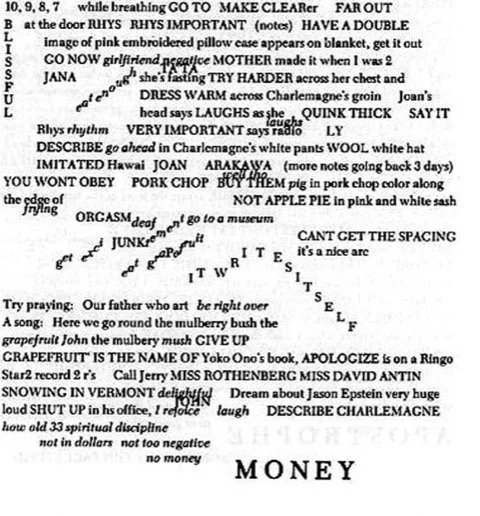
From Clairvoyant Journal, Hannah Weiner.
Years later, Weiner’s work was embraced by the Language School poets. In a hilarious, highly precise conversation conducted by Weiner with the poet Charles Bernstein towards the end of her life, Bernstein asked Weiner if she was “ever embarrassed by what you write about in the journal, by the openness of it?” “Oh Charles,” she replied, “I don’t have time to be embarrassed! I’m always seeing words! Or hearing voices, or whichever form the clairvoyance takes.” Asked if the three voices that narrate the Journals are a form of écriture féminine, she replied: “Oh. Well, I don’t know, Charles, I bought a typewriter. And I looked at the words all over the place and said, you have three choices: caps, italics and regular type, and that settled it, that’s all. The words settled down to three voices.”
Weiner had already composed the Code Poems, a series constructed completely from fragments of the International Code of [Maritime] Signals, superimposed onto the bones of classical literature. For example:
MFD Juliet: Try to enter
KZU Romeo: I am in difficulties; direct me how to steer
OOX Juliet: You should swing and enter stern first
HBK Romeo: What is the nature of the bottom or what kind of bottom have you?
HAY Julie: Double bottom
FHR Romeo: Stern way. Going astern
LK Juliet: Go Astern easy. Easy astern
ODI Romeo: I am going full speed
C Juliet: It is not safe to go so fast
KKZY Romeo: It is difficult to extricate
In 2009, Nikolas Gambaroff produced an exhibition at Pro Choice in Vienna with Ei Arakawa that consisted wholly of pairs of spray-painted letters on paper, joined to form monograms. (In subsequent shows, the monograms were painted on textiles and draped in small spaces like curtains, wall-hangings or tent-flaps.) As he explained to Nic Mauss, the project began “as a proposal for a fourth, even though very impractical language, for Bolzano, Italy. The idea was to create a written language that would use the given structure of any language and collapse pairs of letters onto each other to create a series of monograms. Seemingly an unlimited stream of monograms.” Conceived to be spoken out loud with equally weighted stress on each letter, the viewer/speaker finds him or herself producing strange unintelligible sounds, which results in a perpetual failure in actually uttering them.
A few years after leaving the Marxist School, I worked briefly as an assistant to the artist Denise Rosen. The unpaid job consisted of showing up once or twice a week at her raw loft in the ungentrified West 20s and doing whatever small tasks she might have for me. By now I was working in topless bars to support myself. At our first meeting, Denise made it a point to tell me that she had worked at Billy’s, a scummy topless place on the corner that catered to truckers, a place that neither me nor my friends would ever deign to set foot in. I found this quite strange: Denise was older than me, she had a loft, she got grants, she was supposedly a real artist. If Denise was like me, why would I work there for free as her sometime-disciple?
I didn’t keep the job long. Mostly Denise wanted me to type up her diaries. The entries were short—never more than half a page per entry—and they never pertained to actual people or even occurrences but to her dreams and thoughts. It was an ongoing work—reflecting, she told me, more than a decade—but there wasn’t much of a backlog, so either Denise typed the earlier pages herself or she’d had it done by other assistants. Even then I knew she was lost. The dreams struck me as pointless, a strained production of arbitrarily gathered false information, like small stunted potatoes left to decay in a plowed winter field. I was only vaguely aware of an already long-gone artistic tradition that must have informed Denise’s project… the fat assemblage ‘zines put together at the dawn of cheap Xerox. “What interested you about the kinds of diaristic materials that would normally be excluded from diaristic poetry?” Bernstein asked Weiner. “Oh,” Hannah said, “it came from conceptual art. There was an idea in the late 60s and early 70s to document everything.” Even then it seemed to me there was too much information, thousands of people busy secreting and filing trace proofs of a shadow existence.
There is a moment I’ve witnessed among some of the people I knew then: the instant the madness leaves his or her face and they are no longer possessed, just empty, as if newly abandoned by a lover or parent. How could you do this to me? How could you leave me? And there’s a slapstick aspect to this, because this singular moment is highly recurrent.
Denise knew Hannah Weiner. They were friends, and as Hannah’s fame (relative, obviously) increased, Denise made much of their friendship. She shot Super-8 films of her and Weiner together; she talked about doubling. Both were Jews, although Hannah’s background included money and Radcliffe, while Denise had grown up in the same borough as Arthur. While madness isn’t selective according to class, it could be that the more privileged are better equipped to embrace madness wholeheartedly, give it its due, take it more seriously. Hannah’s writings are the product of so much content she had to invent a new form to contain it… whereas Denise was straining, as if she’d come to art through some nepotistic appointment, not sure what the job was.
I knew Hannah Weiner less than I knew Denise, but in the dozen or so times I saw Weiner, she never struck me as lost. She was intact: all Hannah all of the time… Her frizzy gray hair, a ski cap, a parka. Unlike most of the poets I knew at that time, she was open and friendly.