
SPRING/SUMMER 2026
Seven Questions with Joanna Walsh
interviewed by Rachel Kamphaus
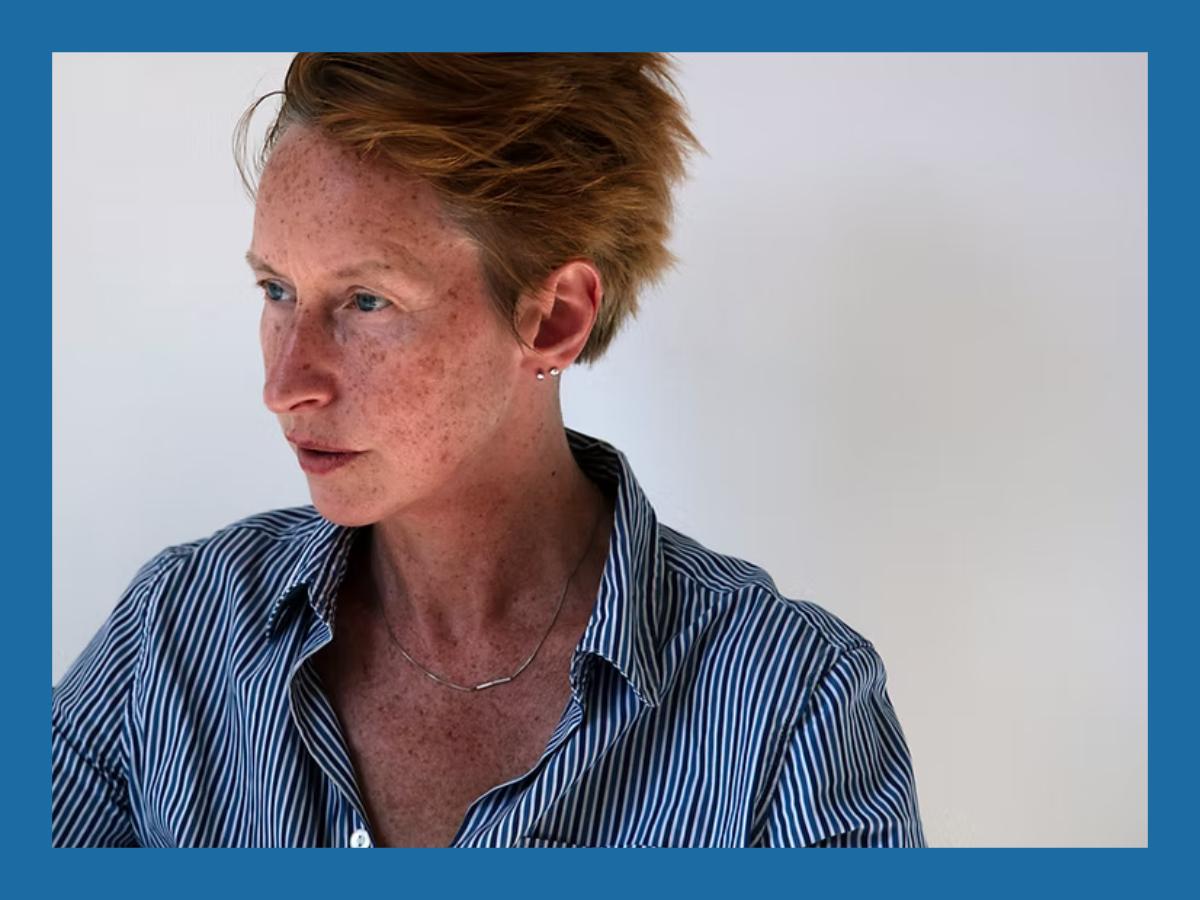
Photo: Joanna Walsh. Image courtesy of Nick West.
Joanna Walsh is a writer, editor, artist, and educator whose work spans print, digital art, and performance. She is the author of over a dozen books, including the 2025 publication Amateurs! How We Built Internet Culture and Why it Matters. Writing about 20 years of distinct internet trends (such as Lolcats, the Trash Essay, and Selfies), Walsh shows how Internet culture has been shaped by communities of non-professionals—at the same time she draws attention to the ways in which this amateurism is now increasingly under attack. She has also published essays in Granta, The Los Angeles Review of Books, The Irish Times, The Guardian, and received awards for her writing and art. Joanna’s work displays a persistent interest in the intersections between digital culture, gender, and labor, themes which we discussed together.
One. Today on the left, we see what I would describe as “techno-pessimism”—and to some extent, this does hold up when we look at the ways in which AI and surveillance technology have been weaponized by the state and by techno-capitalists. But you occupy what I would describe as a “techno-realist” position—it seems that you believe we live in a world that is mediated by social media, by smartphones, and now AI, so how can we understand our own position within it? My question is twofold. Where do you think this techno-pessimism comes from, and how should the Left negotiate our role in this changing technological landscape?
JOANNA WALSH: None of these technologies and practices, from social media to AI, is inherently bad, but the people who own and deploy them increasingly are, and the capitalist landscape in which they are deployed encourages bad behaviour. In particular, the metaphor of AI as “intelligent” is a deliberate smokescreen for bad actions. As we’ve recently seen in Iran and Gaza, governments have used AI to deflect blame from responsibility for genocide and mass murder via the notion that AI makes decisions independent of the people programming it. But, because “AI” is not independent of the human, the good news is that humans can change it.
Is the party political left technopessimistic though? The centrist-left government, in the UK at least, seems hell-bent on integrating commercial AI into just about everything they can. Technopessimism in wider left thought seems linked to other forms of left-wing pessimism with critical parallels in Mark Fisher’s Capitalist Realism and Derrida’s and Jameson’s hauntological interest in a nostalgia for a future we never had. Although Fisher declared his work “negative” rather than pessimistic—a description, not an expression of left pessimism—melancholy, by its nature, is persistent and cyclical. Freud’s Mourning and Melancholia described an inevitable but not ultimately useful reaction to real situations of loss. Cultural minorities (including women) can’t afford this kind of melancholy, having much more to lose from the eroding present; rights—for instance abortion in the US—which are being overturned.
When you ask about how we can understand our position in our current media environment, it’s the same question as, How could we understand our position back in an era when the one-way street of top-down media provided us with ready-made non-interactive culture which we could only consume? Now is a tricky age, like any other tricky age, but ethics don’t change, and the left has to respond ethically. Whether a person is killed with a Gatling gun or an AI-controlled drone; whether their labor is stolen in the factory or on the platform, only the expression of these oppressions is new. Some of these new expressions are particularly good at hiding their embedded oppressions (platform labor is “fun”!) and it can be tricky to work out exactly what’s happening, but that’s what critical thought is for. This is also why it’s so important now to think about aesthetics, which are so often the vehicle for these digital oppressions but also offer chances for liberation.
Two. In Amateurs!, you describe yourself as a “para-academic”—someone who doesn’t work from within the academy, but who uses tools developed within it. You also talk about how para-academics occupy a precarious position, always risking failure. What role does the internet (and having an online presence) play in your own work practices and those of other para-academics? What possibilities does it open for para-academics, and in what ways does it amplify the risks of occupying a position outside the academy?
JW: The internet allowed me to become a para-academic, and also a sometime IRL academic. I have a PhD and spent two years on an EU-funded MSCA postdoc, which supported a great deal of the writing and research for Amateurs! but I wouldn’t have gotten to even the para-academic level without the supportive community I found on early Twitter and online literary journals. During the time I’ve been writing (about 15 years), offline academia has become drastically more precarious and IRL academics risk “failure” in a more defined sense than “amateurs”. Plus most IRL academics are under pressure to produce a social media presence, which many of them hate and which, like much internet cultural labour, is unpaid because it’s classified as “fun”.
I define my para-academic presence as a refusal to jettison the aspects of my work that weren’t learned in the academy. I hold onto a personal voice and contextualize it in terms of gender and class, rather than aspiring to any kind of “neutral” academic voice. I also always work at facilitating interchange (to use slightly more academic, or perhaps grant-writing terminology) between general and academic readerships. I publish with Verso, the English-language publisher that is probably best at crossing this divide. I speak at universities, festivals, bookshops. I teach higher education students going through formal degrees, adult education students taking night classes, and elective students doing one-off courses with no qualification in mind.
Three. Your book Girl Online is, first and foremost, a book of criticism about the changing nature of (female) subjectivity on the Internet. But you also describe it as a “user-manual,” implying that the work is—if not outright self-help—a convenient navigational guide. What is the role of criticism in helping the public understand and navigate technological change?
JW: My title is a nod to Georges Perec’s Life, a User Manual, as well as the largely feminized self-help genre.
In Girl Online I wanted to engage with the varieties of writing that exist online—and especially in the sphere of internet cultural production aimed at women—not by talking about them but by trying them on, and inhabiting their own embedded critical procedures. None of these genres is as trivial as they’re often made out to be and their sometimes superficial triviality is often inherent to their smart ways of thinking about the world from some of the compromised positions most of us are forced to occupy (see my work on “girl rhetoric”).
I can’t pretend that my “manual” is going to “help” everyone—but a variety of critical (and creative) thinking is key to responding to hegemonic digital culture. There are a lot of books on online culture for people who prefer a slightly more straightforward approach to the exploitation of femme content creators: Taylor Lorenz’s Extremely Online is good.
Four. You don’t often refer directly to “cyberfeminism” in your written work (except for an anecdote in Amateurs! about a panel you served on with cyberfeminist artist and academic Cornelia Sollfrank) but I do notice some similarities between your work and that of late 90s and early 2000s cyberfeminists. Your discussion of the “IRL” performance of housework (set in opposition to the online performance of girlhood), for example, reminds me of Faith Wilding’s “Duration Performance: the Economy of Feminized Maintenance Work,” in which she links computerized, informational tasks with repetitiveness of housework. How has cyberfeminism inspired your work?
JW: #Theoryplushouseworktheory, the piece I made for Fondation PHI in Montreal, can be seen in its full 12-hour version on their website. I recommend watching it, maybe while you’re cooking or cleaning: it features an extraordinary range of women writers, artists, academics, activists, reading from their favourite works of theory, while others do housework … The piece was primarily influenced by offline durational feminist art of the 1970s, especially work by Mierle Laderman Ukeles, Chantal Akerman and Martha Rosler. But cyberfeminism is very important to my work too. I’m a member of the Faces group, founded in 1997 by the first wave of cyberfeminist artists. It feels important to be part of a feminist community, and to work via specifically feminist practices, in response to a still predominantly misogynistic tech world.
Five. In Amateurs!, you discuss an interesting experiment you conducted with generative AI: you uploaded a photo of yourself into a descriptive text generator (CLIP Interrogator) in order to produce a textual rendering of your photo. Then, you plugged this generated text into an image producing AI (DALL.E) and continued to repeat the process, comparing the new outputs to the original image you took of yourself. You say that the products looked like “artworks” (that is, commodities), but not art. Yet, in your own artistic practice, you do use AI as a tool (such as, in your piece Markievicz Mark 1, an AI you created in order to generate writing based on a data-base of forgotten/under-read female Irish writers). In what contexts can AI be used for art, and in what contexts is it simply a tool for the production of commodities?
JW: I don’t “use” AI in for my own works, I make it! Or rather I’ve hand-coded AIs for several projects, working directly in opposition to big tech’s unaccountable AI that actively reproduces every prejudice available online. In my AI projects I’ve wanted to see what the handmade can still do, especially when it is trained on material that offers alternatives to the racism, sexism, and political and body fascism that commercial LLMs propagate.
Six. I’m really interested in a recent project of yours, SEED. It has many of the hallmarks of a good Bildungsroman: sexual discovery, the journey to independence, finding one's place in a world of political turmoil--with one radical change: it was first published as a choose-your-own-adventure story. The work is best read on mobile devices, and it requires readers to scroll and click in order to access bite-sized (2-4 page) digital narratives. My question then is how do you think reading itself has changed with the advent of smartphones and social media? And how can writers adapt to the current crisis of attention?
JW: The net is blamed for our “disordered attention,” as Claire Bishop put it, but I like the hyperlinked thinking prompted by internet reading. It suits my brain. And I’m not sure it’s changed the way I write so much as facilitated it. I’ve also seen how it has facilitated kinds of writing that did not easily find expression in pre-internet linear, top-down media, as well as text projects—like Aesthetics Wiki, which I write about in Amateurs!—that allow for non-professional, collaborative, critical-creative thinking. Less has changed than you’d think. It’s important that SEED, as an online narrative, was set in the 1980s. I wanted to show how algorithmic code-switching was just as relevant pre-internet as it is now.
Seven. Finally, what are you currently working on? Is it an art piece, a theory book, a historical document, a coding project, or maybe a combination of all of the above?
JW: After four years of reading and writing theory, I’m starting work on an old-fashioned novel. Though two of my books have been published as novels, I’ve never deliberately set out to write a novel before. It feels quite quixotic, especially as the publishing climate has recently become appallingly bad—see the withdrawal of NEA grants to the US independent publishers of innovative books, and the defunding of arts higher education across the UK and the US. Maybe this means the novel, or at least the experimental novel, has re-become a radical form, as much for its means of production and circulation as its style and form. I’m increasingly full of admiration for independent publishers and booksellers whose labor of love, supporting innovative writing, has been forcibly re-contextualised as an act of political resistance—and they’re living up to the challenge!