
FALL/WINTER 2025
Singing the Blues with Alice Notley
Rachel Kamphaus
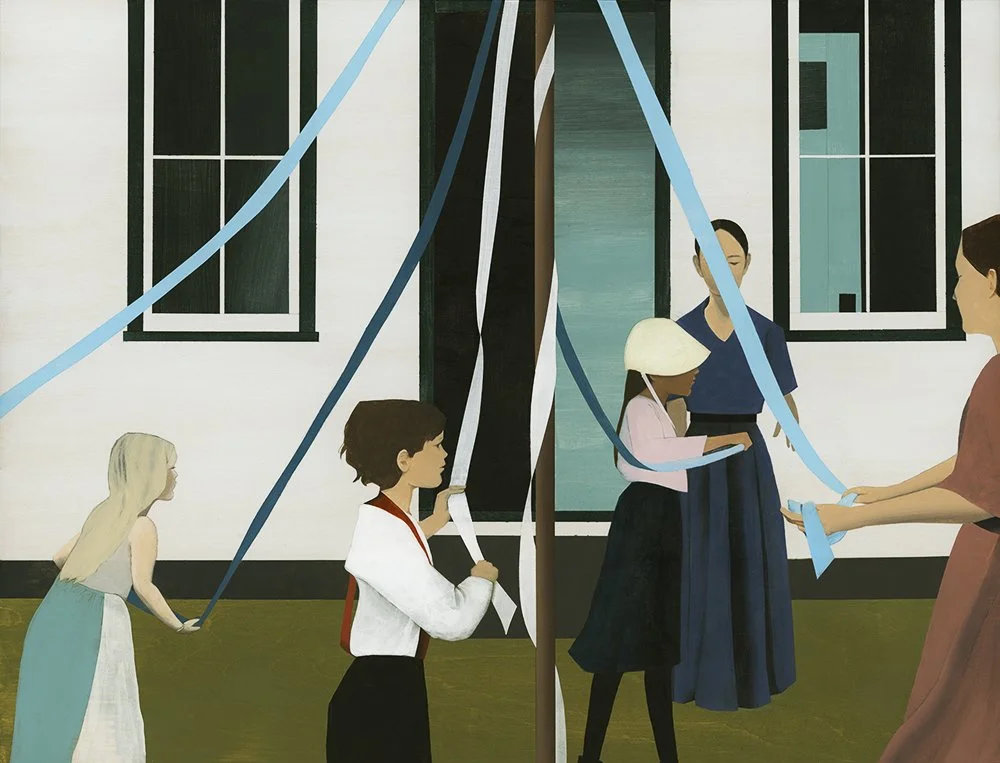
Art: Emily Pettigrew. In and Out, Weave the Ribbons Tight, 2022. Courtesy of the artist.
Death brings out hyperbole. The only way to honor a person’s memory is in superlatives—how many grandmothers have been described as the kindest, or mothers the most loving? For artists, the hyperbole is perhaps more pronounced because of the obituary’s calcifying effect on their legacy. Death is the point at which canonization can really begin; critics flock to blogs and magazines to make a case for why said artist deserves a place in such and such pantheon. So many have been described as “among the greatest” that the term “great” seems inflated beyond meaning, and I wouldn’t blame a reader for scoffing at a certain point. But when it comes to Alice Notley—who died in May of this year—please take me for my word: she was one of the greatest poets of her generation.
Like any great, she was an innovator, known for her rejection of dogma. Her emergence took place in the midst of a war between Language poets, who, following a decade or two of poststructuralist theory, attacked the lyric form, the speaking “I”, and the tendency to assume a stable subject, and a more confessional mode that emerged from MFA programs around the United States in the mid-twentieth century. If poetry was indeed a battlefield, Notley gleefully danced in the no-man’s-land separating the two camps, stealing supplies from each: “There are these sides I’m tired of it/Float in air liaison with illicit spirit/Who cares how I write?”
At the center of these debates—and thus Notley’s own poetic practice—was the question of voice. Traditionally referring to the unique stylistic characteristics that mark a given poem as of a poet, voice is often spoken of not as a construction, but as essence: voice as something to be found, discovered or uncovered. Reflecting on her own education in writing, bell hooks states, “I learned a notion of “voice” as embodying the distinctive expression of an individual writer. Our efforts to become poets were to be realized in this coming into awareness and expression of one’s voice.” Notice how she uses language like “individual writer,” “coming into awareness,” and “expression,” terms that emphasize the way voice is tied to an individual, essential identity. Throughout the latter half of the 20th century, poets began steadily to work against the idea of voice as such in their work; Marjorie Perloff claims “the dismissal of voice” to be “the foundational principle of Language Poetry.” It’s not hard to see why this concept—used in terms not so different from vague demands to “speak your truth,” or “be authentic”—would bother groups of people for whom stable meaning and fixed identity were always suspect.
Yet Notley did not belong to either of these camps: she rejected the idea of stable identity and essence, all while clinging (sometimes stubbornly) to this very idea of voice. If, according to Notley, voice in the Western tradition is implicated with such poststructural prohibitions as “presence, authorial presence, personality, and unity,” she searched for strategies that allowed her to lift that voice above the individual writer. Critic Tausif Noor puts it well: “Notley has always insisted that her voice is her own—even as she absorbs and ventriloquizes the voices of others, from her family and friends to long-forgotten women from the ancient past.” What Notley calls “voice” in her work may be more accurately described as “voices” or “polyvocality:” in a sense, it’s a model that allows her to have her cake and eat it too.
*
In 2007, Alice Notley published In the Pines, her 34th collection. Its themes are familiar to any Notley reader: ambivalence over the poet’s presence, the power of voice, patriarchal violence and the desire to discover a language unscathed by it.
“It is time to change writing completely,” she brazenly declares on the collection’s first page. If In the Pines is not her most radical engagement with voice, then it certainly is the most persuasive realization of her vision. Here, the unitary authorial voice of control dissolves into something more collective: folksongs, laments, and what looks to be communal storytelling. It reimagines poetic voice as a deliberately unstable polyvocal practice that exposes the tensions between collective and individual expression. And yet, by the end of the collection, she still preserves the lyric “I,” arguing that even the most dispersed lyric forms inevitably bear the mark—and the responsibility—of an author.
Where does one begin with In the Pines? Notley’s publisher writes:
[In the Pines] mixes short lyrics with long, expansive lines of poetry that often take the form of prose sentences, in an effort "to change writing completely." The title piece, a folksong-like lament, makes a unified tale out of many stories of many people; the middle section, "The Black Trailor," is a compilation of noir fictions and reflections; while the shorter poems of "Hemostatic" range from tough lyrics to sung dramas. Full of curative power, music, and the possibility of transformation, In the Pines is a genre-bending book from one of our most innovative writers.
And while this description is not inaccurate, it masks the fundamental strangenessone is faced with while reading In the Pines. The publisher’s decision to call the text “unified” is particularly odd: it is anything but! And while we can identify noir elements or “sung dramas” in the text, these genres are only recognizable in outline. While truly reading In the Pines, we can identify contours of the noir—but they are only contours, floating at the edges of our vision and refusing to enter our main line of sight. If there is a plot, it is impenetrable; attempting to make sense of details, identify speakers, or formulate a sequence of events is nigh on impossible. Wispy details float to us in snippets: the mise en scène includes a burning house (or closet), a dead body, and possible (probable?) foul play. This incident may have taken place in the nineteenth century, it may never have happened at all—maybe it’s still happening.
From its first page, the poem adopts a hostile position towards poetic conventions, beginning with a polemical second-person address: ‘Why should I respect, convince, or even interest you? (Respect, conviction and interest belong to him)”. It’s a fascinating opening line: if “one of the great tasks of the lyric” is, as Edward Hirsch claims, to bring the I and you “into right relationship with each other,” then Notley takes an axe to the trunk of the lyric “I/you” paradigm, sending it to the ground with a resounding crash. In Notley’s poem, the blasé subjunctive “why should I” spurns the absent readers upon whom the lyric depends: instead of being invited into relation with the speaker, we as readers are given the literary cold shoulder. The speaker simply does not care, or is outright hostile to, the conditions that make lyric poetry possible.
This act of refusing the lyric “I/you” paradigm opens the door for a more expansive “voice” to emerge. In the Pines examines a space where voices are formless, detached from living beings, gender, or race. Pronouns shift. Quotations drift without clear sources: “I am simplified by my spell, he or I said.” Dialogue occurs without an indication as to whom the quotes belong. “He”s become “you”s and “I”s “hers” and “Her”s become “him”s. Relation itself collapses, not only between “I/you,” but also between subjects/objects, men/women, and even the pieces of a sentence:
“No one but he’s someone to me, and if only these relations remain, after all I’ve done and known, why did I? No one and I’m no one to myself. Not his daughter, but I’m his daughter because I’m him and this love the fire that never dissolves in these eyes you’ve named, because you weren’t a woman. Well neither am I. And there’s nothing for you, too.”
It is difficult to make sense of these phrases because relations simply collapse over and over again: questions garner nonsequitous responses. A conditional clause (“if only”) has no apodosis. The subject “no one” is often introduced with no predicate. There is also the more obvious play upon familial relationships here. The speaker’s relation to the “him” is not static. The speaker is simultaneously not his daughter and his daughter and him. Note especially how this strategy transforms the poem’s “I,” unmooring it from a sense of fixed identity, transforming the singular author into something more like a shifting target.
This is how the central voice of authority in the poem dissolves. Instead of emerging as a singular entity, the poem’s voice instead reads as if it were a chorus or a series of overlapping frames. Sentences do not always relate to each other; stories happen simultaneously. Statements on poetry that could be tied back to Notley (“I don’t think you had a choice except to be the poet, but this world still can’t stand long. He was already sick”) are followed by more narrative snippets for which we have no context (“There’s an enormous pine beneath which she lies. Momma in the pines and of all the pines, this one above, with some of its needles gone yellow, is most beautiful”). The poem’s meaning does not come from its unity, but from learning to listen to each of these voices separately, to pick up threads and follow them where they take us.
*
Notley also, notably, engages with traditions of folk music throughout the book. There is probably nowhere in popular culture where the tension between individual voice and collective authorship is played out as much as in folk music. Its early history embodies collective creative practices, born out of anonymous (and yet still collective) national traditions. As the twentieth century wore on, it was captured by charismatic, highly public performers. Throughout In the Pines, Notley plays with this resonance of folk music: taking advantage of the genre’s communal structure of composition while acknowledging the limitations that come from her own position as a literary quasi-celebrity.
In interviews, Notley often returns to folk as a major interest of her own and a major influence on her work. She goes so far as to describe herself as a “folkie.” As a kid, she says in an interview with Janique Vigier, she “liked all the folk singers; I followed what everyone was doing.” Among her favorite songs were “Wild Mountain Thyme,” “The Water is Wide,” and, yes, the eponymous “In the Pines.” But even more than this, folk provided her with a poetic model; it gave her permission to “draw from others,” to take “a bit from this one, and from that one” like “a magpie.”
Many of these songs make it into In the Pines. Notley incorporates them without introduction, stitching them together with her own writing. “I’m wading in shallow water. Wade in the water. Lift your skirt,” reads one passage. Later, Notley borrows from “All my Trials”: “You can’t have what they had, their loss. Or else the rich would live and the poor would die.” From “In the Pines”: “Don’t you lie to me. Tell me where did you sleep last night. / She couldn’t lie. She never grew, never spoke.” Although I add italics to distinguish between the lyrics and text, there is nothing in Notley’s text that separates these liftings from her own writing.
It is, therefore, quite difficult to distinguish which words are “Notley’s” and which are not, a move that further destabilizes the role of the author in the poem. When the narrator speaks, it is not solely Notley’s words that emanate. Yet it is not clear from reading the poem, unless one had outside knowledge of these songs (and while many readers do, few of the songs have universal recognizability), that the words are not, in fact, the poet’s. In my own reading, I identified songs like “All my Trials,” “In the Pines,” “Wade in the Water,” “Blind Willie McTell,” “Long Black Coat,” and “Poncho and Lefty”. Running certain lines into a database of lyrics revealed another dozen or so others that escaped my notice. The composition of the poem does not even come from a singular voice—quilt-like, it incorporates a multiplicity.
It is possible to think of authorship in In the Pines as a collaborative effort, not unlike the folk songs themselves, many of which were stitched together from unrelated lyrics over several decades, centuries even. A particularly famous example of this phenomenon is “House of the Rising Sun,” (whose unfortunate ubiquity on The Voice, in tourist-trap piano bar and on white dads’ speakers across sub-Mason-Dixon America, disguises its centuries-old origins). The song’s concept may be traced back to the sixteenth-century ballad tradition and elements of its lyrics first appear in a Louisiana newspaper from 1821, after which the song somehow made its way to Appalachia, transported via railroads and through travelling medicine shows, where multiple versions came to circulate hundreds of miles apart. The famous cover of the song by TheAnimals is in fact a synthesis of different versions with original lyrics by Eric Burden mixed in. Notley’s text similarly utilizes temporally, generically, and formally disparate elements to create a single text.
Although Notley uses formal strategies that mirror folk music production, it is still important to distinguish between folk as practice and folk as aesthetic. The first idea is rooted in collectivity and anonymity. When Notley “samples” music in her poems, she engages in a kind of collective folk practice. At the same time, she also uses folk as an aesthetic framework, appropriating its language and imagery. Notley writes several passages in imitation of a “folksy” drawl that clearly comes from black, southern, and Appalachian communities. “Don’t say knowed it, don’t say cain’t like Grandma. These gospel beads around my back are almost as pretty as thee. Some don’ts are pretty” reads one exchange.
There is a clear dissonance at the center of In the Pines, between on the one hand, the highly-experimental, difficult, and theoretical language that characterizes much of the text and the more colloquial dialects that Notley often switches to. It’s in these moments that we begin to see the author’s presence emerge; the book clearly doesn’t come from a communal tradition, but from someone with elite, theoretical training. Paradoxically, in attempting to erase the author’s presence, Notley highlights it; her experimentation shows us the instability of that very experimentation. It’s not that she is unsuccessful in her aims: in fact, bringing the author into the text is an important part of her strategy.
Unlike many of the poets she is in conversation with, Notley does not believe that authorship is something a poet can shirk or de-emphasize at will. “There is no way not to impose yourself as an author on your material,” she claims, even if we would like that not to be the case. Notley herself cannot disappear from the work; she is, at the time of writing In the Pines, well-known (even more so now, as her death has ushered in a number of reappraisals). We cannot fool ourselves into believing that In the Pines emanates from nothing, nowhere, or no-one—that it is somehow of the people, and not from aperson.
What is most radical about Notley’s experimentations with voice is not that she allows the author to collapse completely, but that she proves that she can incorporate interwoven, shifting voices, and still make herself visible.
Near the end of the book’s second section, Notley includes a poem called “In the Garden.” At this point, after we have dragged our eyes across pages of underdefined characters, floating dialogue, and murky plots, still hoping for somewhere to land (a character to latch on to, a relationship to make sense of), Notley-the-narrator suddenly resurfaces. For a page and a half, Notley recounts her personal relationship with the songs “In the Garden” and “Peace in the Valley” (two hymnals both covered by Elvis), which remind her of her family. Unclear voices and vague pronouns give way to clearly drawn portraits: there is Ted, Alice’s husband, who animatedly speaks of his favorite film soundtrack, there is Alice’s father, who claims “Peace in the Valley” as his favorite hymnal, and there is Alice herself, humming the words of “In the Garden” to Ted, crying as “Peace in the Valley” plays at her brother’s wake.
“In the Garden” is a moving poem because it is personal. It is, of course, possible to think of this music as also belonging to a collective: in this case, the Christian, Southern, and gospel collectives. But is it not also meaningful to consider its personal history? To think about how it moved Notley and her family, how it became the soundtrack to pillow talk, family barbecues, and funerals? Or how it remained a small token of Notley’s dead, a faint electrical impulse that survived long after their hearts had stopped beating?
Indeed, the incorporation of a more personal poetics is not at odds with the polyvocal thread that Notley develops in In the Pines. In fact, this poem seems to be the fullest realization of her ideal poetic mode. Notley still mobilizes the type of polyvocality that folk embodies. The poem begins with a quotation in Ted’s voice. Then, we hear from Notley’s mother, who comforts Alice at her brother’s funeral. When Notley’s uncle speaks, it is to announce that he’s heard the voice of his dead nephew in his dreams, shouting. There is even music in the poem: Notley describes Elvis’ voice as “esthetic but awed,” a music teacher as simply “acommpany[ing] himself on guitar.” Together, these characters form their own kind of chorus, one whose poetry emerges from their interwoven language. And still, present at the center of this chorus is Notley herself.
*
To add my own voice: I remember where I was when I first bought In the Pines at a bookstore in Cambridge, visiting my friends before I left New England for my home in Florida, and later, a move to Belgium. That night, we went out to a bar to see some local bands. I remember one singer: amazing, the type of vocalist who was so in control she knew when to break, her voice yelping and whining, only to elegantly flatten out into her original register, like a skater landing a jump on the thin blade of her shoe.
And yet, despite her talent, it seemed she wanted to disappear. She stood towards the back of the stage, letting the guitarist and bassist become the most visible members on stage. Any polite singer knows to shoutout her band, but she seemed to do it excessively: “It’s all them,” she repeated; “The band would be nothing without them.” She acted as an usher, directing our attention to other elements of the music. Listen, she urged. The bass burst through. I could note the droning, slightly bouncy progression of chords looping through the piece. Then the drums: hard and staccato at first, then tapering off into a rattle. Finally the guitarist, more droning than melodic, propelling, more than anyone else, the style of the music.
And as I felt the music come together, I could feel her quiet power keeping the show together. I think of Alice Notley in this way: as neither griot nor rockstar, but as a vocalist who prefers to stand behind her band. Not precisely shy, but conscious of her own perceived role as outstanding when she knows her voice is only one part of the music, only possible because of the efforts of others.
It doesn’t seem like Notley wants an anti-vocal, anti-relation poetics to define her literary practice, or even a practice that is so mired in the communal that it masks her individual voice. “Veiling the speaker” she says, “hedges issues and responsibility for what's said and what's lived, individually and communally.” I highlight this passage because of how well it describes the role of the poet. She should be visible: it is only from this position of visibility that she can “take responsibility” both for herself and for her community.
Importantly, Notley does not abandonvoice, but expands it. In her essay “Voice” she writes:
In the late seventies and early eighties I wrote a number of poems containing many voices. I used peoples' voices verbatim, from the room and also from the street and from the media; I thought at the time I was being practical about writing in a crowded apartment, though also I was in a state of fascination with the voices of others. I thought as well I probably didn't have so much to say on my own, in terms of “saying something”; but I knew I had things to make and wonderful materials. Now it seems clear to me that I invariably created a unified work, out of various peoples' voices and words, which reflected my individual self and situation.
The author, when grappling with their sense of self, usually finds themselves consisting of interwoven vocal elements rather than a singular expression of unified self-presence. Notley’s practice of voice really does the opposite of what many critics claim it does: rather than obscure the subject’s construction, it exposes the very seams that stitch it together. Folk music does the same.
If Barthes took a knife to the author, Notley is the sorceress who tries to bring them back to life, but whose attempts always result in some deformity: extra toes, an inability to blink, a requirement to depart as soon as the clock strikes midnight. More accurately: a dozen throats, through which different voices spill. Such is the real role of the poet—to speak as herself, while spotlighting the voices of others. To speak for others, without losing sight of her own individuality. Not to hide behind the third person or imagine a space beyond relation, but to open her mouth, put forth her voice, and make music.