
SPRING/SUMMER 2026
The Current of Memory
Magdalena Arias Vásquez
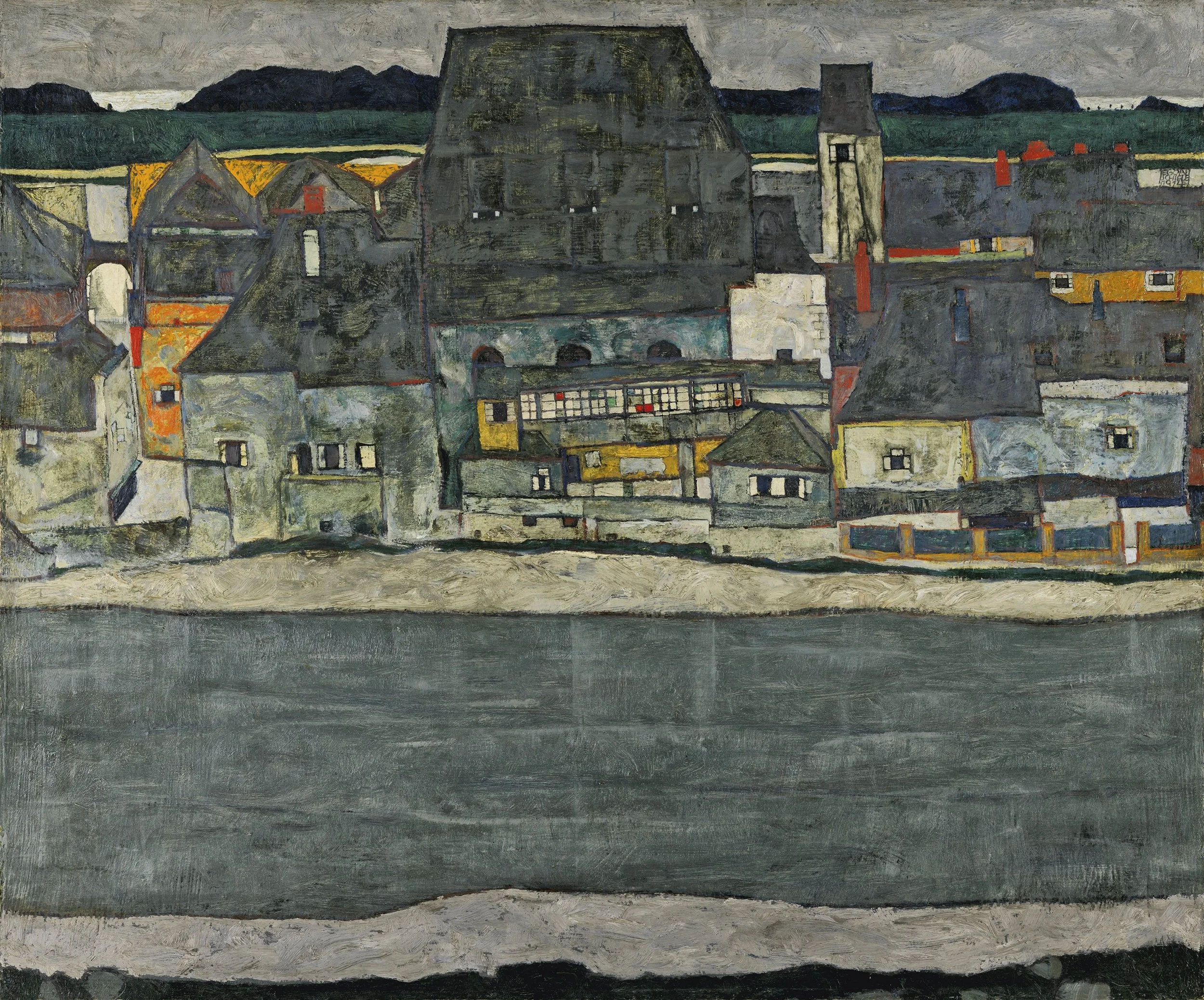
Art: Egon Schiele, Houses on the River (The Old Town), 1914. Public Domain.
The best literature often finds its reader at moments of desperate need. During my fourth year in the United States, I developed an intense fear of forgetting. It was the year my dog died, blind and far away, in the country I had run away from, where the rain embraced the trees in a perpetual dance, and the waves crushed against the earth in a repetitive cadence. In Massachusetts, where I was finishing my studies, I was haunted by the amber slowly taking over the unsuspecting trees, devouring a version of my life with me in it, turning everything in its path into the desolate lands of memory. The death of my dog, who had watched me grow up, was the first death I’d ever encountered, and in its shadow, I began to fear that the past was running away from me and toward total obscurity. I found myself returning to the empty things inside of me: my parents’ stories; history, with all of its gaps and crevices and missing pieces; my sense of absence in a country that was not my own, where my selfhood was dividing infinitely, towards a fatal end.
Years later, when my best friend died in a hospital bed far away from me, one I had not been able to visit even as I knew the end was rapidly approaching, I would turn around to look for the trees again, for a past perpetually submerged in rain, and find that in the space between the first death and the second one—whose violence had pierced me more profoundly than anything I had ever felt—an emptiness I could not name had begun to take shape. I was caught in a current, one I did not understand and could not halt, in whose waters the rising river levels were whisking me away. Drowning, I began to understand memory as the underside of grief. It was in this state that Veeraporn Nitiprapha’s novels originally found me.
Nitiprapha’s imaginative language provides the architecture for the larger emotions of grief—for a country and a time, in the face of death but also in the face of love. At the heart of both The Blind Earthworm in the Labyrinth and Memories of the Memories of the Black Rose Cat are records of the protagonists’ relationship with water, where the medium’s unpredictability serves, ironically, as a constant, a metaphor for the characters’ search for connection in the face of losses both national and personal. These are novels about loss, and it is Nitiprapha’s language around water that ultimately reveals our tendency toward silence in the face of grief and the imprecision of memory. Both novels pinpoint something that feels innate to memory: that it is an imperfect window into the past, one that illuminates grief (and its cousin, love) only in flashes, just as lightning illuminates an otherwise dark exterior. Using water as a recurring metaphor for grief and memory, Nitiprapha seeks to confront us with this reality. For this reason, perhaps, both books begin with an episode of drowning.
In The Blind Earthworm in the Labyrinth, the young and impulsive Chareeya almost drowns in the river behind her family house. This scene is the moment that brings the three protagonists (sisters Chareeya and Chalika and their friend Pran) together, establishing the dynamic that will follow them for the rest of the book. Set in Bangkok and its surrounding areas, the novel follows these three characters, whose childhood is scarred by their parents’ failed loves and early deaths. Driven by their own grief and orphanhood, Pran, Chalika and Chareeya circle each other as they try and fail to find connection and love. Chareeya will spend her life searching for Rosarin, the Thai dancer who broke up her parents’ marriage, sifting through her father’s letters, and trying (and failing) to find love to cure her loneliness. Similarly, Pran’s life is structured by his desire to ground himself in his love for Chareeya, a love which never seems to find purchase, leaving him jeopardously adrift after the loss of his father and the death of a close childhood friend. Chalika, on the other hand, will search for love and connection in romance novels, grasping at something in art that eludes her in real life, where she ultimately falls in love with Pran while he desires her sister.
A child devastated by her parents’ deaths and let down by reality, Chareeya dives into the river to look for a city she believes lies on the riverbank. Instead, she finds her sister and herself in the form of two jellyfish, drifting toward a fatal end: “Two jellyfish bobbed past in slow motion. Chareeya thought they were like Chalika and herself, swept upstream from the ocean. She tried to signal to them: not that way, Charee-lika, the ocean is the other way…” It’s this last realization—that she won’t find anything under water except the vast solitude and grief that already encircles her family—that ultimately pushes her to go deeper.
In the days after the death of my best friend, and plagued by the fear of forgetting and therefore losing her to time, I too began to stubbornly search my memories for something that, despite my insistence, kept evading me. This act of searching, to try and find something at the bottom of the river, is the vain hope that emerges with grief to retrieve what we have lost, despite the fact that it is irretrievable. Chareeya’s stubborn search is that of longing and a persistent desire to remember, and its only outcome is a quiet futility.
Willingly giving in to the current of the river as she swims deeper, even as Pran attempts to rescue her and Chalika screams in desperation from the surface, Chareeya is quickly overtaken by silence: “Oblivious to the fact she was underwater, she shouted, Leave me alo… The rush of water shoved her voice back into her body.” Like Chareeya, those of us who swim toward the bottom of grief’s reservoir are on a singular path toward silence. After all, death is an absence, and to try to speak to it we must approach it from outside the language of sound. Oblivion and silence, Nitiprapha seems to argue, are how we truly converse with our grief. “When we forget something, sometimes it comes back in a flash that quickly vanishes, but as time passes we forget that we ever knew it… Do you think one day we’ll forget Father and Mother and they’ll be lost forever?” asks Chareeya early on in The Blind Earthworm in the Labyrinth, and it is this question that simmers below the novel’s narrative surface.
The stubborn quests of Chareeya, Chalika, and Pran to remember are attempts to confront various forms of loss, but their failure to do so stems from a refusal to accept that grief is cyclical: that this forgetting, this damp emptiness on the other side of language, is unavoidable in the face of loss—an orbit of remembering and forgetting. The fate of those cursed to long always for something lost in the past is to be deluged in this longing.
In the aftermath of that second death, I left the United States after almost seven years of living there. It was not a decision I had originally planned to make, but in the days before I knew she was dying, I began to dream of us, sitting by the beach near my house, hidden among the mangrove trees. We were seventeen and convinced the world would always be as sharp as it was then. The dream was a distorted copy of a memory, one whose definition had already frayed around the edges. Upon waking, day in and day out, as the New York mornings clattered outside my apartment, I began to long for her presence and for a home I was not yet aware would soon begin to fade completely from existence. The fact was that my longing for her was doubled: it was a longing that had blended with my longing for the country I had left. This last truth did not become evident to me until she had died and I was faced squarely with her absence.
Memories of the Memories of the Black Rose Cat is a textual rendering of this experience, of the moment when grief, cyclical and moving, becomes both personal and national. Following the Tong family across multiple generations, this second novel begins with Great-Grandpa Tong, whose decision to leave China for Thailand after his entire family perishes in a flood sets in motion a tale of yearning and loss as his descendants try to find belonging in their new country. Told from the perspective of the youngest of Tong’s descendants—a young child by the name of Dao—we watch the family grapple with their fate as they become convinced they are all cursed.
This book’s first drowning is a tragedy established early on, one which Dao’s attempt to remember as he narrates his family’s story, through Nitiprapha’s intentionally erratic, disjointed writing, will fail to capture, hinting, at first subtly, and then more directly, at the insufficiency of memory in constructing reality after loss: “The house had felt damp for a long time. Since the day Great-Grandpa Tong returned from China and brought with him the interminable curse of the swift-flowing water that once swept away his entire family.” Great-Grandpa Tong grows to believe all the future generations of his family are doomed to die by drowning. It is this grief—for the loss of his loved ones, which initially pulls him into its embrace—that will push the entire Tong family into its inescapable cycle, eventually blending with the loss of a country, which grows to haunt Tong and his descendants in the form of the water curse.
Indeed, during one of the memories of memories that Dao received from Grandma Sri, she whispers: “Drowning yourself in thought is a hereditary trait, do you know that?... It started with Great-Grandpa Tong… He was drowned in his dream of returning home.” Immigration can haunt those who live it through its ability to engulf everything in the past, especially if the past, as is the case of the Tong family, is marked by tragedy. The novel’s outlook on the experience of the immigrant and the grief that accompanies it reflects the doubled grief that is at the heart of the water curse metaphor: as the story progresses, each character, trying to grapple with their position as an outsider in Thailand, ends up losing someone who matters to them, succumbing to grief after loss. For Tong, it is the initial grief for his dead family and for China, which he yearns for and fails to return to. Later, it is grief for his children and grandchildren, who die off one by one, succumbing to the intergenerational longing that seems to plague the family: Jitsawai and Jongsawang, his sons, both die by drowning, while Jarungsilp, his daughter, kills her own baby in the river. Ultimately, Tong himself commits suicide, drowning in an ice factory, just like the family curse predicted.
By the end of the novel, the family members who have yet to drown are killed in a single night of violence, one perpetrated by a character whose identity further problematizes the doubled grief at the center of the story. Searching for love and connection with another outsider in Thailand, Jarassang, part of the second generation of the Tong family and Dao’s mother, marries an American ex-soldier who has retired in Thailand after serving in Vietnam. The man’s position in Thailand, shaped by the United States’ position of power on the world stage, prevents any sort of real connection from forming:
And now he was the one investing his money in this town so far away from his real home—he wasn’t anything at all like those migrant workers who wandered off and became trapped in foreign places like that generation of people had done a century ago.
This disconnect and irony catalyzes the violence that ultimately perpetuates the circularity of loss, transmuting the grief of the immigrant into the more concrete grief that follows death. It is Jarassang’s grief for something she cannot express but that she knows she has lost as a second-generation immigrant that pushes her to seek connection with someone else who might understand her. In doing so, however, she unexpectedly succumbs to the family curse. Like Great-Grandpa Tong, Jarassang drowns in her family’s yearning for what was lost in their immigration, ultimately taken over by the structural power imbalances that mar the lives of immigrant families: the choices of individuals with social power over them, and the policies of developed nations that change the courses of their lives inadvertently.
The result of this tragedy is the existence of Dao, the family story he tells, and grief, left behind with nowhere to go. Dao’s narration of family history throughout the novel is thick with nonlinearity and language that seems to become more and more scattered as memories flow in and out of his consciousness. Eventually, it becomes clear that he is searching for something he believes he has forgotten, which he remembers as the story reaches its close: he is himself a ghost, a memory of a memory, a leftover essence of a child who was never born, killed in the massacre that ended the remaining Tong descendants. His existence and his attempts to narrate the story of his predecessors through his memories of memories are in themselves dialogues with grief, in particular the doubled grief of the immigrant who, having lost their country and their loved ones, is faced with the only choice left to those experiencing this doubled grief: to become testament for grief itself, and construct, within this process of remembering and forgetting, an existence of sorts, one that holds grief and trauma alongside love and family and diaspora. The story itself, made up of braided memories of memories, becomes the only testament of the Tong family’s existence, with no one but grief itself left behind to grieve them.
And this last part rings most true. When faced with this doubled-loss, the experience of grieving becomes an ouroboros: grief, for a loved one lost and for a country and a time left behind, is an eternal endeavor, and unlike life, it never ends. Remembering—and then the process of forgetting, which is inevitable—are our way of continuing to converse with what we have lost: it is our own curse, or perhaps our own blessing, I am inclined to think, to continue to encounter the people and places we have lost in the imprecise and blurry realm of memory.
As I write this, it has been exactly a year since Marina died. Outside, it is the rainy season and the leaves collect droplets the size of gems. I am back in the country I left, and yet, not quite. I am able, as I sit here, to remember a version of this place where my best friend is alive, sitting in our garden under the ferns, or walking beside me along the beach. I am thinking, almost obsessively, of a version of this place where I am not swimming in the river. And yet, so much of her and us as we were then already eludes me, dragged away by the current. I can feel myself fighting the urge to swim toward the bottom, to avoid the act of forgetting, which I know has already happened. I am, as I read and write about this, doing my best to converse with her silence and her absence, whose presence I carry with me as intimately as I carry the knowledge that I am forgetting her and the version of this country we both existed in. It is hot and humid under August’s blanket, and for this reason, I am constantly wet. As I look back now, toward the river and the trees, toward the land beyond, all that is left is this trickling away, this water, birthing sound against the rocks.