
SPRING/SUMMER 2026
To Spill
Nina MacLaughlin
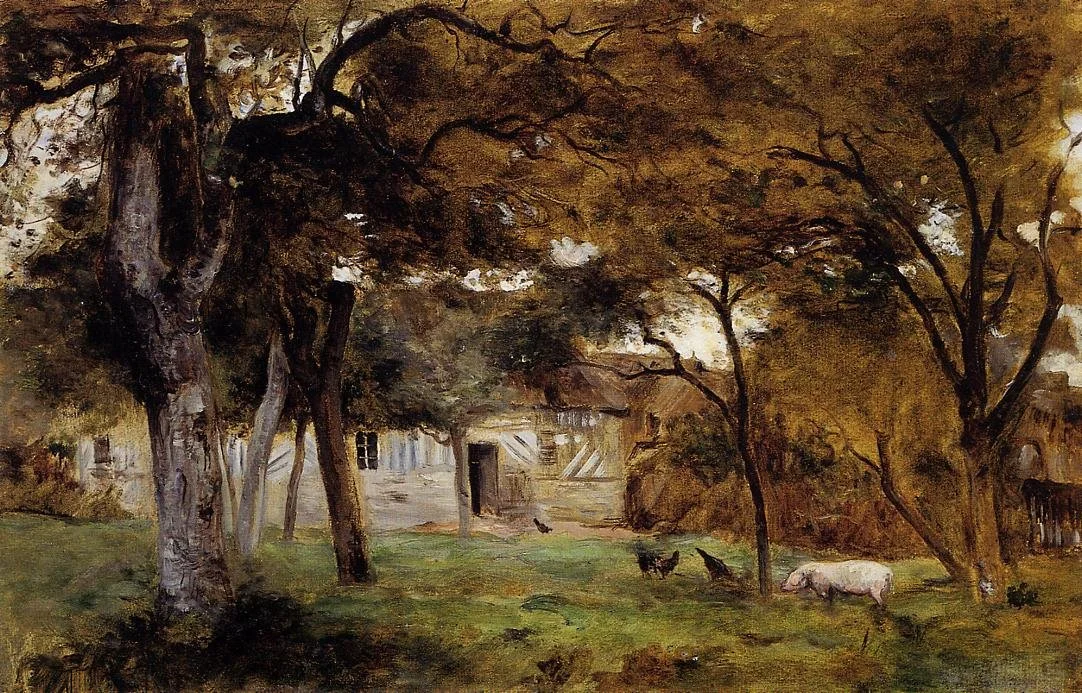
Art: Berthe Morisot, Farm in Normandy, 1859. Public Domain.
The woman rides her bike to his house with a small backpack that holds a green sundress she’ll put on tomorrow, her toothbrush in a plastic baggie, deodorant, a pair of light blue underwear made of lace, the book she’s reading. She pedals fast. She sweats.
“I’m sweating,” she says when she arrives at his house, a small house on one floor on a short quiet side street. A forsythia bush, past blooming, grows at the end of the driveway, and a thick oak tree rises over the right side of the house, dropping its acorns on the grass. The man and the woman embrace and he lifts her feet off the earth for a moment. He is strong. Shoulders, back. It’s one of the things she likes about him. She is strong, too. Legs, shoulders. It’s one of the things she likes about herself. He has invited her for the night. It has been some time, a long time, she knows how long, since she has shared a bed with someone. Her lower back is damp with sweat.
“It’s not seasonally correct, but I had some in the freezer and you said you hadn’t had venison so I’m making a stew,” he says. Inside, dense, steamy air, a dark red smell. That he hunts does not bother her. She likes to use her teeth to get all the meat off bones. When she was small she watched her mother smash rabbits’ skulls and tug their fur off their bodies and pull their dark warm insides out. She learned the woods near her house because when you see your mother smash the skull of an animal, sometimes you need to go somewhere else for a little while, and there are many places to go.
He asks her to chop a cucumber for the salad, and a red pepper after that. He doesn’t tell her they’re from his garden, but she knows they are, and she likes that he doesn’t announce it. “You don’t have to peel it,” he says of the cucumber. She takes a knife in her hand and has a sensation she has when someone new is in her car, when she has to tell herself you know how to drive. Now, as she holds the knife, you know how to use a knife. She slices the cucumber into even pale discs, dark green skin not as waxy and thick as the ones from the market. The pepper is bright red and pops as she presses the blade through one of the seams in the center. The seeds spill onto the board and she removes the ones that don’t. She pulls the cream-colored pith away from the red flesh of the fruit. Once she’s chopped it into small red cubes, she puts a piece into her mouth, bright on her tongue, a juiced crunch. “So sweet,” she says. Her armpits are damp. She ties her hair up to get it off her neck and hopes he’ll turn around and see her do it, even though her armpits are damp, pale yellow shirt showing the wet. He stirs the stew, pushes a mound of mushrooms off another cutting board into the pot.
He takes a spoonful of stew and blows on it. “Salt check,” he says, and hands her the spoon. She is relieved he doesn’t try to feed the spoon to her, like a child or a bride. She blows on it, too, and puts the spoon in her mouth. “More. A tiny bit more,” she says. He takes a fingerful from his salt jar and drops it in the pot, then another, smaller. “I trust your mouth,” he says. The words draw her across the kitchen floor to him and she places a small kiss on his temple. He puts his hand on her hip. They stand close. Then she steps back. “Where should I put these?” she asks, taking the board with the red pepper and cucumber and holding it in front of her. He laughs and turns and takes a bowl from the fridge with green lettuce under a damp paper towel. He takes the towel off and holds the bowl as she pushes the red pepper and cucumber into the bowl. He places the towel back over it and puts the bowl back in the fridge. His sleeves are rolled up, the top few buttons of his shirt are opened, some hair on his chest. When he doesn’t have a beard, his generous mouth is a more dominant feature of his face.
“Wine,” he says.
“Wine,” she nods.
“Glasses are there,” he says, gesturing with his chin at the cabinet to her right above where she chopped. She takes two and places them on the counter.
“I’m happy to be here,” she says, because it is true. And now he takes two steps across the floor of the kitchen, a lay of linoleum with repeated squares edged in green stencil, vegetal, leafy, against an off-white soiled from wear. He puts his hands on her hips and then around to her lower back and he pulls her into him. She thinks of bed, of the whole span of night ahead of them, of their bodies together in the weightless dark. She has missed sharing a bed. Sometimes she’s missed it so much it’s become an ache, the kind that happens to your ankle bones and the sharp bones of your shins when you stand in cold ocean. That is the quality of the ache. Not in the ankles or shins though, in the heartwood, her center place.
They eat outside on the porch in the back of the house. Not a porch as much as a raised platform the man built with his friend, it took them a day he’d told her the first time she’d been on it when they sat and drank beers and talked and she’d noticed the calm-speeded up feeling she had, sitting and talking with him. The greenish tint of the pressure treated wood hasn’t yet started to fade.
The man carries two deep bowls of stew and the woman carries the salad bowl and two napkins and two spoons and forks and knives. He returns to the kitchen for the bread and the wine. He pours the wine, they toast. “To venison,” she says. “To the deer who gave its life for us to eat this meal,” he says. For a moment she’s not sure if he’s being sincere. A solemnity in his face makes her know that he is. She bows her head and blushes between her legs.
She arranges a bite on her spoon, a mushroom, a pea, a small billow of potato, the thick brown-red juice of the stew, careful not to have meat on her first bite. She blows on the spoon and puts the spoon in her mouth and tastes the stew, feels the creamy puff of the potato, the chew of the mushroom, the pea is absorbed without notice. Savory, warm, seasoned correctly, deep tang of wine and blood, dark earth of time and blood. A noise comes from her chest, up her throat, between her closed lips, a noise of pleasure.
“It’s good,” he says. “Did you try the meat?”
“Next bite,” she says.
She takes a sip of wine, red wine, even in this warmth. Her cheeks are warm. She takes another sip and looks across the yard, past his garden beds, to where the trees begin. She feels, from where she sits, the cooler air where the trees start, as though her body is two places at once, here on the deck where the air is thick and warm and there in the woods where the air is thick and cooler. She has a bite of the meat, a medallion of the meat on the spoon, brown as dirt on the outside. Woods, she tastes woods. Not pastures, not meadows, not pens. “I taste the forest,” she says.
“That’s what you taste,” he says. Light fades. Fireflies throb at the edge of the yard.
A deer in the forest stands still. It looks toward the amber glow that comes from the kitchen window. The man and the woman cannot see the deer, they don’t know it’s there. Tawny body still in the twilight, in the cooler air under the trees, it stands and it looks and information arrives through its nose, tiny particles spilling from the leaves, the grass, the bowls on the table, the mouths of the man and the woman, their pores, their hair, the pot on the stove in the kitchen. More information than we can imagine coming in through our noses, all the world spilling its scent. Would your nose know the smell of human flesh cooked and stewed? I fear you, the deer thinks. Her tail flicks, snow on the underside. I don’t want to know you, the deer thinks. Don’t come into the woods.
The man and the woman laugh, they are warmed by the stew and the wine, and the deer leaps off. They hear the rustle and crack in the brush, twigs snap, hooves thud. Neither of them thinks, that’s what I’m eating.
“When did you shoot it?” she asks of the deer. He tells her. “And you cut it open and pulled out the guts, there, where you killed it?” she asks.
“You have to be a dirty surgeon sometimes,” he says.
They eat and drink. She pulls bread across the bowl to sop up the juice of the stew. He pours more wine. She feels it, when everything feels untied inside her, loose and ready to be knotted up with anything, the light, the leaves as they shift in the breeze, a joke, a confession, a secret, you. The warmth spreads from her cheeks down her throat, across her collar bones. There are stars now, a few stars.
They bring the bowls in. They place them in the sink. He lets the water run over them. She places her glass on the counter. She is telling him a story about sledding at the hill on the grounds of an insane asylum, that’s where they sledded, and as she talks she swings her arm and tips the glass off the counter to the kitchen floor. The glass shatters, fast noise, the sound a version of pain, and the wine spills across the pale floor.
Blood moves fast up her neck and heats her face, an immediate and scorching embarrassment, one that removes momentarily her ability to move or speak. Both of them are rooted momentarily in stillness and silence.
“You’ve got shoes on,” he says.
“Sorry,” she says, looking at the floor. “Shit. Sorry.”
“It’s a wine glass. That’s what happens to wine glasses.”
One tiptoes, despite her shoes, she steps across the floor and reaches for the paper towels. He turns and moves to the door of the basement, a flood of cool air, the smell of wet stone, and takes the broom and dustpan from a nail on the wall.
“It doesn’t make a lot of sense we use this thin delicate material to hold something that gets us drunk,” he says. She knows that he sees that she is embarrassed.
“Maybe mugs would be better,” she says.
“Wooden cups.”
She laughs a little as she crouches and presses paper towel to the floor.
He pauses with the broom and looks down at the wine. “Same as the stew,” he says. “Same color.”
“Yeah, a little darker than blood,” she says.
“Not much separates us from all our insides on the floor. Just skin, skin’s not much,” he says. “That’s why spills are so embarrassing.”
Wad of damp towel in her palm, she looks up at him as he stands with the broom.
“That’s what spills remind us,” he says. “Guts on the floor.”
Entrails arrive in her mind, the dark wet interior. “I’ll buy you a new glass,” she says, standing.
“Nope.” He brushes the glass into the dustpan, large shards and slivers.
“Over here, too,” she says, pointing with her foot at a piece of glass.
“They always fly further than you think,” he says. “No barefeet in here tomorrow either.” They finish wiping the floor and brooming the glass. He pulls a bottle of whisky from a cabinet above the sink. “One sip, we’ll look for the moon, then bed,” he says.
Outside again the crickets sing, more stars. They stand on the deck, their shoulders touch. She takes slow, small sips, and feels them all the way down into her thighs. She steps out onto the grass to see if she can find the moon.
"No moon," she says. He doesn’t seem to care about the moon.
He walks inside and she follows.
"You'll follow me into the bedroom," he says. She picks up her bag from the hall.
"I'll brush my teeth," she says.
In the bright light of the bathroom, she pulls her toothbrush from her bag and looks in the mirror and takes her hair down. It falls above her nipples. When it reaches her nipples, she gets it cut. Flushed cheeks, mischief eyes, and something deeper and more grounded behind that. His toothpaste is gritty. She spits and rinses and uses her wrist to wipe the toothpaste from the corner of her mouth. Grey eyes, flushed cheeks, collar bones. Skin’s not much, she thinks.
He stands at the end of the bed. "Do you want to play doctor?" he says.
She looks down, the disappointment is so acute it feels like shame, and she moves her head as though a pinching bug had flown in her face, less shake and more twitch.
"Do you want to play tree?" she says. The floor boards are knotty and wide.
"What's tree?"
"You stand, you stand like this—" and she stands with her feet just wider than hip width, and she raises her arms and spreads her fingers and tilts her head up and closes her eyes "you stand like this and stand as still as you can."
"And then what just imagine you're a tree?"
"Try," she says. He plants his feet and raises his arms and tilts his head. "Eyes closed," she says. He stands still.
"And now you imagine your feet growing roots and passing through the floor, through the wood, through the damp stone of the basement, into the dirt, deep into the dirt."
She takes a step toward him.
"And you can feel the roots going deeper and deeper." Her voice comes from a low part of herself.
She crouches in front of him and puts her hands gently just above his ankles. She moves her hands up towards his knees and moves them up the side of his thighs.
"And as you feel the roots going deeper, you feel the trunk thickening." She crouches before him so his crotch is at her face, the buckle of his belt, her hands are on his hips, then just above his hips. She feels herself slipping into someplace other. "Your trunk is thickening, and it is reaching higher and higher." She rises and stands, her hands along his ribs, "and your branches rise, and spread, into the sky, toward the sun, and your roots, your roots keep going deeper and deeper into the wet warm earth," she is breathing slowly and he is breathing and what is in her hands goes into him. Her hands at his armpits, where he starts to branch. "Wider and wider into the sky." She can smell him, we're animals. Her hands follow his arms up, her breasts against his chest, barely, her fingertips at the tender, blooded part of his wrists. "Up and up," she barely says. "Into the sky, into the earth." She feels her pulse in her lips.
They stand like this, breathing. Outside, the oak tree keeps growing. Outside, the stars spill their light. Outside, the night smells rise and spread. A deer’s nostrils flare. The grass cools. A song falls out of a car as it passes.
He lowers his branches and takes her in his arms and lowers her onto the bed and it feels as though she is falling through space for miles.
"You're a tree, too," he says.
"I am."
"Trees do talk," he says. He has not brushed his teeth. His mouth is deer meat and whisky. She nods.
She wakes in the night, after what feels like hours and hours of sleep. They have their backs to each other, but are touching. A breeze moves through the window, across the skin of her shoulders and her neck, and it gives her the feel that it came in just for them. His breath is a small wind from a great distance, quiet and slow. She looks toward the window which faces the oak tree at the side of the yard. She rolls over and curls up to his back. This is her favorite way. The other way, to have someone wrapped around her is too hot. Her furnace burns in the night and to have a body against her back melts her. He presses back into her. She kisses the base of his neck. They sleep. It feels like love. Maybe that's what it is. It can be love for one night.
Birds and light. Their bodies tangled. She moves in and out of sleep as morning creeps over them, and when she arrives in a waking consciousness, she savors his body against hers, their ankles and shins, the sharp bones, the softness, his armpit, its smell, the hair on his chest, the pillows, the cream sheet that covers them both. Sleep pulls her back to itself until she feels him rise from the bed. He must be going to the bathroom she thinks, and looks forward to his return to the bed in a few moments, a delicious feeling of anticipation, to have them both soft and just woken, touching, to speak quietly, to talk about dreams. What was hers? She knows it’s there but can’t pull it back all the way. She listens. The sound of him pissing, liquid pouring into liquid, a deep sound from down the hall. He must not have closed the door. She stretches her body in the bed.
More time, quiet, and then noises from the kitchen. He's not coming back to bed, she knows, and the golden ease drains from her and a gray settles instead. A disappointment so abrupt and extreme, it almost feels like fear. She rises from the bed, heavy in her limbs. She pulls on the light blue underwear. She reaches behind herself and hooks the fasteners on her bra. She takes the rolled green sundress from her bag and shakes it. Dish noises from the kitchen, water in the sink, the clank and clatter of metal and glass. She pulls the green dress over her head, more of an effort than it should be, raising her arms, and the dress spills down her body.
"No. Bare feet. Don't come in," he says when he sees her standing in the doorway of the kitchen. "It's not safe."
He leans against a counter by the sink. The toaster ticks, coils red-gold glow, and the coffee falls into the pot, two mugs on the counter. She walks down the hall and slips her feet into her sandals though the last thing she wants is to have shoes on right now.
Toast crumbs fall to her plate and the bread feels sharp in her mouth. He places a mug of coffee in front of her.
"Did you dream?" she asks.
"I don't remember my dreams."
A boring dodge, she thinks, or a wall. She picks up the mug, a silhouette of a wolf in dark lines against light gray ceramic. And there it is back. "I had one,” she says. “A dog, or a wolf, a wolf or a coyote, he put his nose to my ear and told secrets. He whispered, but I can't remember, it was secrets, I knew it was secrets, but not what the secrets were." She looks again at the wolf on the mug and takes a sip of hot coffee.
"What're your plans for the day?" he asks.
"I liked sleeping in the same bed as you," she says.
"It's a good bed." He crunches into his toast. Crumbs fall to the plate. He does not look at her. Out of pity or shyness or indifference, she does not know.
She pushes yesterday's clothes into her bag and zips it closed.
"I liked playing tree," he says at the door.
"Thank you for the stew," she says.
“Oh wait,” he says. He turns and leaves her at the door and walks down the hall and she steps outside onto the front porch and leans against the rail. He comes back with a tupperware, the dark stew inside it, a rubber band around it to keep the light blue lid on.
She unzips her small backpack and moves her clothes and places the container at the bottom of the bag.
Her bike seat is warm. She pedals. Sun comes slanting through the trees in the dewy air. Why did she tell him she liked sleeping in the same bed? Why did she tell him her dream about the dog? She pedals faster. What had she revealed? Her green dress rises up her legs as she moves. Not just to him, what had she revealed to herself? Seeing this part she didn't want to see. Who was the dog? What were the secrets? She put something on the table before she knew what it was. And now he knew, and she barely knew. She wants to zip herself up, to suck those things back into her face, back into her body. I liked sleeping in the same bed. He sees now more than he had before. And more so, she sees more. Her own deep need. Horrible to see. She grips the handlebars, pedals and pedals, her green dress around her waist. The road is empty.
He didn't want her to stay. She flicks her head thinking of him pissing, the sound of his piss moving down the hall from the bathroom into the bedroom, and how excited she was to move toward him when he returned.
Okay, okay, she says out loud. Bare legs, her dress around her waist, her backpack on her back with her toothbrush, deodorant, yesterday's clothes, container of stew. Exposed. As though she'd been caught, flashbulb blast, touching between her legs, or dark inside of her brain illuminated for others to see. For herself to see. It is hard to look at her own spilled guts on the floor, on the wide knotty boards of the floor, there at the end of the bed, or on the soiled stenciled white of floor, as they bent to pick pieces of glass. Looking at her own spilling guts on the floor, that is the hard part.
Okay, okay, the seat between my legs, the muscles in my legs, the air between my legs moving and moving. Okay, a loosened grip. Good speed. Soft morning. Still soft morning and the whole day ahead. The oak tree out the window, no moon, his smell.
Ahead, not far, movement to her left, and a deer leaps over a stone wall and trots across the road. She slows to watch. The deer pauses when it reaches the other side of the road, raises her head, looks towards the woman biking slowly toward her, then bounds into the forest. The woman pedals slowly, looking to her right to see where the deer goes, to watch it bound and run through the trees. White flash of tail, the crunch of branches under weight of bone.
She is looking right and she should've been looking ahead.
A fawn has followed its mother across the road, and the woman looks too late, all she'll remember is oh no, no, and then a slow motion slam into a warm creature just taller than her tires, and the body of the small deer, its white speckled back, its legs out from under it, sliding across the road, and the wheels of the bicycle falling to the right under the woman, the skin of her left leg, the bike sliding toward the right, the deer sliding ahead, and scrambling up on its spindle legs with its white speckled back, and it goes leaping off into the trees. And the woman stands and collects her bike. And looks to the trees and the small deer is gone.
And she looks down at her leg, scraped, beaded with black pebbles and sand, a thin river of blood moves toward her ankle. Her elbow throbs, blood there. She stands holding her bike. Okay. She looks into the woods. She holds out her leg and looks at her blood. I'm okay. I'm okay. She adjusts her backpack. She looks again at her elbow. She looks left to see, more deer? She throws her right leg over the bicycle and stands straddling it. The deer sliding across the road, its small twigbone body sliding. But it got up, it scrambled up and ran right into the woods. It's okay. I'm okay. Blood at her ankle. She blows on her elbow and brushes the grit from the road. Her dress on her left hip is dirty. And when she gets home, she'll see that it's not just at her knee, but up at her hip that's been scraped. And over the coming days, a bruise will bloom, purples and reds and yellows, a sunset spreading on her hip, her broken blood pooling against the inside of her skin.
And standing in the shower, feeling the water on her wounds, she will remember something someone had told her so long ago, that deers are hemophiliacs, that they cannot bruise, that their blood does not clot, that if they are slammed against, their blood will spill and spill inside themselves and they will bleed to death internally.