
FALL/WINTER 2025
Tracy K. Smith Turns History into the Antidote
interviewed by Anna Popnikolova
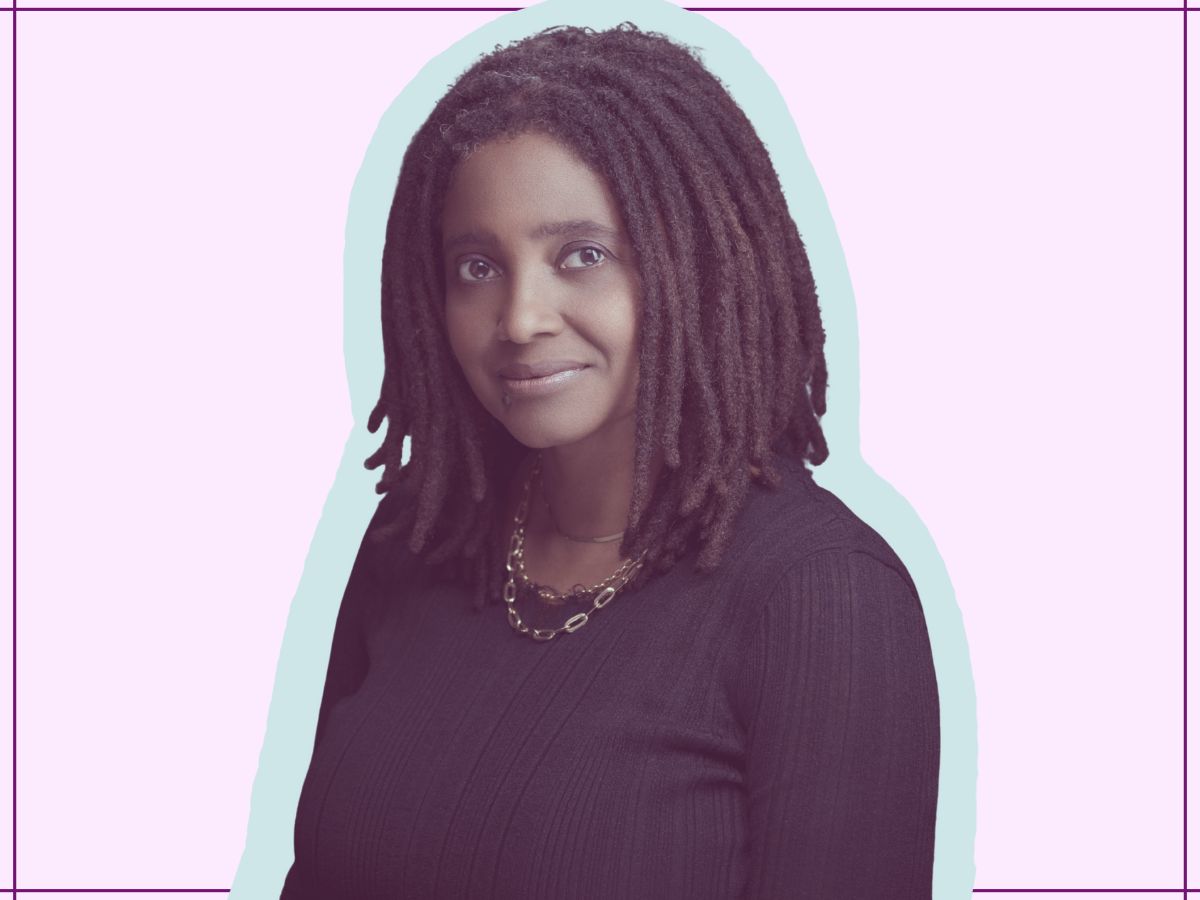
Photo: Tracy K. Smith
From the second floor of Harvard’s Barker Center, I watch the puddles on the red brick below ripple and swell. The rain pours down the window so thickly, it looks like a second sheet of glass covering the first. My jacket dries slung over the back of my armchair. Tracy K. Smith sits across from me, her long dreadlocks hanging over her shoulder, her legs crossed, her hands clasped in her lap.
Smith, who was named U.S. Poet Laureate in 2017 and won a Pulitzer for her poetry book Life on Mars, now teaches in the English and African American Studies departments at Harvard College. She completed her BA at Harvard and her MFA at Columbia. Her published work ranges from lyric to documentary poetry, in The Body’s Question, Duende, Life on Mars, Wade in the Water, and Such Color: New and Selected. In 2025, she published a Norton Short, Fear Less: Poetry in Perilous Times, an argument for the value of reading and writing poetry in modern times. Her memoir, Ordinary Light, was a finalist for the National Book Award in nonfiction.
This rainy afternoon, we sit in her office and talk poetry. Anyone who has spoken with Smith, even briefly on the street, cannot help but notice her distinctive voice—the balanced, soothing tone, the careful way she shapes her sentences. Smith speaks aloud in regular conversation as if reciting poetry. As if spinning a web; as if casting a spell. I have the pleasure of asking her about the documentary poetic form and how she writes about history. She tells me history is not over. She tells me ghost stories. I will always be able to hear the rain from that day in the audio recording from which the following interview is transcribed.
ANNA POPNIKOLOVA: What was it like returning to campus as a professor at a school you went to?
TRACY K. SMITH: It was very surprising when I started here in 2021, to realize how much of that younger version of myself came back, almost like a ghost. I’d be walking down a street and realize, Oh, heartbreak happened for me here, or, This is where I realized poetry was important. It felt a little bit like time travel.
AP: Your work straddles academia and creative writing. How do you teach that?
TKS: Close reading is a method that I return to. I think it’s something that students can always have more exposure to; it’s a way of looking forensically at the choices in language that allow us to see and recognize things in the writing. It’s a way of paying attention that is useful in every context.
As a writer, I’m really interested in the ways we are in dialogue with our literary ancestors and forebearers. I’m really interested in the ways that works talk to one another, the ways that influence travels, even in ways we would not imagine to be possible or ways that our rigid thinking would dissuade us from looking for. We learn from and are indebted to people that we don’t even agree with all the time. One example that comes to mind for me is that I teach a class called “The Black Lyric,” which is 20th and 21st century African American poets, and each week there’s a 20th century poet who’s the ‘elder’ and they’re paired with a contemporary voice. We can think about themes, inheritance, but we can also think about the ways that a younger writer might minister to some of the impediments in an earlier writer’s body of work or areas of struggle.
Amiri Baraka is a voice that we come to in that class, and it’s inevitable to recognise the moments of homophobia and sexism in that early writing, and last time I taught the course he was paired with Danez Smith, who I think ministers to some of those roadblocks, some of those biases, in a way that actually feels like it allows the project of Baraka to be seen in its full sense.
AP: You mentioned the Dark Room Collective often in previous interviews and writings. What was that for you in college?
TKS: I came into the Dark Room in 1991, as an intern. I was operating the stage lighting for the reading series that had been active for several years before that. I think the Dark Room waned a little more after that, as a lot of the founding members went on to MFA programs or started publishing books and moved. I would say the last active years of the Dark Room would have been ‘95 or ‘96. I think it was really great to be a young person in a community of people who were saying we belong to a tradition, and that sense of belonging meant that we could reach out to the writers that we revered and invite them to read.
The biggest part of that education was to be at a table with an amazing author and be able to ask him about his work, or to think, Oh, this poet eats food and laughs at jokes, and is going to go home and reflect on this same meal in his own way, which was kind of mindblowing.
It gave me a sense that not only could I declare it as an aim, but I could say, This is my calling, this is my job, this is the purpose I have chosen. It found me, I found it, and I have to make good on that. Sending work out, getting rejected, but sending work out is a part of that. So much of choosing a vocation like writing has to do with the kind of authority that we can convince ourselves we possess. Speaking up in the other classes I was taking that weren’t bringing up a lot of work by Black writers. It felt like I was representing something. In some ways, seeing myself as belonging to something I could speak up for was huge.
I love the sense of devotion that was drilled into me and my peers, which was also a kind of submission to a time-based process. In some ways, I would love for students to adopt a little bit of that, which I understand is a little bit of a retro mode, but to say It’s possible to publish books, and have an online presence, and to be making it at a very young age, and that’s great — but there’s also something that happens in the long stretch before a poet gets ‘launched’ which I think is irreplaceable. Because it allows a person to say, Why am I doing this? If none of the rewards that I hope one day might be possible are even thinkable right now? And I think for me, and for many of us, what that meant was community became crucial. Not just as a way of bolstering yourself, but as a way of saying that part of being a writer is to commit to the growth of other aspiring writers, and to give something to the community as opposed to thinking of what I myself can get or claim.
I think humility feels like a necessary trait to practice and learn. [Being] a young writer is also learning, practicing, and claiming a wild kind of permission and authority. I think those two things are really important, and for whatever reason, I think the Dark Room was very good at instilling both.
AP: What is it about documentary poetry?
TKS: My first exposure to documentary poetry was reading excerpts of Charles Reznikoff’s Holocaust in a class that I was taking on American Foreign Policy. To think about the ways that the poetic imagination can make use of language in circulation, and use that vernacular relationship to the American vocabulary as a way of listening differently and critically to history, and as a way of challenging some of these patterns as they continue to exist in the present — that was revelatory to me. As a poet, I’ve always been interested in writing about America, thinking about the stories that are often marginalized or defaced or distorted, and to imagine that I could reach into the archive or reach into the files from the Eisenhower administration and listen in a way that actually allowed me to see history as something that’s not over, that’s not far removed, and that’s actually useful even to the forms of critique and resistance that I’m trying to find my vocabulary for in the present. All of that meant that poetry could help me be a different kind of actor in the culture that we participate in.
It was no longer a matter of thinking, How am I going to filter this through my own personal experience, or How am I going to find the right persona to allow me to approach topics that worry me: vulnerability to war, the ways that capitalism can so often pit us against one another, formulating a vocabulary of concern for the most vulnerable among us. Suddenly, I have all these tools that allow me to do these things.
Another reason that documentary poetry has felt so useful, this is the more mystical version of the answer, is that I don’t think that the voices from the archive are finished speaking. I no longer believe that they’re as wedded to the agendas that they had in their lifetimes as they once were. Erasure can be a way of finding another line of dialogue within something like our founding documents, which consoles me when I feel most worried that the darkest chapters of our history are chasing and gaining on us. That’s what sends me to the archive—when I want to think that democracy is possible. When I want to think that it’s possible to acknowledge the forms of bias and erasure that have been common in our history, and to ask some of the documents that most exemplify those patterns to say something else. I think documentary poetry is about listening and surrendering the willfulness of what we’re often listening for.
Approaching the artifacts from a collective history, not with a determination to get back at things that we might believe were wrong-headed, but to work through them towards something that we ourselves don’t even necessarily yet recognize, the challenge of discovering something unpredmeditated—something we have not set out to find—as a result of listening differently to the archive. Erasure has helped me to think through questions of racial disparity, debts that America owes and has not yet made good on to people who were enslaved, people who were stolen as a result of the American project.
I think it’s an exercise in the opposite of cynicism. It becomes very exciting when it almost feels like a life force or a voice that hasn’t been imagined rises through as a result of the kind of open-ended listening that a poet can do in the space of the historic archive.
I love to think about how poets have found the means toward not just testifying but also being taught and changed by the events of history. None of the histories that we’re interested in is over. Going back and listening, not only to the voices of politicians that might have been legislating against an inclusive and biracial government, but to the people that were preaching to its necessity, or the people that were hoping for change—all of those seem like tools and strategies and vocabularies for possibilities that are incredibly relevant to what we’re hoping to salvage at this moment, and forge the many things that are coming apart or under attack.
Our news cycle: different versions of what is happening and what will happen and what should happen. It means that we’re not fully grounded in the present. We’re leaning toward these versions of the possible future. I think that looking back at the archive means that time becomes larger. It becomes something that we’re not racing through on our way toward a victorious outcome, but that we’re becoming more resourceful in terms of listening to, receiving and being unsettled or consoled by what has happened and either been heard in one way or overlooked altogether. I think it makes us attentive. You’re going back to something that has happened, and in many ways is over, and you’re trying to listen to what it’s still saying.
I think it’s a kind of deep listening that changes the way you are in the present. Changes the questions that you’re willing to ask or be vulnerable to in the present, and that feels like one of the larger gifts of poetry in general, that’s really particular to this process.
I really realized that the best thing that I could do was to invite my readers to sit down at the feet of these voices, these people, and listen to them. Documentary poetry is something that invites us to get beyond the authority of our own voices and listen, and to curate spaces for us to listen to different configurations of speakers, whose voices are not yet done reverberating just yet. That I think underscores for me this other hope that I have, which is that poetry is an art form that is very useful to our civic lives and our behavior as citizens.
It’s exciting to be made vulnerable, even as the artist who’s trying to write the poem, to be made vulnerable. We’re sort of buffered — we’re very well rehearsed at boundaries, it’s almost like a self-defense mechanism to be able to scroll away from something, but it’s a bad habit to carry over into these other contexts that are urgent.
The thing that worries me most is because social media is a delivery system for something that is monetized, it is something that is grounded inevitably in the mode of the consumer and the mode of the pitch that we are ingesting, even as we’re looking for the beauty and the creativity of other people, we’re getting this other dose of something that I think is dangerous. Young artists: you can have an artistic community that spans every continent, but you’re also in the mode of having to sell yourself in a way that undermines some, not all, but some of the lexicon of artmaking. It’s always been that way, but it’s tactile and daily, and it gets into the dream life.
AP: How do you write a documentary poem? How do you pick?
TKS: It’s different. Sometimes, it’s a poem that comes from journalism that I’m reading, which allows one context to be activated by another. That feels like a really good coincidence that tells me: There might be a poem that can come from this transaction. Sometimes a documentary poem comes out of a persistence of a certain circumstance being activated by everything that I see.
I wrote a poem much more deliberately in that same summer, which was an erasure of Woodrow Wilson’s essay in celebration of Robert E. Lee. I taught at Princeton at the time and Princeton had just decided to remove Wilson’s name from the school of public and international affairs, so looking for Wilson’s voice and asking to hear a different message within this characteristic celebration of this confederate general was also a way of saying, Hey, woodrow wilson can you meet me in the ether and can we talk? I know this is how you felt when you were human, on this earth, but what can you allow your words to have bearing upon now that you’re not invested in the small power-based pursuits? The first version of that poem was me pushing for something, and it just didn’t work. The second version of the poem was me pushing a little less, but still trying to drive, almost like how you’re playing with the Ouija board—you want something to happen, and so that’s what gets spelled out, as opposed to letting go and letting something come through. The poem that ultimately resulted from it becomes a poem that swerves away from Wilson’s legacy.
The lines are: “if you love a country that does not does not, was conceived not to want you, I want to remind you, you live you live, turn your minds and your hands likewise, to the task of life,” and there’s a line in his essay about war, and it’s thinking about loss but also allowing that to be turned to the other direction. That felt like a really beautiful, haunting moment where something could be audible that was not the thing that I thought I was looking for, and not the thing that Wilson had set out to write about, but that felt incredibly relevant to the moment and to the question at heart. That was my favorite poem to write in that mode, where it feels like another life force that’s not gone.
A lot of that has to do with my willingness to believe that Wilson’s somewhere and he knows more now than he did in life, but maybe a huge part of that art is finding yourself and putting yourself into a position of being beholden and to believe that that kind of encounter is possible.
AP: This sounds a lot like this is a spiritual pursuit, also in a way—
TKS: I think poetry for me is. The first poems I wrote were thinking about just defining myself and slowing down to see what world I belonged to and what mark I might make on it, and [realizing] I belong to a nation that has a great bearing on other people’s lives, in ways I don’t agree with. How can I deal with that? How can I grapple with that, too? There is something a poem can do to bring you into a willing sense of encounter that defies what ought to be possible.
In my mind, it’s like a clear path. It also means that I come to believe that poetry, if you let it, can be a spiritual practice. I know everybody doesn’t hold that kind of vocabulary, so another way to say it to myself is that poetry is a consciousness practice.
AP: Are they ghosts to you?
TKS: I don’t think they’re ghosts. This is definitely where I am reminded that I was a student of Lucille Clifton. In her class, she would talk a lot about how her practice as a writer was also a way of talking to her deceased mother and her deceased husband, and her language is a tool that allows a divide like that to be crossed. Sometimes it’s wonderful, but if you’re open to that, it means you’ve also asked to see and bear witness to things that are harrowing.
I was 22 or 23, I was sitting in her classroom, and my mother had just passed away the year prior to starting graduate school. I wanted that to be true for me, but I wasn’t courageous enough to imagine doing that, and I had so many others—my religious education was not about trying to talk to ghosts or spirits, but I knew I needed to, though. And I knew I needed to, though. And I knew I needed to use poetry as a bridge.
For her, what that becomes is a reason for a large and pervasive accountability. Those other voices are only willing to speak to her because there is a larger human work that must continue that she was here to do. In her archive, which i visited a couple times, a lot of her automatic writing comes from seeking to make contact with other figures in the spirit realm who have a message of urgency for humanity, and they’re warning her about hatred, they’re warning her about being fixated on the differences between us, they’re warning her about having allegiances which are too narrowly inscribed in tribal ways, all of this stuff that we understand but not always from a luminous spiritual vocabulary.
There are thousands of pages of these sessions in her archive. Finally, in one of her last books, she writes a very short poem that distills that into one powerful prophetic message called “the message from the ones,” but it was a preoccupation to write every day for years, to sit down and call upon these others and listen to what they needed her to hear and do and recognise in trying to figure out how in her human work she could do good on that promise. And I really love that, and I think that informs my belief system of what art calls upon us to do, which is to be useful outside of our own time in collaboration with huge things.
I think poetry asks us to be accountable to, invested in, and allied with projects that span generations and geographies. Even if the imagination is not willing to take that step toward the afterlife, language is capable of doing that work.
AP: What is your philosophy on self-insertion into documentary poetry?
TKS: I think it’s perfectly welcome and useful, and in some projects, necessary. It makes a path for the reader to say, I don’t have to guard a certain kind of distance and this doesn’t have to be a purely intellectual project nor a project that is grounded solely in empathy, if I can move toward this material and understand that I am implicated in it, that there is something there for me, I think that also activates a certain kind of agency.
When Jay Bernard [Surge] writes poems about finding joy in a queer community—in the very landscape when another community was subject to a violent disregard, I think in some ways its a way of saying that these former losses are still present, and maybe they’re us in some ways, and part of the work that I can do is listening, part of the work I can do is testifying or attesting to these lives and these events, but part of it is making space to live in a certain honest way or a certain porous way.
I love it when poems convince me that I have a stake in something. When a poet inserts themselves into a documentary poem, that’s exactly what they’re doing.
It’s a response in some ways to other forms of silence and erasure we’re all aware of, that also characterize a lot of archival documentation—but it does more as well, I think it allows something to rise out of violence and loss that is generative. And that is characterized by a kind of imagination and care. I think those are some of the lessons that the archive can teach us, otherwise there’s a lot of grief that we’re bearing and a lot of dead ends that we might become preoccupied by, so when someone goes in and has the courage to say Here’s another strategy, and it’s at great risk and not everyone is going to believe it's valid, but to some, it’s an antidote.
AP: A lot of the content in the archive, especially some of the things that we’re interested in now, is just so devastating. Where does joy come into our poetry, and where’s the value of that?
TKS: Because we know joy is a survival tactic. When I think about the archive of Black life, and how so much is lost and disenfranchised, and so much is people being rendered into objects and scattered—I know that what has held families, communities, and legacies together is the propensity to make and find shared joy, love, and laughter. All of these things become engines for the creation of persistence. That’s gotta be a big part of the process of making poetry out of time in the archive, bears witness to.
When you’re able to say, I want to shape your vocabulary for joy and what I think of as continuance, continuing, I’m going to do it in a willful way. I’m going to get really close to this material. I’m very grateful for that when it’s done, and it's done in ways that elevate the real stakes as well.
AP: Why should we read documentary poetry?
TKS: A lot of what happens for me, when I’m reading the news and looking for news that might be heartening, is that I’m looking for a specific kind of outcome that aligns with my own moral compass and my own opinions. So, I’m feeling the frustration and discouragement every day.
Documentary poetry has to make you see other approaches to news, even if it’s no longer new. It models, again, these different ways of listening, these different ways of being vulnerable, and it necessitates that we step out of our own framework for what positive resolution looks like, because it hardly exists. And so, when we’re going back, we’re asking to be guided to new terms of value, things that have been undervalued, and maybe even evaluating what we’re vulnerable to and what we’re capable of. There’s no poem that succeeds by giving the reader what they think they want, in the way they think they want it. Documentary poetry lives up to that, but with the matter of history, it tells us that the tools have to be different from the ones we wish for. And I think that’s really helpful, because the ones I wish for just don’t seem like they’re coming. Like the hammer of Thor just smashing down in justice, or something.
AP: You talk about history as a sort of character. It’s animated. How do you define history?
TKS: It’s voices that we have access to, and it’s lives that we know were there, that we have to become very sensitized to the evidence of. Because there isn't necessarily the same kind of thorough documentation surrounding them. History is a process. I wish I were a better student of history in the context of scholarship of historical research, but poetry, I believe, has made me more avid because I can think of voices and handprints and communities and all of that; it feels ongoing to me. It feels grounded in many narratives at once. The skills I possess as a poet enable me to get very close to details, gestures, images, and language. To hear and see it in multiple ways, and to feel myself implicated in it, or to be willing to feel myself implicated in it in some ways.
AP: What kind of archive do you tend to — is it books, is it news, is it film, is it other art — what is the archive to you?
TKS: I think it changes from context to context. If I’m interested in a topic or set of events, I’m going to look at antecedents: Are there voices, are there statements, are there actions? I love letters because I like to hear the voice and the breath. I feel like a letter is filled with life's breath, in the way a poem begins to be. That’s my favorite kind of document to work with. Photographs, as well, because they do what images and poems do — they tell you what’s present and what’s absent, what’s needed, and what just happened and what likely followed from this one instant.
There are a lot of films in my poems. I wrote a poem about the John Ford film, The Searchers, many years ago, and revisited that film and the history associated with it. More recently I was thinking about Black cowboys and that the myth of the American cowboy as this individual who is walking away from a certain kind of duty toward freedom, which is one view, but history also tells us in the context of Black cowboys, they’re walking toward a duty, to a community, to a family, to all the things that enslavement sought to undermine.
The vision of a film that has a profound bearing on the American imagination is an archival tool for thinking about other potentials or dimensions of the American imagination.
AP: What is the niche that you think documentary poetry fills?
TKS: I think one thing I notice is how often writers of marginalized communities are interested in documentary poetry. I think it’s because of a desire to expand the record to correct certain omissions or distortions, I think there’s a huge trend in contemporary African American poets to be thinking in archival terms, so much of that history is being erased or distorted or discounted or outlawed, and this is work that has to continue to be done, to make it realer and realer and realer. Not just in terms of corroborating facts, but also touching face with the emotional urgency of it. I think that’s a big charge of the form.
I’m thinking about those poems that were part of the work I did in Life on Mars and Wade in the Water, and the new poems in the New & Selected—they’re poems about citizenship. I’m trying right now to write lyric poems about citizenship. Lyric poems about what it means to be alive and what it requires us to bolster in terms of the other dimensions of our imagination. I feel like those are connected projects, but they’re different modes of asking that same question.
We care about citizenship even when we’re not citizens—maybe especially. And so, when you think about all of the ways in which people are so resourceful in overcoming the hurdles to be recognized by a nation and its institutions—those are imaginative acts, those are creative acts, and I think they’re beautiful for poetry. To be willing to say, I’m a citizen, but I recognize a kind of robust resourcefulness and doggedness that is most visible in those for whom that kind of belonging has been barred. It appears to be an important site for study. What can I learn from this? What am I being taught by this?