
SPRING/SUMMER 2026
Trap and the New Black Aesthetic
A Young Music Genre’s Aesthetic Footprint in Contemporary Art
Alyssa Gaines
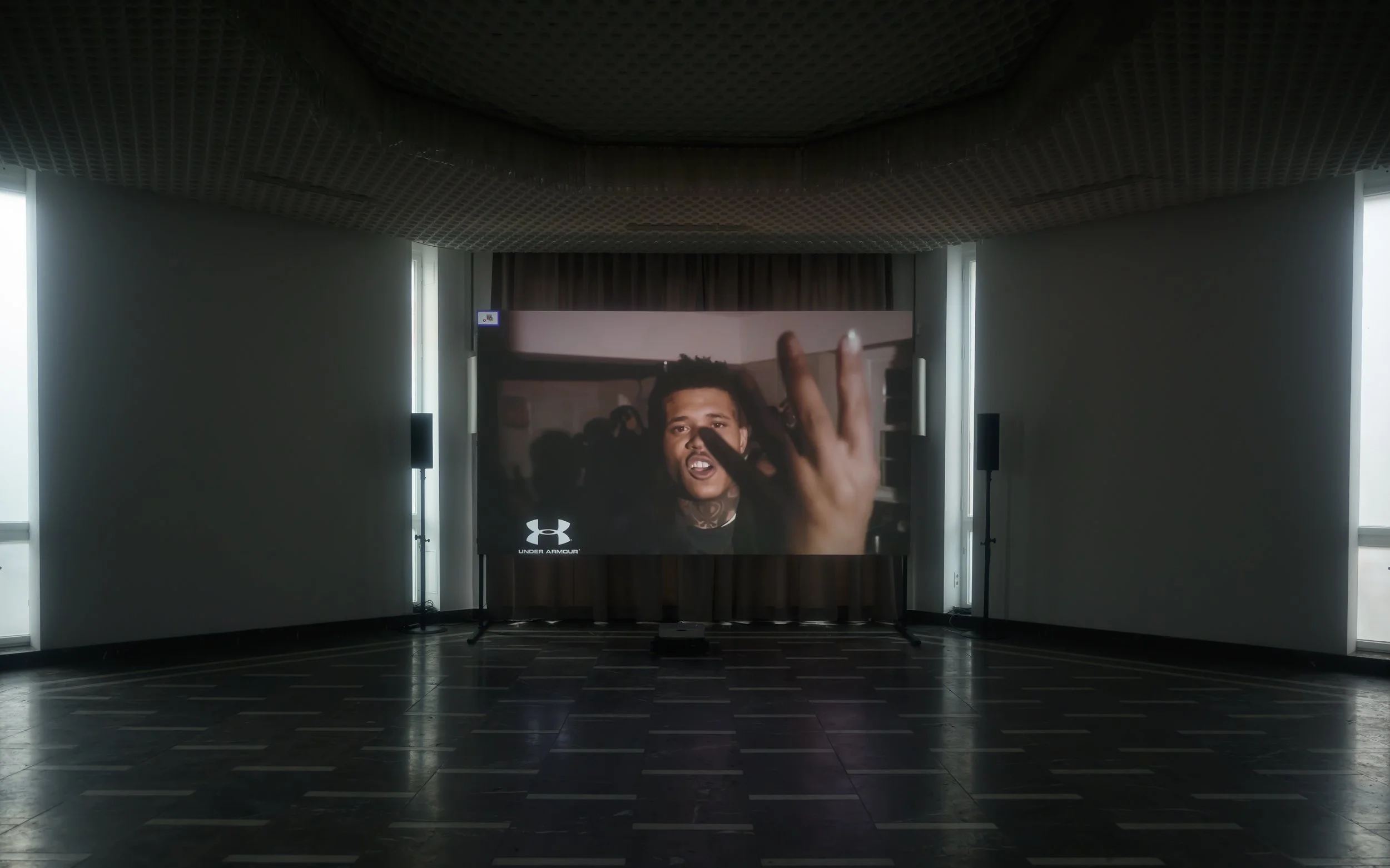
Still from Sojourn, Allen-Golder Carpenter.
Last summer, I discovered the work of Allen-Golder Carpenter and Emmanuel Massillon through an Instagram post of Massillon standing beside his Mud Libation (RIP Fredo Santana), a statue just over 6 feet tall in the Baltimore Museum of Art. Named for the Chicago rapper, Fredo Santana—the older cousin of Chief Keef—who died of a seizure in 2018, the tributary structure alluded to the viral legend of the rapper’s tragic passing, thought to be connected with his addiction to lean.
A kind of optical illusion, Mud Libation is an outsized and freestanding double-cup of styrofoam suspended multiple feet in the air, pouring literal mud into a dirt mount on the pedestal below—playing both with the language used in rap to describe the act of turning soda and cough syrup into the opiate vernacularly labeled “lean” and the act of pouring out libations itself. “Pouring mud,” a linguistic abstraction, is given form by this work of conceptual abstraction, invested in street culture, trap music, blackness, and the internet.
From this work, I found Massillon’s Instagram account. Who was this artist, followed by art world figures, trap producers, and Lil Baby alike, and what was he working on? When I first got in touch with him, Cell 72: The Cost of Confinement at Harlesden High Street had just closed. A collaboration between him and artist Allen-Golder Carpenter, this installation transformed a tiny gallery space into a jail cell where Carpenter confined himself for three days. In full view of anyone who passed by the gallery’s storefront he inhabited the cell wearing prison-issue clothing, eating cup noodles, using decommissioned prison phones, and hanging framed images and hand-written journal entries on the walls.
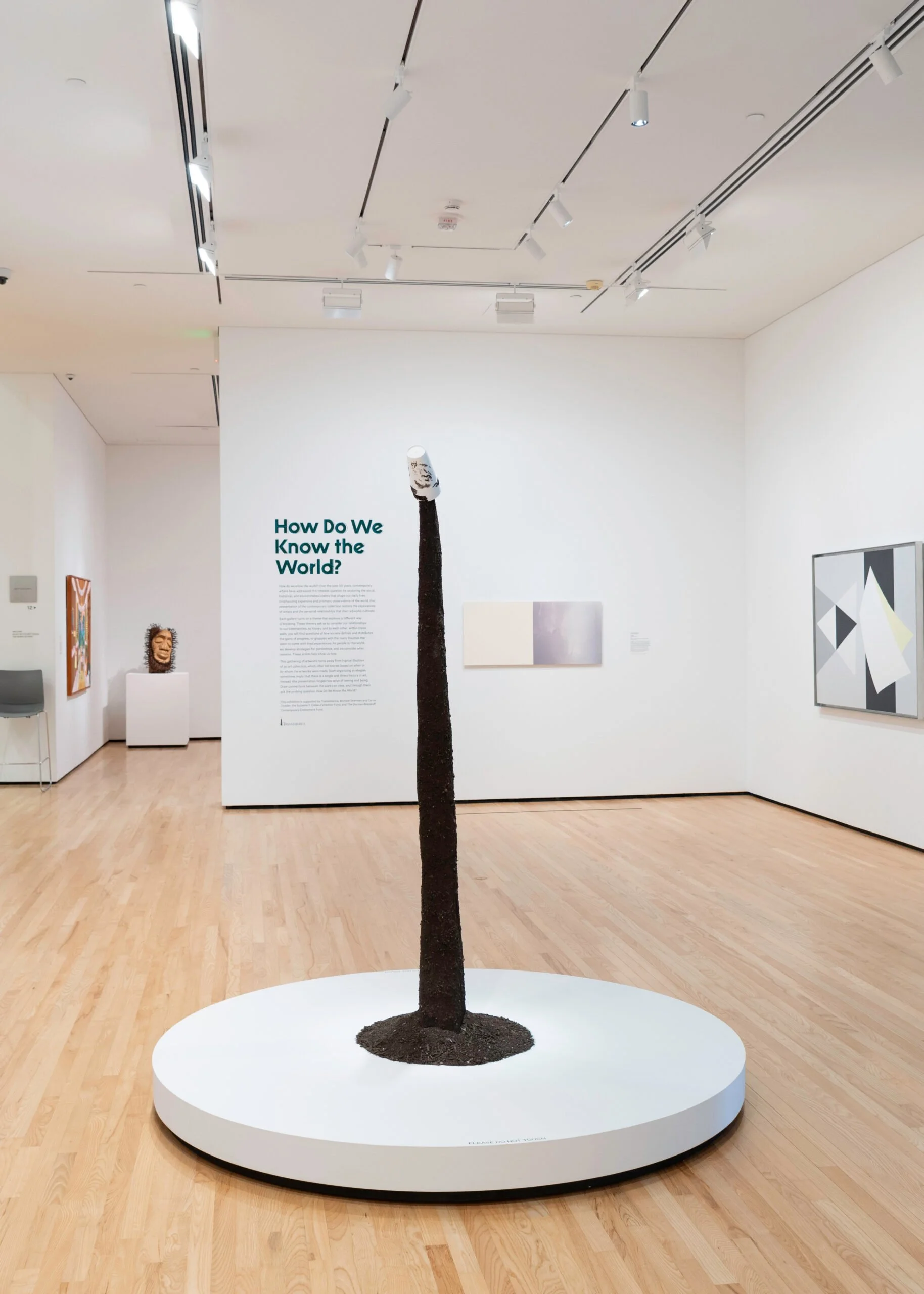
Emmanuel Massillon, “Mud Libation” (RIP Fredo Santana), 2020.
The works for sale from this performance included pieces made from cement, soup packets, hand sanitizer, inmate property bags, decommissioned prison phones, cup ramen, and even Carpenter’s excrement; carceral detritus became collectible and viscerally immediate for the show’s art market audience. Also for sale were the cell’s wall adornments, including Carpenter’s “First Day Out” works. If you are wondering—assuming you weren’t already—about the ethics of two artists (who have never been incarcerated) turning carceral trauma into financial gain through art—if you’re asking whether or not this is an inherently exploitative act, and whether or not it is ethical to support it—this is exactly Massillon and Carpenter’s point.
In their collaborative and individual practices, these two artists often draw from hip-hop’s imagery and its affective relationship to the internet to build the aesthetic language of their work and to render its critique. This language, due to the nature of trap, brings with it a unique set of epistemic offerings to the world of contemporary art that unsettle the kind of racial knowledge art has historically been used to manufacture. Simultaneously, the language—trap—challenges, with its visual idiom and the curiosity it provokes, those who have simply stopped caring about racial representation in art.
The “First Day Out” pieces strike me. Hung like a diptych, Untitled (First Day Out) and Untitled (First Day Out [blurred]) are near-identical 20.3 x 25.4 cm screenshots of Georgia rapper Glokk40Spaz’s 2019 first-day-out song cover reposted to Instagram, enlarged, printed, and then transformed into photoprint and aerosol paint on wood. From installation views, all that is legible about these images is that they are song covers (through their parental advisory label “Explicit Content”) and their punchy, emboldened caption: “First Day Out.” Clearly, embedded in their project is a concern with carcerality’s cultural footprint, particularly in street culture and rap music. But what exactly is the nature of this critique?
Regarding this installation, The Guardian asks explicitly “how do Massillon and Carpenter counter allegations that what they’re doing is appropriative,” and Massillon answers that their aim is twofold. Beyond showing the horrors of prison to those culturally distant from Western carceral apparatuses, they want to “raise awareness” about the horrors of prison’s cultural consumption. They are explicitly interested in trap culture and the internet’s fetishistic repeated carceral imagery and how these images distance consumers from the reality they depict.
“I don’t think people really know the horrors of prison,” Massillon says, though, interestingly, he assumes a certain cultural proximity in his ideal viewer: “you might listen to a song, you might hear it in music, you might say ‘wow, this seems cool,’ because people glorify it…” Massillon imagines that maybe his viewer has access and familiarity with the kind of first-day-out record built explicitly into the construction of the cell. “But there’s real people that are being put in these situations,” he continues, “I came up with this project to show people that this isn’t a place you want to be.” The installation, then, is conceptualized as information even a proximate viewer might lack. The mechanism of this simultaneous proximity and distance which their work reconciles, provides a central lever of Carpenter and Massillon’s critique: the internet.
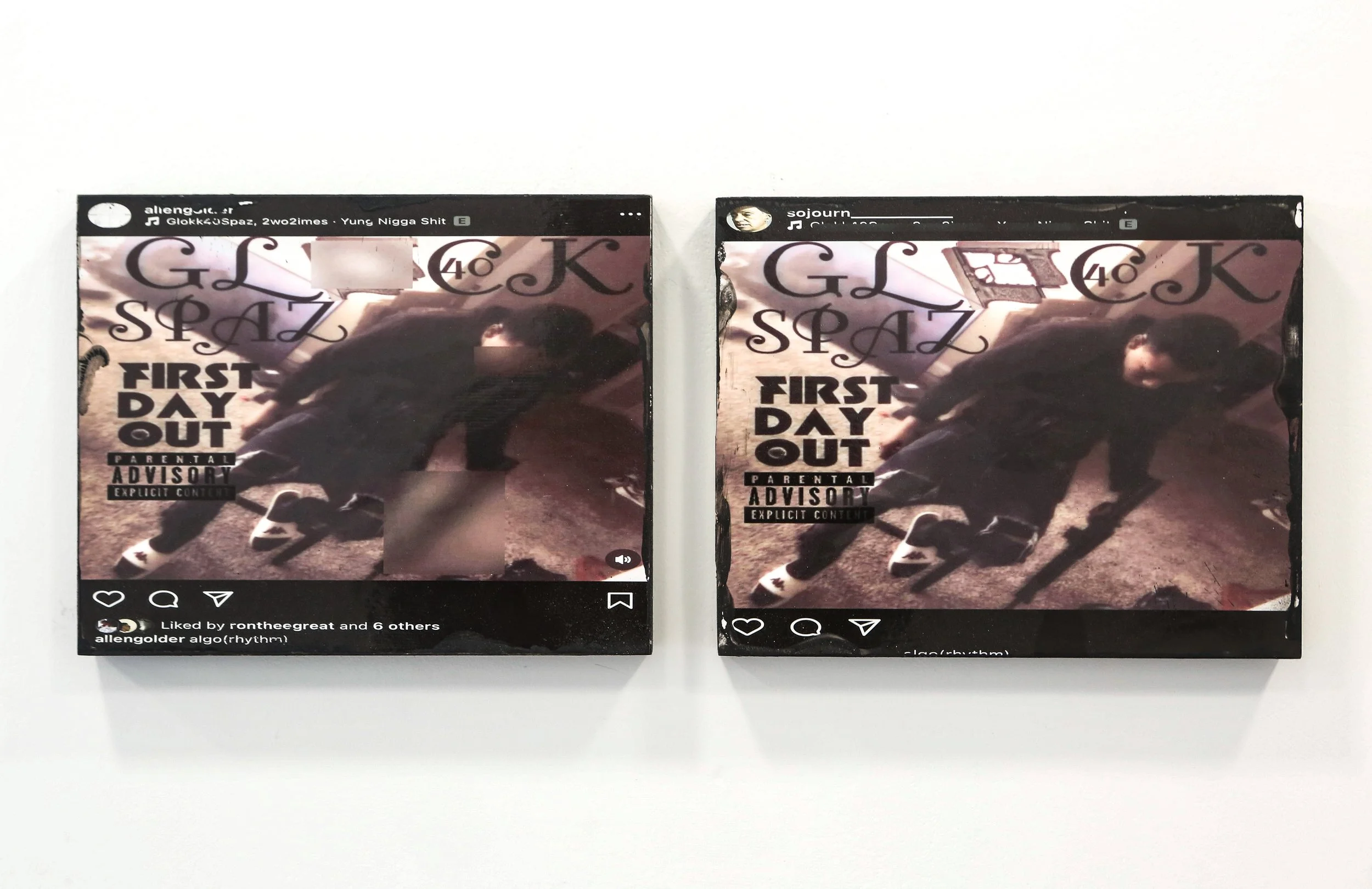
Allen-Golder Carpenter, Untitled (First Day Out), 2025.
A closer look at Carpenter’s two Untitled (First Day Out) works reveals that the pair’s investment in trap is inseparable from the transforming transmission of rap and “street” culture online. The diptych does not simply reproduce Glokk40Spaz’s cover art; it reproduces an Instagram post of the cover art, complete with the platform’s framing conditions: captions, censorship, comments, attached music, and usernames. In the blurred left wing of the diptych, where guns and the person on the cover holding them are both censored, the post is captioned “algo(rhythm)” and uploaded by “@aliengolder,” the artist’s own Instagram account. In the uncensored version, the social-media information is obscured and the post appears under “@sojourn,” not a real Instagram user, but Carpenter’s project of installation, video, avatar, and performance. The work’s meaning depends on the viewer recognizing not only the first-day-out trope, but the mechanics of its mediation and online circulation through which such tropes become aestheticized and algorithmic and rappers become like fictional characters akin to @sojourn. Trap is not merely the content or the language of the image’s content, but it is the system through which we learn to see the image; it is the subject of the piece.
For the same Guardian piece, Carpenter specifies, “Prison itself is [...] intimately tied up with black American culture, especially through hip-hop [...] It’s inseparable, almost; prison is a pressure cooker that deeply impacted and influenced blues and jazz and eventually rap music.”
Massillon uses sonic categories to frame the way carceral systems affect black culture. Still, it seems for Massillon, the mechanisms of this culture—of the music specifically—also affect carceral systems: “The glorification of violence through music is at an all-time high. It’s almost like a caricature of itself.”
Music is essential to Massillon’s understanding of black culture and its relationship to the politics of black life. This is largely a shared understanding. When people talk about Black American art from visual art to literature to film, they are eager to reach for—and, often, essentialize towards—the musical categories of jazz and blues.
Here, Massillon names these categories specifically, and then names another, with which he and Carpenter’s work is more explicitly in conversation: rap. Further than just rap, I believe both artists’ work is concerned with something a little more specific. What Carpenter and Massillon are working with most often is trap— rap’s more narrative, hook-y, autotuned, and synthetic subgenre of the digital age.
*
Essentialism in Black art describes the degree to which said Blackness is thought to inform the art itself. It is the process through which black art becomes Black Art: a category confined by racial imperatives, namely the imperative to read the art through a racial lens and the imperative to ascertain some stable racial essence of the work. The paradox is that while critical periods of Black Art History have needed black art to be both Black and political, this category constrains the critical conversation around black art and reproduces a racial logic many black theorists have fought to resist. While figures like Amiri Baraka of the Black Arts Movement dedicated themselves to the articulation of a Black aesthetic as a liberatory aim, others chafed against being called “black artists” entirely.
No matter the degree to which you believe black art possesses a Black essence or a fundamental racial character, all critical conversation about essentialism must first pass through music. Then, from music, it moves inevitably to Black poetry and Black art. Baraka’s aesthetic theory, for example—articulated across books like Blues People and Black Music—begins with a theory of Black music and its history. George Packer’s 2016 “Race, Art, and Essentialism,” for The New Yorker, an example from the other side,begins quoting Rick Moody on James McBride’s biography of James Brown.
Rick Moody praises the tendency of black writers to claim authority over black music, arguing they offer insights nonblack critics simply lack. George Packer fundamentally disagrees, objecting to the late 2010s identity politics and the assumption that identity itself could guarantee privileged interpretation. If black critics are presumed to possess special access to black music by virtue of being black, he argues, that praise flirts with other brands of less tasteful racial fantasy: “a few more steps and you’ll find yourself saying they sure do have rhythm.” Packer’s 2016 provocation echoes Darby English’s 2007 argument that the stable “Black subject,” required to justify black critics’ special access to it is, itself, a projection— the same racial fantasy through which “black writers lay claim to the discourse of black music,” slips into “they sure do have rhythm,” and then it is the same logic as Fanon’s “Mama, see the Negro! I’m frightened!” from which English’s argument builds.
While there is merit in carving space for Black Americans to write with their own insights about their own culture, to essentialize is to essentialize: it is to believe that race endows racialized subjects with certain abilities, tendencies, proclivities, and attunements they otherwise might lack. This is the logical consistency Packer seeks to expose, imploring readers to “Think of Moody’s proposition in reverse: Mozart can only be fully appreciated by people of European background.” If, out of Packer’s otherwise convincing argument, this “proposition in reverse” rubs you the wrong way, you're in the company of thinkers like Du Bois, who saw Black music as “the singular spiritual heritage of the nation and the greatest gift of the Negro people.” The essentialism question circles back to black music. Of the past 100 years, two genres stand out the most: jazz and blues.
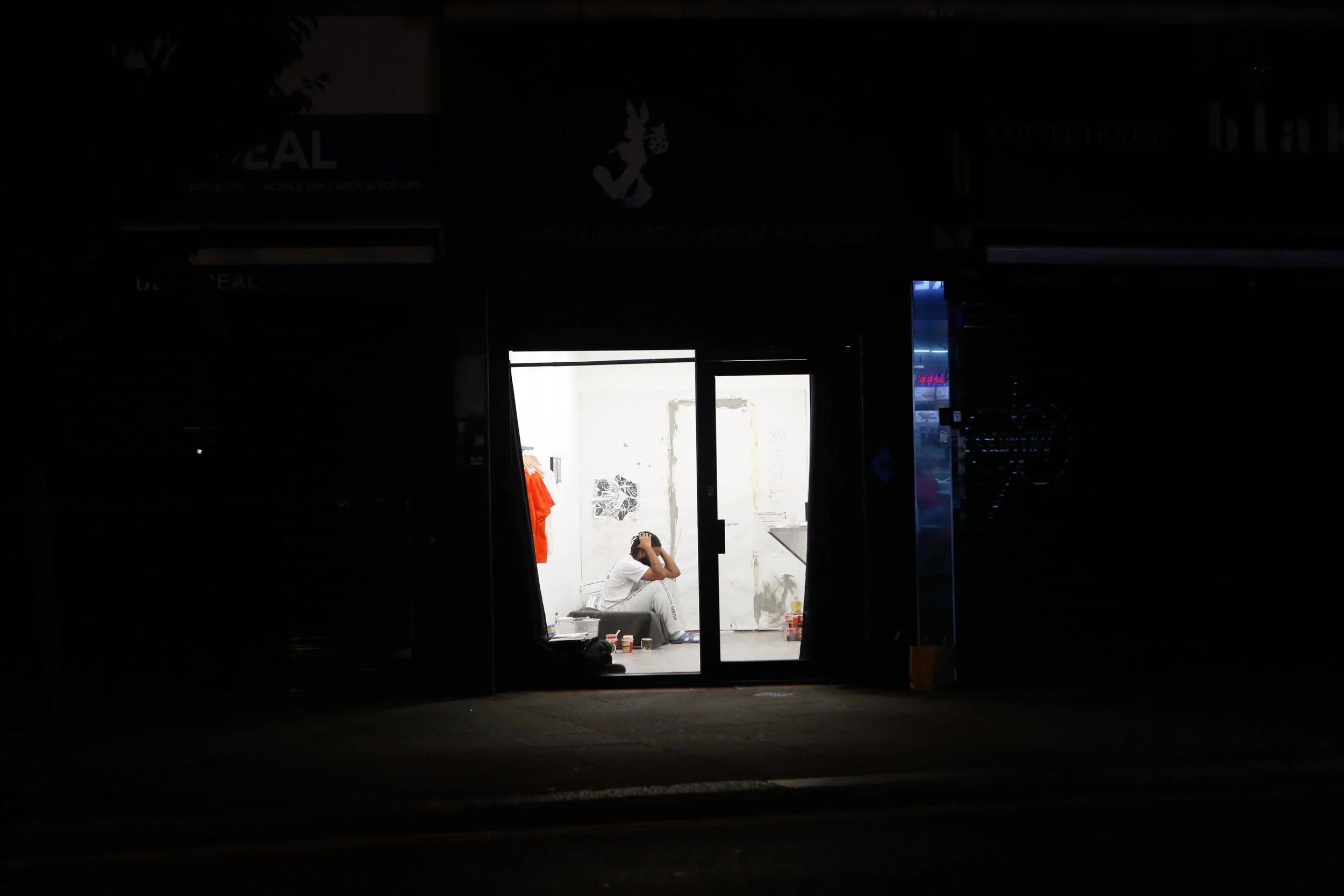
Outdoor Nocturne Image of Cell 72: The Cost of Confinement Performance at Harlesden High Street Gallery in London, England, 2025
There is Toni Morrison’s Jazz which finds its literary form in the sonic structures of the genre, and Kevin Young’s Blues Poems where Young offers a theory of the blues as a form that “fights the feeling,” gathering a history of the black lyric into its canon. There are Ralph Ellison’s writings on jazz, a counterpoint to the essentialism of Baraka, including his review of Blues People for the New York Review, where he declared “Unfortunately for those who expect that Negroes would have special insight into this mysterious art, this is not enough.” There is Jesse McCarthy's The Blue Period, which uses the blues to analyze a mood, a political atmosphere, an aesthetic position of black writers between World War II and Black Power—and Imani Perry's Black in Blues, which takes the color itself as a category of analysis. The music is a mode of connection-seeking; a category of analysis.
Because jazz and blues have been encased in such a resin of academic valor, it makes sense then that other, newer Black American musical forms would seek legitimacy through their idiom. On the tail end of hip-hop’s golden age, after witnessing its mainstream oversaturation and decline, it is difficult to imagine how new the genre once was. When Perry wrote Prophets in the Hood, there was novelty in her assertion that “hip hop is an iteration of black language, black music, black style, and black youth culture.” One reviewer called this essentializing premise “debatable” (though I’m unsure if anyone would debate it now). Tricia Rose’s Black Noise: Rap Music and Black Culture in Contemporary America was reviewed in 1995 as “engaging and provocative,” in its address to those who thought rap music was just noise. In defense of taking rap seriously, scholars returned to the Black music exemplars they knew.
A 2005 review of Jeff Chang’s Can’t Stop Won’t Stop for the New York Times observes “hip-hop has had 30 years to seep into the national bloodstream, and our cultural guardians have spent much of that time trying to fit the form into musical narratives that stretch from jazz and the blues”—“well-intentioned efforts,” he calls these accounts. However, they have “gotten the story half-wrong.” The reviewer seems to appreciate Chang’s use of these comparisons as a “starting point” to record the history of hip-hop as a cultural movement instead of merely historicizing it musically, although he is skeptical of Chang’s success. Still, even in 2005, when hip-hop was only 30 years old, jazz and blues were ways writers felt they could legitimize it, so much so that reviewers were becoming fatigued.
This was also a period when rap was being attacked from all sides. C. DeLores Tucker called it “pornographic filth” and campaigned against Time Warner; Vice President Dan Quayle called it “a disgrace to American music”; Stanley Crouch dismissed Tupac as “dredged-up scum.” In that climate, reading rap through jazz and blues offered legitimacy though this analysis seems trite and low-stakes today. Hip-hop has fizzled, has fallen from glory, is no longer worthy of such frenzy, and so we look back at all its once-snubbed relics with rosy lenses feeling nostalgic for a generation defined by this sound. We grieve the masterpieces too niche to recover, too recent to approach with their proverbial flowers, and their seemingly inevitable loss to the annals of time. But we no longer need to legitimize the genre. Instead we might be curious about its impact on both a generation of black creatives and the aesthetic idioms of the contemporary landscape.
*
Instead of repeating one of the many illuminating theses on jazz and blues or reducing them to an analytical lens through which the fundamental glory of all black aesthetic production might truly be seen, we can take up the comparison as a structural model for deriving aesthetic forms from black music. As Imani Perry does in Black in Blues, we can use the structures of a genre to—as Tina Campt theorizes—listen to black artwork. We can use trap to connect wordplay, art histories, and interdisciplinary continuities. We can go even further. We can let musical and lyrical forms inform our formal understanding of black visual art. Beyond jazz and blues’ structures, trap offers an aesthetic structure of its own.
When Emmanuel Massillon opened his recent solo show, System Structures, Allen-Golder Carpenter activated his multi-format project Sojourn in the gallery. Fitted in an all-black suit and boots with a long bandana obscuring his face and his act of playing itself, Carpenter moved through the space playing saxophone before a number of Massillon’s illusory conceptual works. In one slide of an Instagram post, he kneels before Fall From Grace, an upside-down preacher's stand suspended mid-collapse, its papers, cash, and clothes frozen in the air, an upside-down microphone guiding your eye down toward the mound below. Carpenter’s caption reads: “I pour my self out for my brother, my soul as libation,” tagging Massillon, the gallery, and a separate account for Sojourn.
Although Sojourn is playing jazz, the figure Carpenter created functions less like a jazzman than a platform-era avatar: a persona, project, performer, exhibition, and online presence at the same time. Uploading clips from a 2024 Berlin performance under the pseudonym “sojourner june heron,” Carpenter wrote, “Was gonna wait till I got the official documentation for the show, but instagram clips are rawer i think.” This means that, for the artist, the Instagram Reel is a primary means of documenting the work. Across Sojourn’s all-black clothing, obscured face, microphones, stage lights, live poetry, film fragments, smoke machines, and social media afterlife, the audiovisual work tests the expectation that a black man in such a context must be rapping. This critique comes through Sojourn’s stage-name pseudonymity, short-film audiovisual framing, and platform-circulated invented lore. He is a part of a digitized, mediated, parafictional visual world, so while he plays jazz on the saxophone and performs spoken word, the logic of Sojourn is built on the structures of trap.
In another activation, Sojourn was accompanied by a short film with the same name. The short film spliced and collaged clips, disconnecting them from their audio, backdropping an installation and the performance of spoken word. The video clips—rap music videos with guns flashing at the camera, Chief Keef live performing “Don’t Like” live circa 2012, blues guitarists, Belly—suggest audiovisuality though their audio has been replaced. You are meant to listen and listen closely. Though your expectations of the images are destabilized, their essential audiovisuality remains. We recover not the substance of the blues and jazz analytics, but the structure. We listen to the images, all of the images, because of the fundamental audiovisuality of trap’s aesthetics.
In Listening to Images, Tina Campt proposes listening as a method for approaching the black diasporic image beyond its apparent visual evidence. Against the camera’s claim to authority over black subjects and archives of black subjects both limited and lost, Campt encourages a return to archives of images produced by apparatuses of uneven power like anthropological images or images produced by the state and attend to the sound pictures like passports and mugshots have lost. Campt pushes us to explore the image’s full register—affective, haptic, and sonic—and Carpenter works with the archive of the internet to demand the same. He manipulates the already-audiovisual images of trap, similarly produced by repressive structures and surveillance technologies, then places them in a gallery setting to be heard as much as seen.
Just as they are layered in the genre’s visual identity, “the quotidian practices of refusal, fugitivity, and futurity,” Campt looks for are embedded in trap’s lyrical framework as well. Through the layered opacities of the genre’s linguistic investments, to which Massillon is particularly attuned, subjects refuse to become knowable again and again. As Massillon exposes in his word-painting works which visualize various kinds of sonic manipulation, there is a structured refusal in the form’s sound.
Take Massillon’s Dog Food (42 Dugg Whistle), in which the artist asks you to listen for “dog food” as the 42 Dugg song with his signature whistling introduction and a catchy refrain and, through large-scale image-transfers of black-and-white barking dogs framed in masses of layered acrylic paint and literal dog food, to hear dog food as a vernacular term for heroin as well. Massillon attunes our ears to such absurdities, and then changes the way we listen to his source material in real life. It changes how we hear the whimsy of 42 Dugg’s whistle and “dog food” beyond the piece.
“Dog food” itself is a kind of opacity. It carries with it layers of meaning and centers a significance casual rap listeners from beyond the culture might otherwise overlook or not hear. The series finds its abstract expression through a kind of literalization, not unlike the language poetry of Haryette Mullen, where “Dog food” becomes dog food. Allen-Golder Carpenter's signature processes of defamiliarization—abstraction through redaction, deconstruction, and assemblage—are similarly opaque. Thus the racial politics of both artists’ work, the nucleus of their works’ critique, is not directly expressed. Instead they approximate the racial theory—or an aesthetic relationship to essentialism—of works that have been called “post-black.”
*
In the Studio Museum of Harlem’s 2001 Freestyle exhibition, music was once again the primary catalyst for addressing the essentialism question, this time in order to sidestep it entirely. In her introduction to the Freestyle catalogue, an exhibition that raised the profile of a cohort of this generation’s formative black names—including Fred Wilson, Kara Walker, Kehinde Wiley, and Lynette Yiadom-Boakye—Golden issued the term “post-black” to gather up the show’s aesthetic language. Born of conversations with conceptualist Glenn Ligon, this term proved extremely consequential and central to the show’s legacy. It was a “clarifying term”—“shorthand for a discourse” on essentialism, gesturing toward the black artists of the post-civil rights generation who “were adamant about not being labeled ‘black’ artists, though their work was steeped, in fact deeply interested in redefining complex notions of blackness.” To talk about “black art,” Golden discovered, meant “embracing and rejecting the notion of such a thing at the same time.”
“They are both post-Basquiat and post-Biggie,” Golden wrote of the artists. “They embrace the dichotomies of high and low, inside and outside, tradition and innovation, with a great ease and facility.” As essential as Basquiat is to the post in “post-black,” is Biggie, a hip-hop figure. The show’s title itself addresses “the cultural markers that defined these practitioners,” of which Golden argues “music culture prevailed.” Not merely music culture, but the music culture that turned the practice of improvisation into the “freestyle,” a “relentless and unbridled expression of the self,” a spontaneous expression of embodied, embedded mastery with sprezzatura and flare. The music culture in question, of course, is rap.
By these definitions, the trap aesthetic of Carpenter and Massillon’s work is necessarily post-black, both post-Basquiat and post-Biggie, post-rap and post-internet, interested in the high and low—the art world and the Instagram accounts of rappers—the inside and outside—those who know what “dog food” means and those who don’t—traditions and lineages of black conceptualists and innovative uses of overlooked material: sunflower seeds, dog food, black people going to jail and coming back home Muslim, R.I.P. tributes, first-day-out songs, mugshots, and memes. As the black abstractionists of the mid-20th century used visual abstraction as a strategy to capture the complexity and abstraction of their racialized subjectivity, as post-blackness often finds its expression in opaque forms, trap’s aesthetic is similarly coded. Trap’s layered references, its abstracting and pastiching wordplay, its mediation and defamiliarization, its regional specificity, all work to situate an ideal viewing subject that is curious. The viewer is immersed in layered works, asked to engage a dynamic and active act of inquiry.
Jazz and blues are not the most immediate aesthetic categories through which works like Carpenter’s Black Internet or Massillon’s inna Trap find their form. Carpenter’s Black Internet v4, for example, montages screen recordings, music videos, Instagram formats, historical footage, logos, speeches, and dislocated audios, assembled by the artist’s own logic akin to an algorithmic feed. A clip from DMV rapper QDaFool’s Instagram story praying the salah is screen-recorded as uploaded to the sound of Chicago rapper Lil Durk’s “Alhamdulillah,” then overlaid with Kia Boyz footage, poetry, Cell 72 documentation, MLK speeches, and clips of Kenyan protestors smoking tear gas—all deepening the connective tissue Carpenter asks viewers to trace. It is not as easy a task as it appears. This unstable layering and algorithmic arrangement of references built on facial recognition, sounds, digital platforms, and internet lore is Trap. As in trap, the images begin to run together ominously after a while though they resist an easy assessment if a viewer is to move toward analysis. Thus Carpenter uses Trap’s algorithmic format to turn passive scrolling into active curiosity. At the very least the viewer understands that there is a logic to what is arranged before them, a logic they may not possess all of the context to fully or immediately know through pure consumption alone.
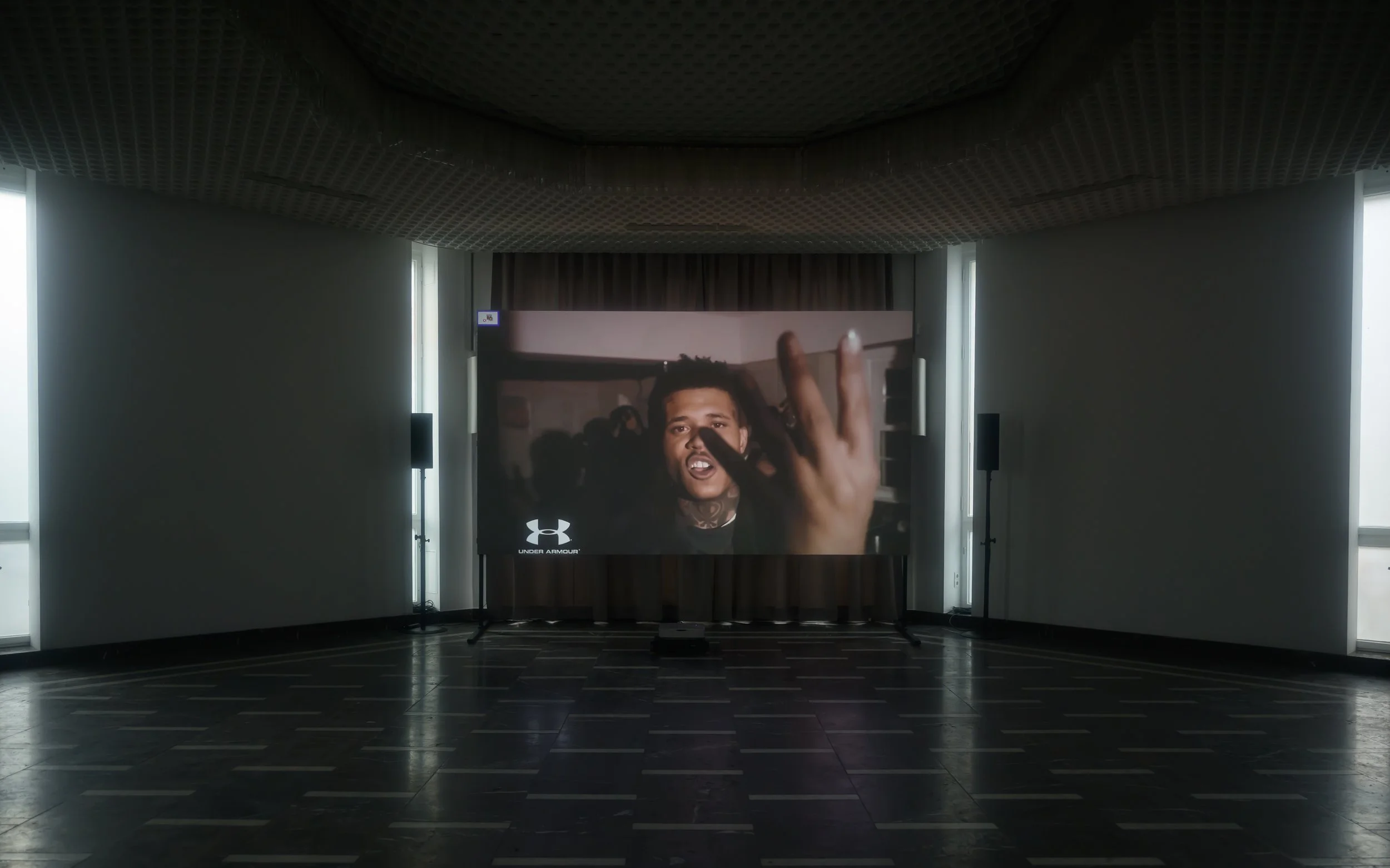
Allen-Golder Carpenter, Sojourn, 2025.
Some clips are easier to recognize than others: the Alabama Boat Brawl, Civil Rights-era footage of what seems to be black protestors being hosed, The Boondocks’s rap-satire character Eat Dirt, guns, and music videos with regional martyr-murderer figures from Chicago drill. Then beyond what the video tasks me to actively recall, there are elements of the assemblage even my own background is insufficient to help me identify. Thus the work centers on what I am calling “digital sight”: the racialized and classed mode through which the internet structures our encounter with streams of systematically curated images.
Inhabiting Carpenter's artist-algorithmic “black internet,” I think critically about my own way of seeing online—what it lets me know, and further, what it lets me think I know, and to what degree of success. This is the same digital sight that let regional rap scenes be consumed through Reddit threads and YouTube “deep dives,” severed from the hyperlocal feuds that birthed them, producing an algorithmic incentive toward escalating violence between artists hoping to pop. Describing his 2024 exhibition To Dream of Smoke, Carpenter frames this as the voyeuristic space between consuming a culture and knowing it:
“Although the works in the exhibition make use of the aesthetics of hip hop culture as their dominant point of reference, the show isn’t really about hip hop music itself, but primarily uses it as a vehicle to open up a dialogue around peoples’ proclivity towards the consumption of things they don’t fully understand.” The trap aesthetic, for Carpenter, is then deeply concerned with the practices of knowing and knowledge’s relationship to consumption and spectatorship. Furthermore, this lack of understanding, in Carpenter’s view, comes “often out of a reluctance to accept the reality that produced said thing.” To overcome this reluctance, trap allows Carpenter to confront us with layers of all we have been perfectly content not to know.
*
From the colloquial “trap house,” trap is a subgenre of hip-hop and a broader platform-era aesthetic. It is the gritty-first person narration, hook-y melodic vocals, catchy digital production elements, and the diaristic self-mythology affected by blogs, streaming, Worldstar Hip-Hop, and algorithmic feeds. B-boys become DJ Khaled and DJ Khaled becomes DJ Khaled because of his viral posts on Snapchat. It is the music and the way the music found its audience, the optimization pressures and the million-dollar media conglomerates these pressures produced.
In hip hop, for example, a regional scene required privileged knowledge, lived experience, and literal geographic proximity for listeners to participate and know what’s going on. In trap, regional scenes formed and clustered around kinds of regions and soundscapes. Detached listeners sought front-row access to deadly local feuds—like those involving Black Internet v4’s FBG and Gakirah Barnes, or Lil Durk, who the piece also features. With listeners so removed from the implications of what they consumed, Trap is the way regional identity, for Carpenter, becomes a “means of psychogeographical analysis,” through which he questions “the communicability of objects and aesthetics as they move from hyper-specific cultural and social spaces into mainstream and pop lexicons.” Trap is what facilitates this epistemic inquiry, and formally, it allows Carpenter to frame this inquiry under the stakes of an even more pointed question: do people know anything about the media figures they engage with, the conditions that produce such figures, and if they do, do they care? Carpenter tests the ways visual art can make them.
One method is referentiality: the opaque process central to how Black Internet v4 and the works of To Dream of Smoke make sense. In trap, significance comes often through lyrics. It depends on allusion, metonym, metaphor, sonic texture, and constantly updating slang which allows a single act of wordplay to become a shorthand for layers of linguistic, regional, and sociopolitical evolution. In Tay-K 47’s “I <3 My Choppa,” for instance—an artist Carpenter names in his artist statement for To Dream of Smoke— “choppa” signifies an automatic or semi-automatic rifle metonymically referencing the sound of its fire. This then becomes “yoppa,” a sonic mutation which covers gruesome violent descriptions in a layer of sonic manipulation. In this movement from what could be classified as a Henry Louis Gates-esque signifyin’ to playing with the signifier, words drift from direct reference into accumulated reference. Thus their field of potential meaning expands. Meaning happens across clever false cognates, allusion, and entendre. Words, the smallest unit of rap music, are coded and charged. The same is true of pop-cultural allusions. Pulling from an assumed shared field of media references, rappers reference shows like The Boondocks or movies like Belly or Juice to make their figurative language richer. To be a diligent knower of trap, then, is primarily to approach the music understanding that you might not know it all. Listeners are expected to be curious or be content with not understanding.
As a contemporary art idiom, trap lets Carpenter ask how much viewers really understand about the images they consume. In the gallery, where curiosity is rewarded, he places viewers before references they may not recognize and makes their partial knowledge visible. Trap’s own epistemic standards, its conditions for acquiring or verifying truth—from inspeak and inside jokes which structure truth to sampling and interpolation which produce its terms—become the conditions for approaching the work. To understand it, you must be attentive, aware of your own knowledge, and curious about its boundaries; you must trust that there is source material, that references have been strategically assembled, and that their arrangement is worth becoming knowledgeable enough to critique.
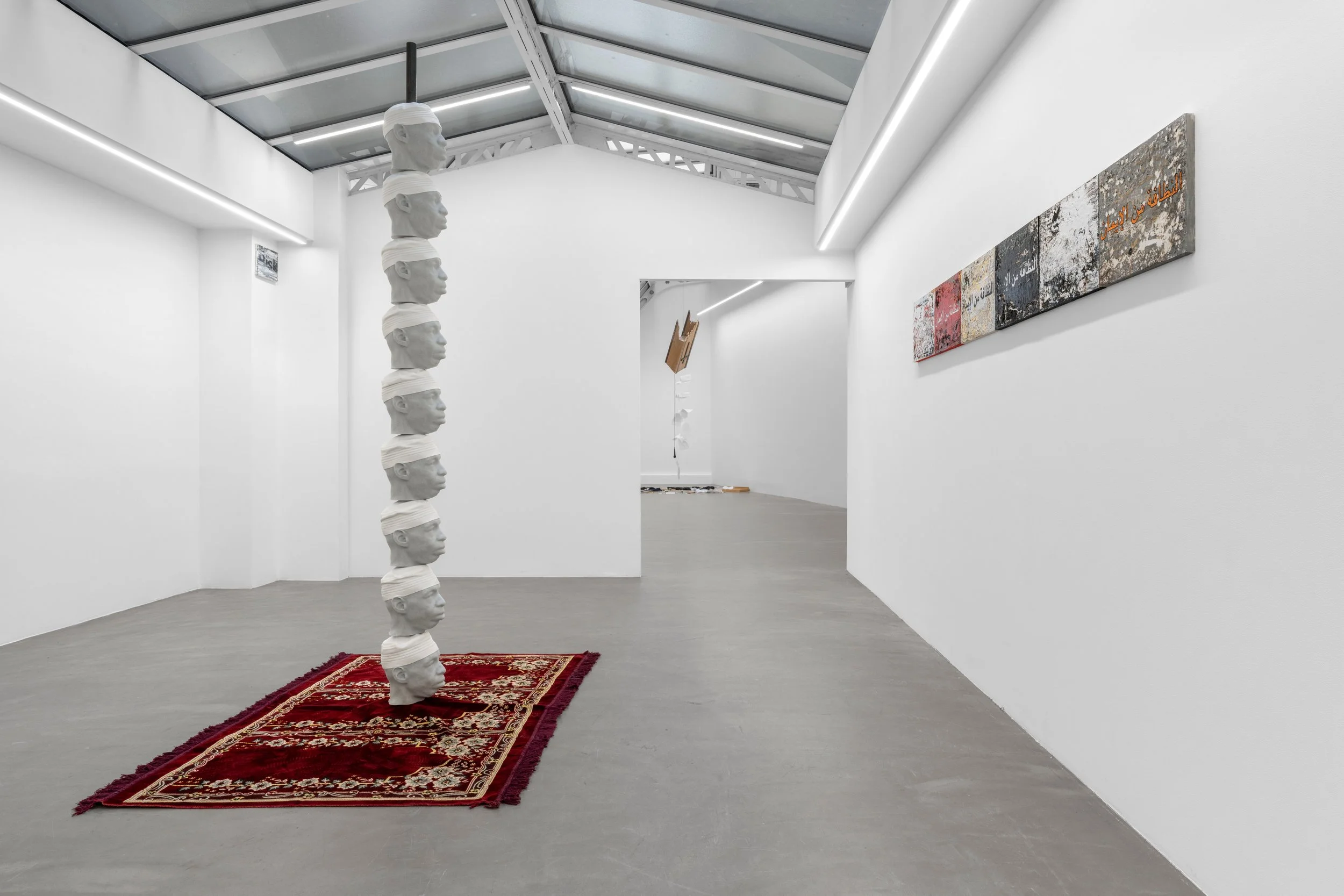
Emmanuel Massillon, Alhamdulillah, 2026.
In Massillon’s recent solo show, System Structures, one of the most stunning works is his nearly eight-foot Alhamdulillah. A freestanding sculpture in Massillon’s typical phantasmagoric mode, Alhamdulillah is made of nine identical life-scaled 3D-printed and kufi-adorned heads stacked along a central metal stake, rising from a deep crimson prayer rug woven with gold accents below. The stake connecting them all to each other extends above the final head about a foot, threatening and difficult to ignore, while the rug below softens the structure’s industrial texture and separates it from the gallery’s concrete floor. Facing a wall-hung painting series of Arabic scripts worked into layers of paint, the sculpture immediately produces questions of direction and force: are the straight-looking heads being pinned down into the prayer rug, like the archery arrow that fixes a tithe tray to a wall in Massillon’s 2023 Tithing is Transforming (Targeted), or have they fallen over the rod one-by-one into place? The face itself is cast and recast with near-invisible variation as unsmiling and almost painfully neutral, held at the edge of expression by tension around the brow and mouth.
The title immediately calls to mind the clip of Carpenter’s Black Internet v4—formerly incarcerated rappers across regions connecting through Islam to the tune of Lil Durk’s song by the same name. This is an association Trap facilitates, calling us to listen to the work in the way of Tina Campt and hear both an incantatory praise and a rap song backdropping the act of prayer. This emphasizes the carceral system’s footprint on the meaning of the work. As a praise, Alhamdulillah simultaneously holds the expression of gratitude and the acknowledgment of strife. This imagery is familiar to me—I've seen Nation of Islam and Black Islamic practitioners selling incense and newspapers roadside in cities like Chicago and Detroit. Maybe another viewer hasn’t. Maybe they have, and never asked why. Massillon rewards the acquainted, using contemporary art to observe even that which we have seen often with a more careful aesthetic eye, while offering the unacquainted a glimpse into what acquaintance might look like and the attention through which acquaintance is acquired. This is a kind of knowledge in and of itself, one that demands curiosity for all its restraint.
*
The Instagram bio of Massillon’s seemingly defunct art account, @massillon.massillon reads “In the age of information, knowledge is freedom,” entering his work into a broader academic and curatorial turn. The Harvard scholar and critic Carrie Lambert-Beatty wrote about art’s “epistemic shiftiness” in the post-truth era; the same year, Nenad Miščević defended curiosity as an active force toward truth, rather than a passive desire to know. The contemporary is one pressurized by unstable algorithmic information, artificial intelligence, media distrust, and general apathy. It seems to be both “post-woke” and “post-truth.” Scholars and critics across disciplines are returning to art as a site where knowledge and its facilitating practices—attention, curiosity, belief—can be scrutinized and explored. Trap enters Carpenter and Massillon into this arena, from a vantage that seems appropriately “post-black” as well.
Just as Lambert-Beatty proposed “parafictional” art as centering how “real and/or imaginary personages and stories intersect with the world as it is being lived,” and thus leveraging an intentional deceptive act to bring viewers’ attention to the technologies of their belief, are the constructions of Carpenter and Massillon not engaged in an adjacent practice of calling into question the kinds of stories those observing trap aesthetics might ignore or refuse to question? In Massillon’s non-figurative constructions—conceptual illusions built from vernacular habits, sonics, and wordplay—he aestheticizes elements of trap culture in ways viewers must approach with renewed curiosity if they hope to understand them. In other words, you must approach his “structures” curiously and return curiously to motifs which you may have otherwise encountered in real life or online. You must learn to see the concept. You must try to get the reference. Thus you are a subject affected by Massillon’s work and eager to know more.
For African Americans, the trap aesthetic is thus doing a simultaneous work of protecting and alluring, encrypting its racial politics in layers of references which—though they are more accessible to members with the same set of cultural and lived experiences—remain open to discovery by diligent viewers from distant vantages. If you are interested in carceral aesthetics, digital aesthetics, the internet age, new media forms, and conceptual art, you are tasked with a learning act to understand the artists’ work. Disrupting the historic expectation that black subjects be inspectable and then knowable through information produced by the looking act, Massillon and Carpenter make the looking act demand more. The thick layers of Black Internet v4 trouble the all-seeing eye of the digital age as a producer of truth. Carpenter renders salient the conditions under which viewers participate in digital spectatorship while sidestepping the burden of truth in the knowing act. Authorizing his own “Black internet,” he disempowers his viewers, making them conscious of how mere looking itself, as an epistemic behavior, is not enough. This is a radical assertion.
Just as jazz and blues opened aesthetic forms for addressing the social and political situations of their day, Trap addresses the unique audiovisual landscape of the contemporary. Social media algorithms curate, circulate, frame, and saturate images of blackness that can be consumed or ignored. Media ecosystems—now inextricable from state and capital technologies—manufacture racial information which hardens into racial truth. These “truths,” and their saturation, discourage the kinds of knowing practices which once produced racialized empathy; instead, nobody cares anymore. Far from the media landscape of the Civil Rights Era, when television was used to broadcast thoughtfully constructed empathetic figures and moments of protest, both of which needed the widespread visual coverage to work, the racial mountain of the late 2020s is the apathy of people who think they know everything about Black America and don’t care to know more.
Aaron McGruder, creator of The Boondocks, anticipated this situation in a 2003 C-SPAN panel on “Black Youth and the Media.” Speaking as a “political cartoonist” on “Redefining the Image,” McGruder argued both that the political left underestimated the power of images and that the technologies of the image had changed. Civil rights images once produced moral urgency; by 2003, McGruder argued, visibility had become repetitive, spectacular, concentrated, and politically compromised.
Even then, McGruder was anticipating the later work of media scholars, using epistemic language to describe how “the bigger the lie, the more likely you are to believe it,” and analyzing what these conditions had done to the black image. Respectability politics aside, white America had been so bombarded with images of Black Americans “acting like fools” that these depictions hardened into truth. Their moral sympathy was used up. “How would they knowyou’re not a damn fool?” He asked. “You think they’re going to talk to you? Yeah, right.”
Now, media scholars, philosophers, and contemporary art historians have given us language for this phenomenon. Legacy Russell’s writing on the black meme examines how images can be severed from their context and made available for endless re-use; Wendy Hui Kyong Chun’s work on habitual new media clarifies how this habitus hardens circulated imagery into a kind of accepted fact. Lambert-Beatty might agree with McGruder here in his argument that new media’s purported access to other people, places, things, and perhaps even ideas rendered the old epistemic practices of getting to know for yourself obsolete. Individual interaction, inquiry, and skepticism are less valuable in producing truth. Instead, we have watching, scrolling, and habitual sight.
This is not a new idea. During the Enlightenment, painting was a technology of knowledge, even racial knowledge, and seeing was an epistemic practice. The difference is that our sight is negotiated through algorithms, and “forget hating black people or not hating black people,” the task now is that people are beginning to simply look away. Trap, as an art historical language, addresses the references the mainstream consciousness fetishized, discarded, and never cared deeply enough to spend time with and leverages their intrigue under new circumstances. Carpenter and Massillon scrape a salvage yard of formats, digital shrapnel, and social media detritus into a form that, like jazz and like blues, is capacious enough to “fight” a new kind of feeling entirely.
One of the largest works in To Dream of Smoke was Carpenter’s 100 Rappers, a “living… cocktail of a bunch of different meanings,” a mosaic of small “archival gloss photos” sized like photo-album prints, all depicting trap figures or trap-adjacent moments, arranged by Carpenter like a social media grid. The images span A$AP Rocky’sLive.Love.A$AP cover, screenshots from rappers’ Instagram accounts, edited memes of Kodak Black, and iconic frames of Nicki Minaj at awards shows. Some are censored, blurred, or digitally degraded; some are repeated; others feel funny, ominous, elegiac, personal, or obscure. From a distance, the viewer tries to invent a logic for their arrangement, smoothing over what they do not recognize with whatever prior knowledge they bring. But the piece resists smoothing. Each possible logic is broken by another image: porches, memes, dead rappers, and blurred faces which, upon closer looking, do not so easily belong to the world one assumes they do. This attempt to make sense is a part of the work. The gallery setting pressures viewers to spend more time with the piece, asking more questions of what is arranged before them than if they were merely scrolling through a feed. This produces an awareness of the contexts that allow viewers to shortcut, overlook that which doesn’t fit, to make assumptions and be satisfied with unverified or partial truths. This awareness thus alerts viewers to the kind of curiosity a gallery can inspire.
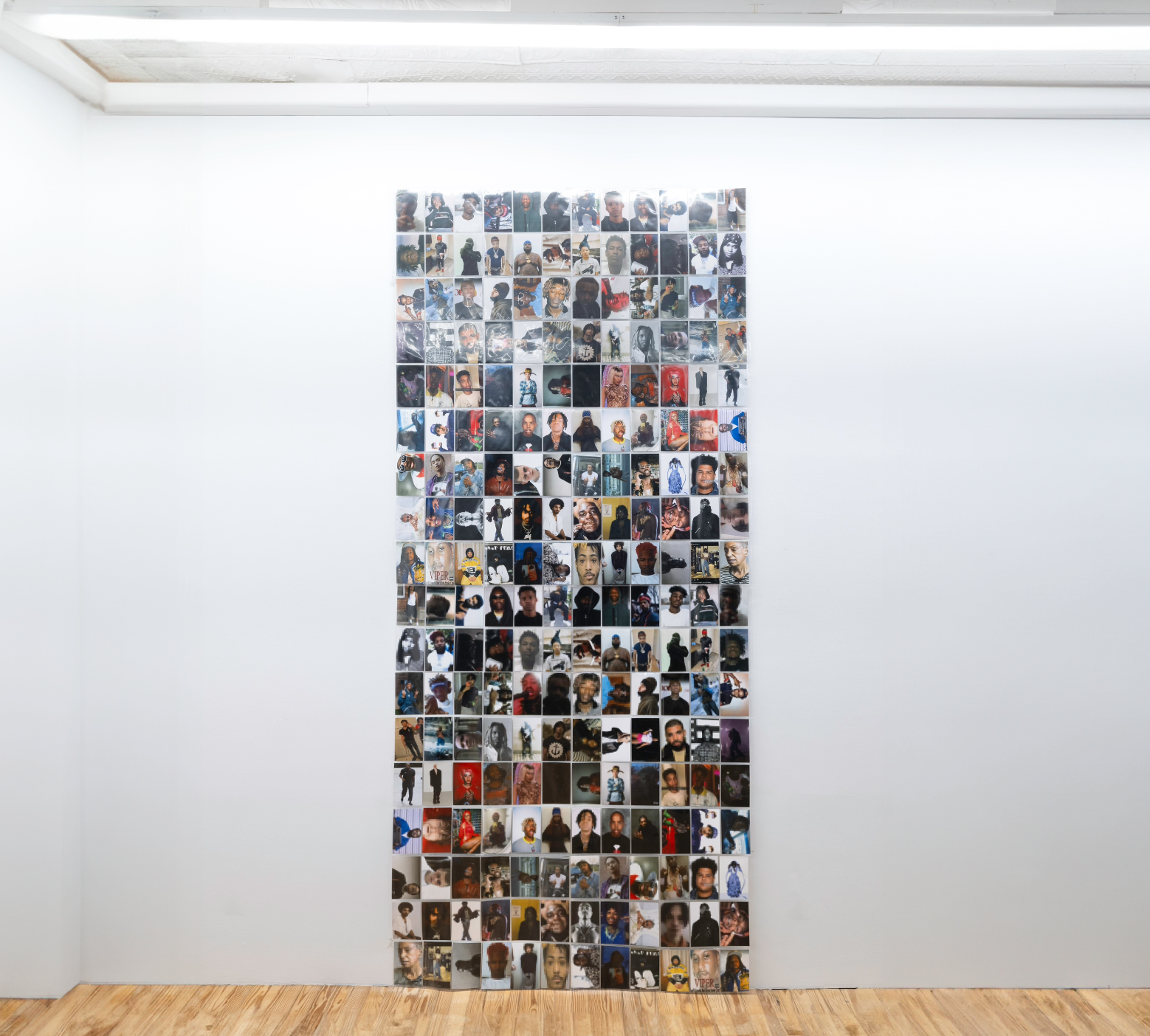
Allen-Golder Carpenter, 100 Rappers, 2024.
“I love rap music because it is so thick with lingo and many times very regionally specific terminology and accents,” Carpenter said in his artist’s statement regarding the piece. Furthermore, he is attentive to the media landscape that circulates such lingo, such hyperregional terminology, and even produces fictions imagined from these severed realities that passive consumers take as truth. “I wonder how much someone outside this music culturally understands when listening?” He asks explicitly, separating information from knowledge, and centralizing the latter. Across all that trap has left behind, these questions are meaningful. How much do we write off, or assume we understand, about black art? Why don’t we do our due diligence? What don’t we care to know? 100 Rappers lets you ask these questions of yourself, challenging viewers to conjure up some logic or meaning, and then asking what they will do—how will they think differently—once they realize it is wrong.
*
A year since I first found these artists’ work, by way of Instagram no less, I have an even greater appreciation for the brilliance and urgency of their project. In Cell 72, Massillon critiqued the glorification of carcerality both from populations affected, those inside of trap culture, and from voyeurs, those beyond. “If you’re mad at us for creating a mock scenario of somebody locked up, why are you upset?” He asked in The Guardian directly about him and Carpenter’s intentionally provocative performance, though I believe the work speaks for itself.
Listening to Massillon speak, I get the sense that he sees abstraction and absurdity in trap culture that he wants to make others more able to see. In another interview, he quoted 50 Cent’s likening of rap to a kind of zoo, suggesting there is something artificial or even self-parodying about the genre and its networks of consumption. He gave examples of so-called “hood news” Instagram pages, cathartic violence passively consumed, and the fictions of trap insofar as it does not exist free from the pressures of the internet age. Often, he will upload screenshots or videos from life to his “close friends” story—spanning the Nation of Islam’s street-corner proselytizing to hopeful rappers DMing him and asking for him to put them on—with the simple caption: “conceptual.” To heighten our attunement to the mediation and abstraction already in the culture, Massillon makes it tangible. He translates the “conceptual” into structural, tactile forms where their absurdity cannot be ignored.
Carpenter has also shown I Choose Violence, on the mental-health struggles coded into drill lyrics, and Traphouse 3 got a K with me and 3 young n****s that stay with me, a cutout installation of portable trap figures debuted this year in Dallas. Massillon has secured institutional acquisitions and continues experimenting with lyric painting and large-scale sculpture. Together, their Trap thread aligns their own projects with a wider field: @Back2Ba6ix's Instagram archive of the last decade’s digital rap culture, Ronald Baker's found-object assemblage of money counters and cowrie shells, Toast Best’s viral trap-meme paintings, all become legible as Trap. This visual language gives us a framework for seeing “parafiction” in bigger names too, like Deana Lawson’s photographic dioramas, and for identifying the strange, internet, hood-culture elements of her work.
Lawson’s 2018 Nation, for example, captures two black men seated on a leather couch in accoutrements that resist being read as straightforward, from-life, “hood” dress and instead become stranger the longer you look. This staged portrait arrests viewers in their tendency to read such a depiction as from life, and uses cut-and-paste content, digital overlay, and trap aesthetics to situate a viewer who is curious again. Even if the viewer resists this curiosity, they become aware of this refusal, this satisfaction with not being able to understand.
In the photograph, both men are shirtless and gold-chained, posed like straightforward “hood” portraiture. The man on the couch's left points a finger gun at the camera. The other man’s mouth is held open by a spiked wooden dental rig your brain ignores. The rest of the room looks ordinary—until, looking longer, it doesn’t: strange paintings on the walls, and in the top right corner, an archival image of historic dentures is spliced over a third man's head. This collage exposes the others, and the whole photograph's surrealism becomes impossible to ignore.
Trap in mind, I ask how an image like this, too, foregrounds curiosity: how, as a viewer, you must become curious to know the work. Who made it? Why? What might it mean? Upon being curious about the archival dentures, if you seek more information, you learn that the dentures are George Washington’s, something you likely did not immediately know. This is epistemically rewarding. Then, perhaps, further research informs you that these dentures were made from the teeth of slaves, which you also, perhaps, did not know. Lawson makes this seeking essential. Otherwise, a viewer retreats defeated to their shortcuts, aware of their settling— their not knowing what to make of the image’s strangeness. Otherwise, a viewer’s lack of curiosity or willingness to accept absurdity under particular conditions is impossible for the viewer themself to ignore.
The breaks in the image’s reality call into question other kinds of information that are unquestioned or taken as truth when observing black bodies in such a setting. What other strange practices do viewers ignore? What other self-adornments reference histories otherwise forgotten? What parafictions have we gone on believing without asking why? What do we scroll past, like, or listen to without understanding? Why? To what detriment to truth itself? Isn’t an arrogant boredom with blackness at least the same apathetic logic that lets other lies—about immigrants, vaccines, the state—go unquestioned too? To be uncurious about blackness, or bored with what you think you know, is no different than watching Fox News and thinking “sounds about right.” Perhaps an awareness of our own practices of knowing, across the aisle, might be the first step towards recovery. Trap carries its own awareness, provocations, and models an alternative knowing situation, allowing contemporary artists to focus these epistemic questions on blackness, asking how black life is known and what, really, black art can do.
*
If rap is dead, it died the way jazz and blues died: mass appeal invited capture, and what was once cool, dangerous, and resistant was co-opted into the simulacra of itself, its revolutionary edge severed from its product. Despite hip hop’s global influence, in recent history it was mass-marketed, appropriated, and so boiled down to mere simulacra such that it no longer resembles the reality which birthed it. The kind of rap that does numbers now, does so because algorithms cluster very diffuse publics around niche stars in the streaming era’s answer to regional celebrity. Meanwhile, the real regional celebrities are making increasingly violent music steeped in increasingly violent conflict encouraged by streaming infrastructures and algorithms while mainstream media shows nothing but indifference to the matter.
Still, because the trap era occurred online, all of its former excitement and innovation have not merely disappeared. All of its archives, its formats, its references exist still in clever lines and wordplay in the storeroom of a shared cultural memory. Its structures are recoverable and repurposable even though its mainstream appeal has dissolved. Carpenter and Massillon bring these structures from the online ether into real life; into the gallery, where they offer us a new language for thinking across aesthetic categories about a new generation’s productions and constraints. They are turning a wealth of faulty, parafictional racial information, from a subgenre of music’s constantly-updating digital wasteland, into tangible sites for knowledge and new means of making it.
The logic of trap cautions listeners against listening expecting to know immediately. Without aestheticizing black pain, what trap adds is the transformation of wounds into clever and coded battle cries which invite listeners into an orientation of “those who get it” and “those who don’t” without the alienation of a strictly essentialist view. In its truth situation, in its epistemic arrangement, you must be curious, you must know that you do not fully know, and you must be aware of the ways you try to know; critical of the shortcuts you otherwise might take and under what circumstances you take them.
From a freestyle’s apparent sprezzatura, from the rapper’s perceived “flow,” trap in contemporary art embeds the epistemics of curiosity and close-listening into visual works. The dragged-out words of Massillon’s word paintings are meant to be heard like slowed music, along distorting tones. Carpenter’s censored portraits sound like the same beats and voices we let run together, the sonic ease which turned violent drill songs into memes and background noise, then force us to pause before them and ask them new questions. If you trust these artists that their confrontational, exciting, innovative works are presenting you with novel information, if you trust that you don’t already know everything about black people, and question the kinds of information you are presented with while recognizing that pure information is not enough, your curiosity will be rewarded with surprise.
In the wake of trap’s sonic dominance, we can identify now that perhaps the sonics were not the most exciting innovation of the form. From the language of a generation influenced by this aesthetic, the aesthetic forms and visual formats unable to escape its footprint, there is a complexity to be recovered once buried beneath the genre’s music. After the scholarly models have done so with jazz and blues, the challenge is now to take this form on its own merit, to figure out what can be learned from its structures, to ask what connections across visual art, poetry, and music can still be made. The challenge now is to be excited by art that asserts itself with a winking, If you know, you know.