
SPRING/SUMMER 2026
Undead Internet Theory
Samantha Rose Herle
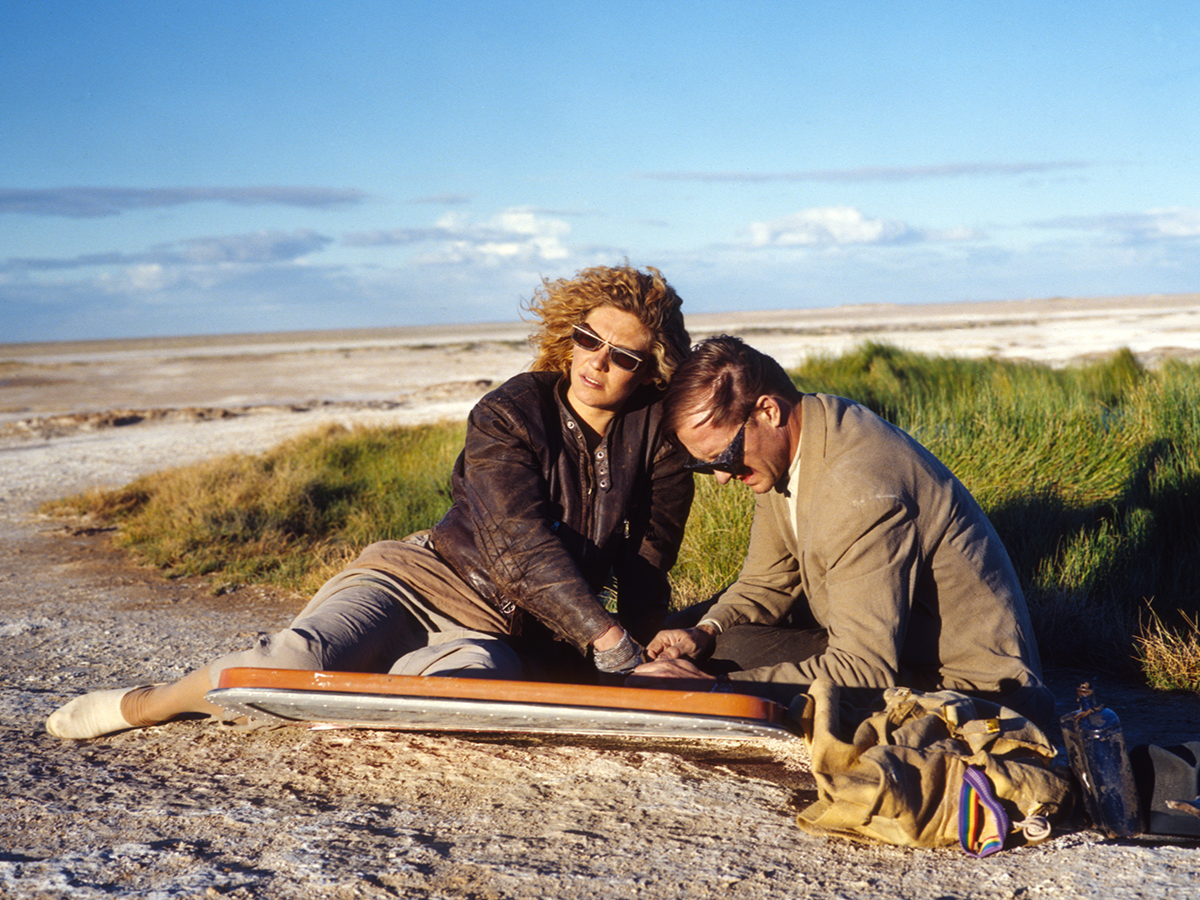
From Until the End of the World. Copyright: (c) Wim Wenders Stiftung. Editorial use.
In Alejandro Jodorowsky’s film Endless Poetry, writer Enrique Lihn stands in front of a crowd, reciting a poem to a small handheld mirror he positions in front of his face. He says to himself, both into the mirror and in front of the crowd, “I am only my own absence behind a broken mirror.”
The young Alejandro depicted in the film, one of the crowd members, is enthralled by this performance, feeling that he must somehow become the poet’s friend. Soon after, he shows up at Enrique’s door and is let inside. Once again astounded by Lihn’s poetic abilities, he comments on his bedroom walls, which are entirely scrawled with poems—“This wonderful work will be lost,” he exclaims. Lihn replies, “Everything will get lost. Our souls are going to be lost. It does not matter. Dreams also get lost, and ourselves, little by little, we dissolve. Poetry, such as the shadow of an eagle in flight, leaves no trace on earth. A poem reaches perfection only when it is consumed.”
In poetry readings of the past few years, many times I have encountered a poet in front of a microphone, hunched over and buried deep in the bright, glowing screen of a cellphone. The writer’s face lit up like a spectre in a dark room; I feel like I am intruding on a private scene rather than attending a performance. Unlike the one Enrique holds up, this mirror is not one that reflects the present moment; there is a delay to it. The reflection in the cellular mirror is reactive and dynamic in its reflection. Its aim is not to reproduce the present perfectly, but to entomb and then regurgitate the past. To see someone drawn into their device is to see somebody with their palms up to the glass of a backwards-moving time machine.
In a short piece of creative non-fiction entitled The Internet is a Haunted House, I write that to go online is to “look into a mirror whose reflection lags slightly behind your own.” This piece, published in ODDCRITIC earlier this year, compares going online with the experience of exploring an abandoned mansion in the forest. I explore the melancholy and uneven decay of obsolete digital artifacts lingering on as broken links or unplayable flash games, along with the idea that although some haunted houses want to drive you away, the haunted house of the internet wants you to stay; “your time and attention make up its lifeblood.”
When we look into our reflections in these cellular mirrors, we are brought face to face with countless past actions, compounded and reanimated. It is not uncommon to feel haunted, per se; that there is an “eerie” quality to existing online as pieces of information we do not even remember thinking about surface time and time again as advertisements or Instagram Reels. The past consumes us. There is no need to look forwards or even up. The internet is an “undead” space, where we are constantly fed iterations of the past—in particular, of our past selves.
When reflecting on the way information persists online, I think of a glitch that was once common on early Windows-equipped computers: drag the window across the screen, and see it duplicate itself countless times, tracking the movement. Although we may feel we are in the present moment, operating with lightning-fast WiFi speeds, the second that information enters the digital realm it becomes removed from the flow of time. Instead of allowing it to cleanly disappear, the digital sphere hoards these snapshots of time and our virtual landscape becomes quickly overspread with them. Through the act of preservation, a sort of stasis can be created. The act of creation, of action itself, becomes unnecessary and grinds to a halt.
In Endless Poetry, Lihn’s acceptance of his work’s finitude merits a reaction from Alejandro: “I could not bear to see such a work be consumed. Let’s do something. Let’s go for a walk.” Here, we are introduced to what becomes a central point of the film: poetry is action. The present moment is all that is real. So, let us do something.
In a similar film, Wim Wenders’s Until the End of the World, we see a scientist who invents a machine with the ability to record the imprint of images on the brain. First this is used to let his blind wife watch videos of family members; later on, it’s developed to record and then play back people’s own dreams to them. The devices that the characters use to replay these dreams, their small, screen-laden, and handheld “video monitors,” almost eerily resemble the contemporary smartphone. There are quite a few shots of our characters in various locations, numb to reality and fully invested in the playback of their dreams, slouching and slack jawed, glued to their machines.
When first exposed to the technology, watching a dream played on a computer screen, Claire, the first protagonist of the film, exclaims, “It will eat us up alive.” A scientist replies: “How could we ever turn away from this?” Later on, a different character states that “once she saw the lost world of her childhood, she was helpless against the desire to see more.” We might be reminded of this same character's earlier line: “The present will look after itself, but it’s our duty to realize the future with our imagination.”
Whether it’s the subconscious mind of dreams or an algorithm collecting a minutia of data we don’t even know we contain, it is easy to become lost in the desire to learn more about ourselves than we would have even thirty years earlier. Our own pasts, like our own selves, represent a bottomless pit that one can jump into at a moment’s notice by way of the smartphone.
*
“Soon they were hooked, all of them. They lived to see their dreams, and when they slept, they dreamed about their dreams. They had arrived at the island of dreams together, but in a short time, they were oceans apart.”
“They ignored each other, and neglected themselves. The dreams which should have been flushed away with the first yawn were now their only diet, and thus became more and more concentrated. They made monsters for themselves that they could neither tolerate nor do without.”
Quickly, the characters with video monitors lose interest in any other aspect of their lives, watching them constantly and repeatedly. It is infinite jest. If ever they find a part of their dream that is unclear, they aim to go to sleep that night and redream. This is, of course, to make it perfect. Notably, these videos are only for themselves; it is a closed loop of self-obsession. That is satisfying.
Wenders’s second protagonist, Gene, is concerned for the device-holders: “They suffered finally from a complete loss of reality,” he says.
Gene walks through the desert and finds Claire laying down in a crevasse, glued to her screen and oblivious to the world around her. She holds up her video monitor with one hand, looking at it with a dismayed expression. “The child I am is so happy, and then I fall, she says. “Why does she always fall? Don’t leave me all alone. Why do you leave her so alone? The fall! Wait. The solitude. The fear.” Sucked into her portable device, she is already in complete isolation, and shows little care for the presence of Gene as anything other than a sounding board. Why should she care for him as anything else? All that matters is the virtual world before her.
Watching Claire absorbed by her device, one of the scientists looks on with a concerned expression. “There is a line that should never be crossed. And we passed it a long time ago.”
*
The undead nature of the internet consists of more than a mere appreciation of happy days gone by: in perpetuating the past, the present moment is consumed by self-obsession and a kind of retromania, and the future is negated. Mark Fisher uses the word “hauntology” to describe the persistence in time and memory of what should have disappeared, and the failure of a future to emerge and replace it. In his essay “What is Hauntology?” he writes, “There was no leading edge of innovation any more. In music, as elsewhere in culture, we were living, in Franco Berardi’s suggestive phrase, after the future.”
As Claire in Until the End of the World was drawn into watching the repetition of her dreams, over and over again, we are drawn into the “undead” internet where we are fed iterations of our past selves over and over again. It is immortality, but only in the sense that an infinite time loop, limited to the past on repeat again and again is an immortal moment. Very little growth is possible, and we remain stuck within the past, occurring over and over again, becoming entranced in a formless dream world.
In Ghosts of My Life, Fisher addresses critics of “hauntology” who would say it is simply nostalgia, posing the infamous question “nostalgia compared to what?” In a culture where our lives are both dominated by and cast through reanimation of past event, there is no fundamentally “new” present moment that the past can be compared to; the ability to imagine a different future for ourselves has been replaced by an ability to imagine endless continuations of the past in our presents. Fisher writes: “[the] past cannot be forgotten, the future cannot be remembered.” We might recall in this instance a saying of William Faulkner’s: “The past isn’t dead. It’s not even past.”
*
In Until the End of the World, there is a scene where the batteries on Claire’s video monitor begin running out. “Gene, can’t you make it work?” she asks in dismay. “I can’t Claire. It’s dead,” he says. “I’m dead,” is her anguished reply, “My heart is dead!”
Fisher writes, “Do we really have more substance than the ghosts we endlessly applaud?” The fickle, fleeting present finds it difficult to hold its own against the past, recycled and remembered constantly, familiar and seemingly stable, yet able to constantly be remade anew in memory. “But the old memories persist, intact… constantly commemorated…”.
*
When I consider both the past and the present, I draw on cinema rather heavily, film itself a medium that highlights tensions between past and present with great formal nuance (tell me: is the novel or the movie more “present,” per se?). But the commemoration we find in movies is not a place we ought to dwell long. The credits roll, the lights go on in the theater, and everyone should file out (linger too long, and the theatre screen might reveal itself as a large, dark mirror as well; though attendees rarely do). The environment is shared, but only briefly.
In the filming of Endless Poetry, the first film I mentioned in this essay, both the character representing Jodorowsky and the character representing his father are played by Jodorowsky’s own sons. The film is shot in the town that Jodorowsky grew up in. In one of the final scenes involving the strained relationship between the character Jodorowsky and the character representing Jodorowsky’s father, director Jodorowsky steps into the frame. At a 2017 conversation at the Museum of Modern Art, director Jodorowsky says that during this filmed recreation of their farewell, he was able to say in that moment what he had never been able to say previously: that he forgives his father. Perhaps the media of film provides a means of escaping that which ensnares us so that we might move into the future should we wish to. Do we wish to?
When the past is regurgitated through film and music, it is a symptom of haunting, not an example of haunting as such. In Ghosts of My Life chapter “The Slow Cancellation of the Future,” Fisher writes about the audiovisual aesthetics of aughties band The Arctic Monkeys. He describes watching the music video for “I Bet You Look Good on the Dancefloor,” and truly believing that it was a kind of lost artifact from circa 1980. “There ought to be something astonishing about this,” he writes; “Count back 25 years from 1980, and you are at the beginning of rock and roll. A record that sounded like Buddy Holly or Elvis in 1980 would have sounded out of time. Of course, such records were released in 1980, but they were marketed as retro. If the Arctic Monkeys weren’t positioned as a ‘retro’ group, it is partly because, by 2005, there was no ‘now’ with which to contrast their retrospection.” Why do we return to the past in this way? What is it that keeps our culture and ourselves from moving towards the light? and, to borrow once more from Faulkner, leaving the old homeplace alone?
This recycling of culture is derived partially as a result of the limited view of reality created when one engages with “content” online. More so than books, magazines, or mirrors, online content preserves the past and claims it is infallible. Computer memory is trusted more than human memory; a photograph is definitive evidence of an event occurring, and our albums, both musical and photographic, are now largely on “the cloud.” We go online and see a world that is more real than the one that surrounds us. I think towards Jean Baudrillard’s epigraph for Simulacra and Simulation, attributed to Ecclesiastes: “The simulacrum is never what conceals the truth—it is truth that hides the fact that there is none. The simulacrum is true.” It is worth noting that this quote is not indeed from Ecclesiastes at all, but rather fabricated by Baudrillard himself. Get it?
“Dead internet theory,” the theory that the name of this essay plays off of, is a conspiracy theory that posits the idea that the internet primarily consists of bot content automated by algorithms, and that human users make up a minority. When users go online they are bombarded by generated images, articles, and content that seemingly represent the viewpoints of real people, though in reality this content is generated, either with or without specific intention, by non-humans. Even before AI-generated images and content, the internet was far from infallible: the truth could be nearly anything, if disseminated online. What is more true than what thousands of other people affirm? Identity becomes viewed through a filter of affirmation; when backed up by the imagined masses, the act of looking into a screen and seeing your own self reflected back at you seems less like self-obsession and more like a social activity. I am reminded of the “reaction video,” a genre of short-form content in which somebody will take a video that somebody else has shot and paste themselves in front of it, often in the form of a head and its shoulders just to the left of the main attraction, to show themself laughing or shocked at the content in front of us both. In other words, they tell their audience exactly what they should be feeling, prescriptively representing the imagined reaction of the masses.
The past is perceived as the truth (or the social consensus on reality), but only as it has been filtered by the opinions of a presumed majority. The future is undetermined, and since we are unable to agree on it as a monolith, it seems plausible that the future does not exist at all.
*
On April 7th, in reference to the announcement of the Claude Mythos model, Elizabeth Holmes tweeted:
Delete your search history, delete your bookmarks, delete your reddit, medical records, 12 yr old tumblr, delete everything.
Every photo on the cloud, every message on every platform.
None of it is safe.
It will all become public in the next year
Local storage and compute [...]
Regardless of intention, this was widely interpreted to mean that all of this information would become available for employers and bad actors alike to search for, thus resulting in a brief moment of internet panic. The majority of people worldwide have spent hours of their days online in various forms for years now; if this statement is true and to be taken literally, it makes sense that even those who feel they have nothing to hide would shudder at it. Who knows exactly what would surface? The notion that our most intimate messages will one day be laid bare for all of the internet to see is reasonably horrifying. “The internet is forever,” we were once told. When did we stop believing it? Why?
Despite fears of an internet dark age and the reality that information sits physically in a data center and can be corrupted forever by nothing more than a spilled drink, it often does for all intents and purposes feel that it will exist in perpetuity. Last year, I dropped my phone into the ocean by accident. The feeling of permanence and immediacy was jarring. Not often do we find ourselves face to face with the physical realities of the data we accumulate and engage with… Quickly, my feeling moved from that of shock to that of catharsis; I was unburdened from my many thousands of photos and notes that I’ve never had the time to go through properly. Most of what mattered had already been sent to other people anyways, right? But the next day, I was shocked to see all of my photos and notes still present on a new phone, saved in the omnipresent spirit world of an immaterial cloud that I didn’t even remember having subscribed to. Back it was, up from its watery grave to haunt me.
*
Time and time again, in such different environments as hackathons and digital headlines driven to virality by shock value, I have encountered the idea of “resurrecting” past loved ones with digital recreations that mimic their writing or speech patterns. While this idea seems both misled and morbid, it surfaces continuously with the intention of either compassion or fear-mongering. In the abstract of the article The law of digital afterlife: the Chinese experience of AI ‘resurrection’ and ‘grief tech’ by Kwan Yiu Chen, Chen describes the practice where “a digital replica with the appearance, voice, and personality of the deceased is created to interact with the real world. The intention is to offer solace and comfort to the bereaved by interacting with a digital representation of their loved one, providing a semblance of continued presence as if the departed had never left this world.” I remember a similar concept having been raised in my childhood: the ideas of deceased performers resurrected as holograms, empty light shows mimicking the dance moves performed when their performers were alive. The idea depressed me even then. How could a musician rest in peace while being conjured up again and again to perform on the stage? Memory, in all of its malleability, seems much more personal and humane than the idea that somebody can be recreated from the data that they have output. As much as we would like to keep our loved ones with us in perpetuity, the people we once knew have passed on from this world.
*
With so much information preserved somewhere untraceable to us, capable of reanimating into the present at any given time, are we to constantly live our lives in proximity to these ghosts lurking just outside of view? Shrinking ourselves in fear of them, wiping our tracks, and becoming mere ghosts ourselves? Understand ourselves as future-ghosts and act (or underact) accordingly? These ghosts act in a similar fashion to most other common haunts (for instance: Edgar Allan Poe’s The Tell-Tale Heart, resting peacefully under the floorboards): they feed off of the attention and fear we give them, and only exist as a result of it. The sole way to let go of the past is to let it fall away, ultimately recognizing it for the ghost it is. Even though it may appear in our present time, we have the option to look away and render these immaterial forces nonexistent. It is our attention that gives the digital world its life as well as its re-life.
What power do ghosts have? To material reality, they are quite inconsequential. It is only psychologically that they have the power to rule our worlds. Despite the immateriality of the internet, it remains true that our ideas are what shape us and those around us, driving the human project into a future separate from its infinite pasts. Undeserved hysteria towards something that is in itself quite formless can quickly bleed its way into shared reality. If all we do is consume content (interact with the past), then we must believe there is a purpose to it. It is the arena in which many will most likely live large portions of their lives. But take a step back: it is obvious that there is very little form or consequence to the information that most regularly consume. If anything, the consumer has become the product, freely giving away their data like fruit to the harvest. The act of absorbing information is only the byproduct.
*
Per Fisher’s theory of hauntology, when the past is recycled endlessly, it negates the ability for a new future to emerge. Nature abhors a vacuum, but the internet prevents one from ever forming.
Change is the constant quality of life, and the resurrection of the past that the digital world enables can create an unhealthy stasis. Death is a part of our lifecycle; let us consider the revitalizing potential of the forest fire. Although one might appear devastating to an ecosystem, the fire actually represents a vital clearing-out of undergrowth. Only now can new life enter—there are, after all, certain pinecones that only break open and release seeds through the heat of the fire. It is a necessary stage of growth in the forest.
Although there is much to learn from the past, we must also have faith in the present and in our ability to take that knowledge and create a new path. The price of being alive, of moving forwards, is allowing the past a clean and permanent death: let it fall away. Drowning in the pollution of millions of screens, I believe there is a light that beckons us to walk towards it.
Finally recovered from her devastation and returned to a coherent self, Wenders’s Claire is at a loss for what her future could hold. “What happens now?” she asks Gene, who earnestly replies, “Oh. That’s for you to invent.”