
FALL/WINTER 2025
When Memory Becomes the Dream
william o'neal ii
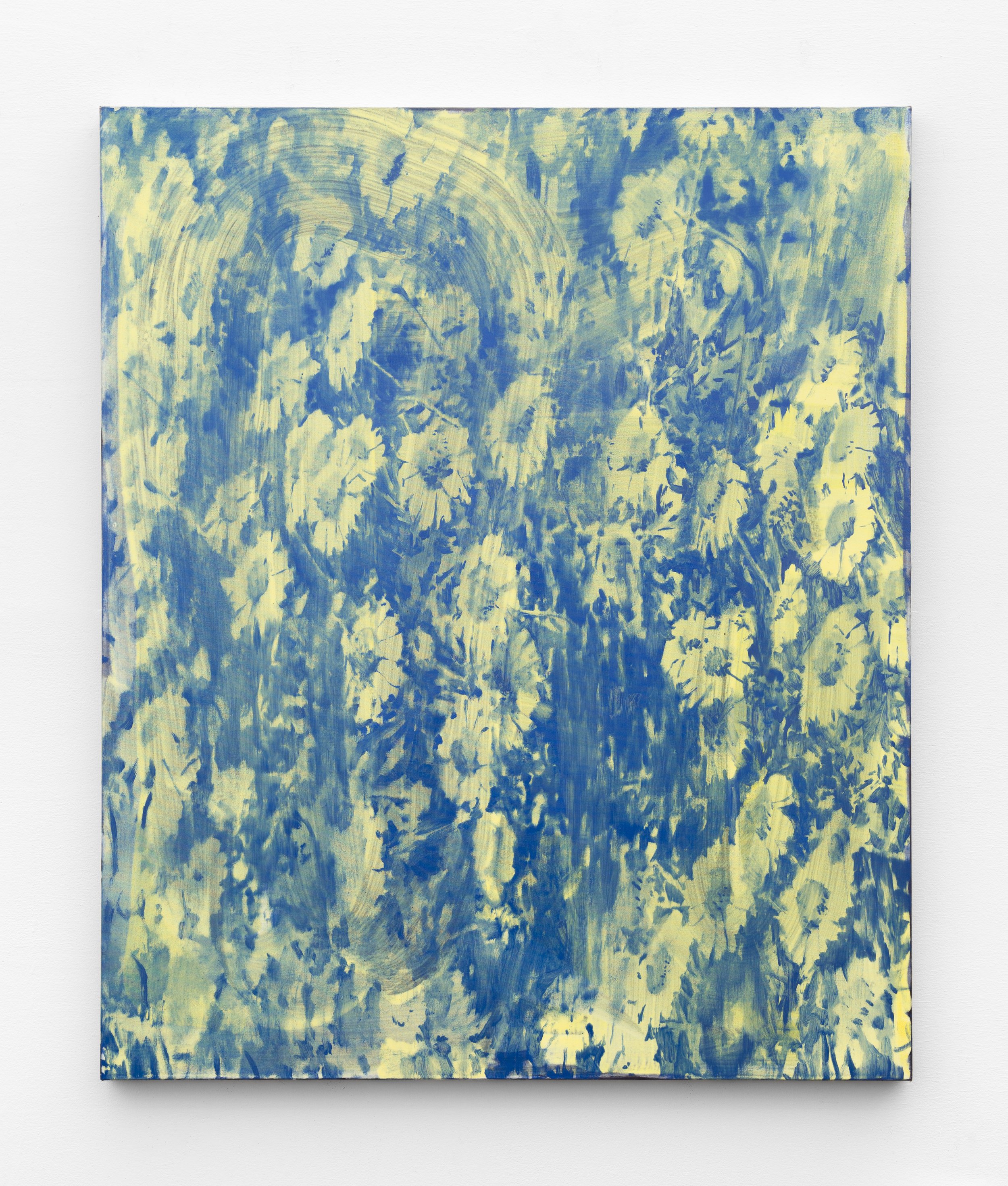
Art: Dane Lovett. CIVIC, 2024. Courtesy of the artist and STATION Gallery, Australia
You dream the lover’s hands are your hands, the lover’s face is your face, but he is leaving you, and you can’t call out to him because you have forgotten his name—you wake alone in the dark.
I was first introduced to Richard Siken’s work when I was eighteen after moving to Florida to learn how to make movies. At Florida State University, I enrolled in an introduction to poetry class, and on the first day, the young professor handed everyone a copy of Crush. The collection begins with a plea addressed to the reader:
Tell me about the dream where we pull the bodies out of the lake
and dress them in warm clothes again.
Stepping into the world of Crush is like receiving a letter sent across time from someone with whom you once shared many secrets. A desperate attempt to reconcile tragedy propels forward into a narrative of gay desire that is full of boys on motorcycles, boys with pills, boys with oily guns, boys who bite, boys who drown you in pools, boys too beautiful to look at. I was moved by its sense of urgency and desperation. Crush was seminal because while it held onto the honest violence and disastrous nature of desire, it did not neglect the joy of tenderness:
We’re filming a movie called Planet of Love— / there’s sex of course, and
ballroom dancing, / fancy clothes and waterlilies in the pond.
Twenty years have passed since Richard Siken’s Crush was first published and awarded the Yale Series of Younger Poets prize.His debut spread like wildfire through the literary landscape, queer communities, and eventually the internet. Before God said, 'Let there be Instagram poetry,' there was Richard Siken. On the cusp of both new treatment breakthroughs and a heightened sense of grief, fear, and uncertainty in the aftermath of the AIDS crisis, Crush’s release canonized Siken as a living patron saint of queer desire.
I—like many other poets—became a disciple of Siken. During that first university year, I had not yet experienced my first kiss or the drama of falling in love. All my early poems and short films were dreams of having lived a life of cinematic heartbreak using Siken’s narrative tone as a blueprint, but they weren’t true.
The resonance of love in Crush is held together by language that invokes a sense of dreaming. Relying on the second person and use of enjambment, Siken allows the reader to move through the book as both witness and beloved. In this dark fairy tale of sweet disaster, bank robberies, car wrecks, and gold ballrooms, we get to imagine ourselves as both dragon and princess. Crush feels like the beginning of love in its expansiveness and possibility. While we dream alongside Siken, we start to wonder what is real and what is not—where the poet ends and fiction begins. We assume a story of love this urgent must be rooted in reality, yet we are left in the dark to wonder what is truth and what is myth. The important truth of Crush is not what Siken has actually lived, rather all that he can envision on the page.
*
When I was born the doctors told my parents that I would live a short life, forty years at best. They told them it was rare for a Black child to be diagnosed with Cystic Fibrosis (CF). They said the odds of that were 0.0058%. They said it was genetic, that there was nothing they could’ve done (save not falling in love). They said I had won the wrong lottery. They said there was no cure and handed them a few bottles of small pills to crush up in spoonfuls of applesauce.
I grew up in hospitals. My days were full of medications and treatments to keep my lungs clear of phlegm. I believed in God because it comforted my spirit and because my father was a pastor. I never fell in love because I was too insecure and afraid of it being cut short. Who wants to invest in loving someone who is predicted to die early, anyway? I fell in love quietly with all the nurses who would put their hands on me. I missed lots of school days. I was behind socially and in my studies. I watched tons of romances and thrillers, I dreamed, I never talked about my illness. I thought everyone with CF was ugly, myself included. My body directed the inner workings of my life and my heart.
*
In 2019, Richard Siken suffered a catastrophic stroke. He became paralyzed on his right side, lost his short-term memory, his capacity for language, and his ability to lie. Twenty years after the release of Crush, Siken returns with his third book, I Do Know Some Things. Many of the images in Crush resonate in Siken’s new collection. Dissenting from the highly constructed dream-lyric in his first book, I Do Know Some Things, is an autobiographical account of his recovery over the past six years, which tries to bifurcate myth and memory.
A reductionist view of Siken’s poetics would center on the transformative nature of the physical body after being thrown into the world. In Crush, two boys meet and plunge their hands into each other.In I Do Know Some Things Siken’s body fails him, and he is thrown into a dark hospital room by himself. In an interview with Rattle, Siken echoes a line from his new poem “The Horns”:
The body: I’m insulted by the physicality of it.
Affliction of the physical body creates a discontinuity in its symbiotic relationship with the spirit, and consequently distorts the reality of the patient in physical crisis. The throes of illness create a dream world of the Other that alienates the patient from reality. Susan Sontag calls it the “kingdom of the sick.” In The Cancer Journals, Audre Lorde reflects:
I’m so tired of all this. I want to be the person I used to be, the real me. I feel sometimes that it’s all a dream and surely I’m about to wake up now.
In Siken’s case, the severity of his stroke disconnected his mind from his body and his body from the world. Each poem in the new collection is an exercise in relearning how to name the world around him while recounting his memories of childhood.
I Do Know Some Things structures time in a way that is both linear and unhurried, with two narrative timelines running simultaneously alongside each other: the story of his recovery from the stroke and the story of his parents’ convoluted marriage.
Siken has lost his sense of the lyric and is relearning his charm. In “Zeno,” he remembers:
I was charming with my limp and cane. I was getting to the ends of my sentences. I still got everyone’s name wrong, […] I will heal, but not completely. Always approaching, never arriving.
When discussing his choice not to break any of the lines in the book, Siken explained that he would not do it because “Too much was already broken.” Recovery is often a slow, counterproductive process, and the book mirrors that slowness, keeping us confined to the carefully contrived paragraph. The book asks us to sit in the dark well of remembering with him as he tries to climb his way out. It’s a high climb — I Do Know Some Things is longer than both Crush and his 2015 collection War of the Foxes, totaling seventy-seven poems.
Recovery is not only inherently slow but inherently lonely. Unlike Crush, where the reader is implicated within the narrative, these poems keep us at a distance. I Do Know Some Things relies on the first-person point of view to shut the reader out of the intimacy of recovery. We can only be a witness in these poems as we watch Siken rebuild his identity and capacity for language. In the beginning of his poem “Doubt,” Siken writes:
I wanted to continue the list. I said mourn, dream, but I could have said anything. It was starting to weaken, the premise that I could build an encyclopedia of myself. I didn’t know anything. Pick a word. Slap a brick with mortar and call it square one.
The poetic style of the love poem is to the lyric as the poetic style of recovery is to the confessional. In Virginia Woolf’s essay “On Illness,” she claims that literature about illness is the greatest confessional because it alienates the patient from both society and their own continuity of selfhood. It shocks us back to the mindset of being kids, helpless and alone in our bodies, reliant on others as caretakers to help manage the pain they cannot see or touch.
Writing about the body is difficult because language cannot internalize the immediacy of its pain nor its pleasure. Hegel describes language as divine because it is a tool of transformation. By naming the body, language transcends its physicality and turns it into a type of external memory. In I Do Know Some Things, Richard Siken is angry at the written word. He is trying to relocate himself in the world, but he keeps slipping through the fingers of language. He repeats the aphorism, “we are the story we tell ourselves,” but the story keeps changing. A harp becomes a grand piano, a clock becomes a record player, Pinocchio becomes a real boy, and the boy wants to be a robot. Everything is blurring into everything else, and Siken can’t seem to keep his footing. In each poem, he is someone new looking back on a memory of himself. In “Metonymy,” he stumbles:
I said black tree when I meant night. I said the branches blow and we sleep in dirt. I said Telephone.Safe harbor.Perhaps you are, perhaps you are diamonds.
Language not only fails Siken as he is relearning the world in front of him, but also when it comes to diagnosing his stroke. Siken says that after his initial incident, he had a friend drive him to a hospital where they sent him home after declaring that he, in fact, had not experienced a stroke. Siken felt like no one was understanding him.
To use language as a tool to describe pain borders on absurdity. Virginia Woolf says there is a “poverty of language” when trying to speak of the private world of pain. When a patient is in pain, attempting to communicate to a caregiver or doctor the magnitude and validity of the sensation, it is like two people standing on different planets trying to describe the sky during a storm. Language fails to bridge the gap because there is no common reference point. In Elaine Scarry’s The Body in Pain, she explains:
Physical pain does not simply resist language but actively destroys it, bringing about an immediate reversion to a state anterior to language, to the sounds and cries a human being makes before language is learned.
The McGill Pain Questionnaire was created to try and mitigate the black hole between the two planets of patient and caregiver. In “Pain Scale,” Richard Siken still finds this method to be lacking:
My primary care physician is not a neurologist. He doesn’t understand the difference between sadness and damage […] He refuses adjectives […] This is the third time I’ve been in his office. My pain is eight. I am speaking in his language. He isn’t listening.
Diagnosing an illness and its symptoms of pain is a type of constant waking, a continuous recreation of the patient’s world through language—I am speaking in his language—without ever becoming free of the body. Siken describes his recovery as a dream of becoming. In every poem, Siken is reaching forward and backward to construct a new linguistic shape of identity that is not easily accessible. His faulty memory makes him an endearing and unreliable narrator. He has become the little man in a brown suit attempting to define a room he is outside of.
Siken uses his new limited capacity for language to further alienate himself from sense-making in hopes that his performance of poetry will be enough to coax us back into our admiration of him—“The performative self: it flutters in the wind. I would like it if, for just a couple days, everyone would pretend that they still love me,”––he confesses in “Ventriloquist.” Siken says the vocabulary of loss is the dictionary, and because he has lost his own sense of identity, he must create a new dictionary. Creating a new catalog of language, hoping others understand, is alienating. Siken is not only scared of being left alone in his recovery, but of being misunderstood. He is pointing to the things in the room around him, and making archives of his daily routines. He is hoping that we are following along with him, that we understand:
Once, I said restaurant nurse instead of waitress. It was good enough. The meaning survived.
*
CF is a hidden disease. It weakens the lungs, the pancreas, the liver, the reproductive system and can increase risk for other diseases, but it rarely externalizes itself in the body, besides the occasional coughing fit or loss of weight. When pain does not make a spectacle of the patient, it alienates them from sympathy, and language fails to deliver justice in bridging that gap. The bi-annual hospital visits were lonely and took a toll, but they at least gave others a performance to watch that proved the validity of my experience, that I was not making anything up. All language is fiction if it does not materialize in physical form. Language requires large doses of faith.
In 2019, I left Florida State after my lung function rapidly declined, and the doctors saw no other option but to recommend that I undergo a lung transplant. I couldn’t breathe well enough to walk or speak long sentences, but I wasn’t quite “sick enough” to qualify for a spot on the transplant list. The language used to diagnose my illness was insignificant to meet the qualifications for treatment. They sent me home and told me to wait. I spent months in my parents' basement in a room with no windows. My father hung stars that glowed green on the ceiling; my mother stocked the fridge with Jello-O. I read lots of books and watched lots of porn.
After several months of being bedridden, the FDA approved a new drug that changed the landscape of Cystic Fibrosis healthcare. My doctor overnighted a new bottle of blue and orange pills, and for a week I began to involuntarily throw up phlegm. In a month, I was healthier than I had been since childhood. It wasn’t a cure, but it was a miracle, an exorcism. Recovery is a type of rebirth. The mind becomes so accustomed to the body as broken that when the body begins to transform again, the mind must relearn the body. It must reach for a new language to bridge the gap between the physical and the metaphysical, myth and truth, history and present.
I used my newfound dream of a life to finish my education at Emory University and move to New York. I threw myself into sex parties, raves, underground theater troupes, and financially irresponsible trips to Paris—falling in love in every direction and, consequently, breaking my own heart. The first time I let a boy kiss me was after my recovery. He gently pushed me against a brick wall outside an Argentine bar after asking me, “Do you only like kissing girls?” and pushed his tongue into my mouth. The night glowed orange.
*
One summer night in New York, I stumbled into a small theater after seeing that they were playing a documentary about the masochistic performance artist Bob Flanagan. Flanagan was diagnosed with CF in the early 50s and used S&M to manage his pain through reclaiming a sense of agency over his body. His wife, Sheree, acted as both his caregiver and his domme. He created shows from New York City to Berlin in the mid-80s, pushing his body to extreme limits (hanging from ceilings with a chain around his penis, alligator clamps on his nipples). In the last year of his collected journals, he reflects:
Home. Buttplug up my ass […] The day drags on and on until it ends as it started—in bed, in front of the TV. Slept on the couch a little. Worked on the computer a little. Breakfast with Sheree. The nagging depression, or whatever it is. Emotional numbness. Alone. But don’t want to be with anyone, not now.
Recovery and the erotic have a symbiotic relationship. Chronic illness and its pain are a prison, trapping the spirit in a submissive relationship with the body. Yet willingly submitting the body to outside forms of pleasure or pain allows the patient to regain a sense of power and agency. Marquis de Sade writes, “It is always by way of pain one arrives at pleasure,” but for the patient, erotic desire is an act of reaching away from the body towards a different fantasy, a different reality. Sade was said to have been afraid of reality, using his fantasies of masochism to escape from “space, time, prison, the police, the void of absence…” Bob Flanagan said that he would have died much earlier without S&M. In “Pornography,” Siken is afraid of intimacy but still fantasizes:
I want to fuck everything but I don’t want to be touched.
Suppose the erotic is a device to dream a new reality that has yet to come. In this case, Richard Siken becomes both lover and beloved in I Do Know Some Things, reaching towards another version of himself that is more intelligible. These poems evoke a sense of the aftermath of love – the solitude of standing in the ruins of oneself. In “True Love,” he warns that if you have not prepared yourself for the end of love, “I strongly suggest you do.”
Illness complicates romance, but for the patient, the erotic offers a temporary escape from the body, a distraction from the inevitability of death. Siken’s new poetic autobiography leads us to the same place as all forms of eroticism, as Bataille says in Eroticism, “to eternity, it leads us to death, and through death to continuity…the sun matched with the sea.” Siken no longer fights against the inevitability of death; he makes his peace with it:
When I die I will come in fast and low. I will stick the landing. There will be no confusion. The dead will make room for me.
In I Do Know Some Things,Siken is more reserved, cautious, and less dramatic. He isn’t afraid to be honest and tell us only what he wants to tell us, omitting the rest. He is afraid and lacks clairvoyance. He is relearning the music of the world, poetry acts as his cane, language his limp. He uses repetition to score a new type of music, a fixed melody of memory. He has not forgotten his sense of beauty or tenderness, nor his humor.
Earlier this year, Siken tweeted ahead of his release:
The hard truth: I wrote about gay desire 20 years ago. Since then, I have written about war, friendship, talking animals, art, death, and disability. If you want me to write about desire again, someone is going to have to step up, take the hit for the team, and fall in love with me.
Susan Sontag thinks in Illness as Metaphor that “sadness makes one interesting.” Siken’s tendency towards melancholy made him interesting to the general public. He now believes that sadness is overrated, but his frustration with language in I Do Know Some Things will make him a literary treasure.
The well-known bloodied gray thumb falling limp from an open pair of lips has been covered up by a mirror that is black on both sides. Siken looks in the mirror and scribbles on the dark glass in all caps, I DO KNOW SOME THINGS. We have no choice but to believe him.
*
Since the new modulator medication, my relationship with my own body has changed dramatically. I haven’t been to a hospital in almost seven years. The number of treatments I have to take to manage my symptoms is half of what it used to be. I am living a dream that has only ever existed inside my head; my body has become a memory of itself. Still, every day, I am fearful the body will suddenly fail me again. Recovery is also a type of death. No one prepared me for the guilt that comes with being offered more time or the anxiety that comes with having to relearn how to navigate the world with a new body. My recovery was a slow waking, a relearning of the rules of my body in relation to the world. I was now the slender boy with a bottle of pills, living a fast life. I became sexy, I became charming. I became a hedonist. I became afraid of death.